 By st20113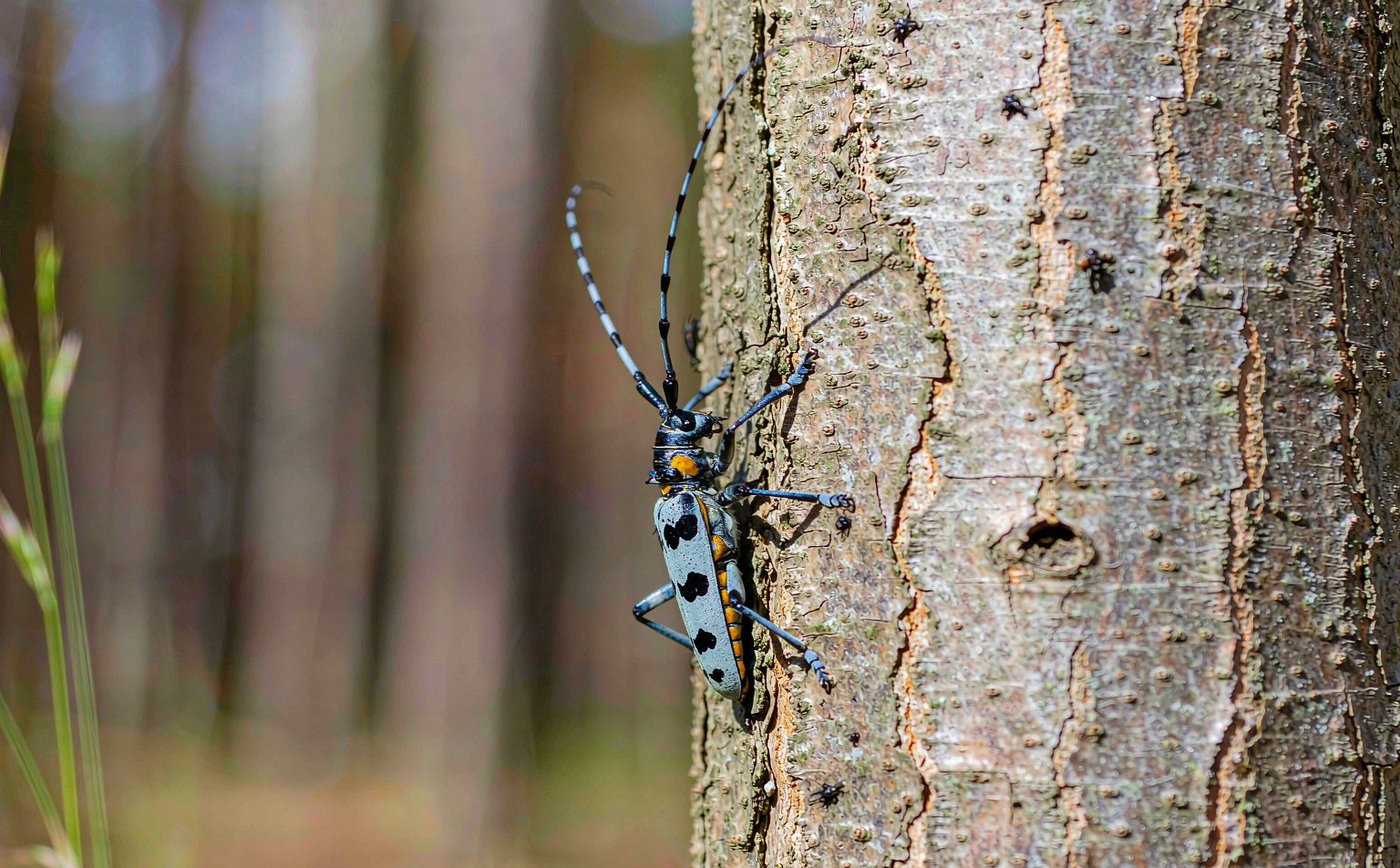
Rosalia alpina | Rosalia Longicorn
Introduction
The Rosalia Longicorn (Rosalia alpina) is one of Europe’s most striking longhorn beetles, instantly recognised by its pale grey-blue body marked with bold black spots and patches and by the extraordinarily long antennae of the male. A member of the family Cerambycidae, it is closely associated with old, sunlit broadleaf woodland and with the decaying timber of mature beech and other hardwoods. Although rarely abundant, its vivid coloration and gentle flight make it a favourite among beetle watchers and a useful indicator of healthy, structurally diverse forest.
Taxonomy
Rosalia alpina was first described by Carl Linnaeus in 1758 and placed in the genus Rosalia, which today contains only this and a handful of closely related species. It belongs to the longhorn beetle family Cerambycidae, a large group of wood-boring beetles whose larvae develop inside timber. Among European saproxylic beetles it is often compared with the more familiar Stag Beetle, another species that depends on decaying broadleaf wood, and with the Edible Dormouse, a mammal of the same mature woodlands. The Rosalia Longicorn is the type species of its genus and has no commonly recognised subspecies across its European range.
Physical Characteristics
Adults measure 15 to 38 millimetres in length, excluding the antennae. The ground colour is an ash-grey or pale blue-grey, overlain with contrasting black spots of varying size and a characteristic black “cape” across the pronotum and base of the elytra. The antennae are banded black and grey and, in males, can exceed the body length; in females they are shorter but still prominent. The legs and antennae are long and slender, adaptations for clambering over bark and for the beetle’s distinctive, somewhat wobbling flight. The underside is dark and finely haired. Freshly emerged adults have a soft, velvety sheen that fades with age.
Habitat
The Rosalia Longicorn is a species of warm, open broadleaf woodland, especially stands of beech, hornbeam, maple and oak with plenty of dead and dying timber. It requires large, sunny dead trunks and thick branches—often those still attached or recently fallen—where the wood is neither too wet nor too dry. It is most often seen in riverine forests, sheltered hillsides and traditional coppice-with-standards woodland, and it avoids dense, shaded plantation forest and treeless land. Across its range it is strongly tied to lowlands and foothills, though it can occur in warmer upland valleys.
Diet
Adults feed mainly on pollen and nectar from a range of open, sun-loving flowers, and sometimes on sap oozing from fresh tree wounds; they are not pests of living timber. The larvae are the wood-consumers: they bore long galleries through the heartwood of dead hardwood branches and trunks, taking several years to mature. The larval tunnels help break down coarse woody debris and recycle nutrients, linking the beetle to the wider decay community of the forest floor.
Reproduction
Mating takes place in early summer on or near suitable dead wood. Females lay eggs in cracks and under the bark of freshly dead or declining broadleaf trees, preferring trunks and limbs thicker than a human arm. The grubs burrow into the wood and develop slowly over two to four years, depending on climate and timber quality. Pupation occurs in a chamber near the wood surface, and the pale, spotted adults emerge in late spring or early summer to begin the cycle again. There is no parental care after oviposition.
Conservation
The Rosalia Longicorn is classified as Least Concern globally but has declined locally because modern forestry removes the old, decaying trees it needs. It is protected under the Berne Convention and listed in Appendix II of the EU Habitats Directive, making it a priority species in several countries. Conservation rests on retaining standing and fallen dead wood in sunlit woodland, maintaining a mix of tree ages, and avoiding the rapid clearance of veteran trees. Where such “messy” woodland management is allowed, the beetle can persist close to human settlement.
Fun Facts
- Its electric blue-grey colour comes from a microscopic structure on the cuticle, not from pigment alone.
- Males use their extra-long antennae to detect females from several metres away by scent.
- The larva can take up to four years to finish growing inside a single branch.
- Despite the fierce-looking jaws, adults are harmless and gentle when handled.
- In some central European cultures it is regarded as a symbol of old, undisturbed beech forest.