 By st20113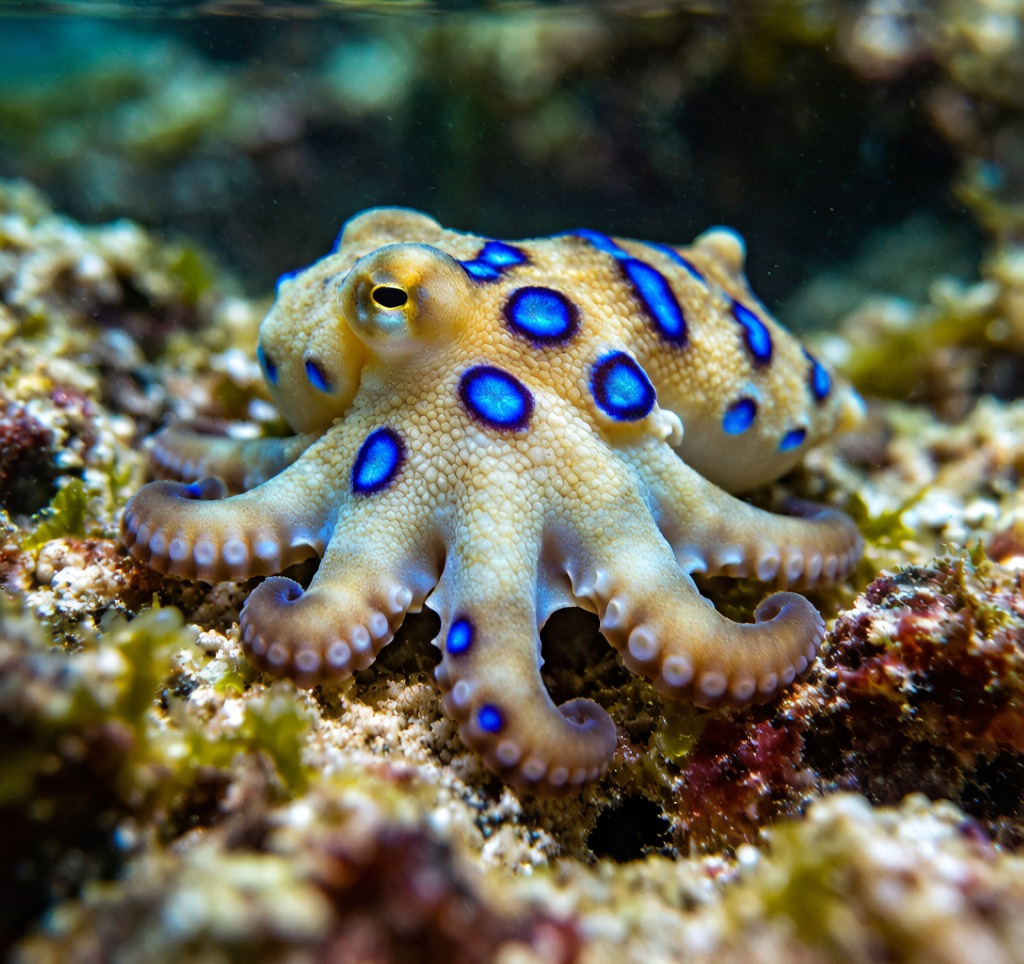
Introduction
The blue-ringed octopuss are a group of four species in the genus Hapalochlaena, found in tide pools and shallow coral reefs throughout the Indo-Pacific region. Despite their small size — typically no larger than a golf ball — these unassuming creatures are among the most venomous animals on Earth. Their vivid, pulsating blue rings serve as a striking warning display to potential predators, and their venom contains tetrodotoxin.
Taxonomy and Classification
The blue-ringed octopus is a member of the family Octopodidae within the order Octopoda. Four species are currently recognized: Hapalochlaena lunulata (greater blue-ringed octopus), H. fasciata (blue-lined octopus), H. maculosa (southern blue-ringed octopus), and H. nierstraszi (last described in 2015).
Physical Characteristics
Blue-ringed octopuses are among the smallest of all octopus species, with a mantle length of typically 4 to 5 cm (1.6 to 2 inches) and a total span of 10 to 20 cm (4 to 8 inches) including the arms. When threatened, brilliant electric-blue rings and lines appear and pulsate across their body, creating one of the most striking visual warning displays in the animal kingdom.
Venom and Toxicity
The blue-ringed octopus’s venom contains tetrodotoxin (TTX), a powerful neurotoxin that blocks sodium channels in nerve cells, leading to progressive paralysis. One individual carries enough venom to kill 10 adult humans within minutes. There is no antivenom — treatment requires immediate artificial respiration, as the victim remains conscious while becoming paralyzed.
Distribution and Habitat
Blue-ringed octopuses are found throughout the Indo-Pacific region, from Australia and New Guinea to Japan, Southeast Asia, and the Bay of Bengal. They inhabit shallow tidal pools, reef flats, and coral reefs at depths of up to 50 meters. They prefer areas with abundant crevices and small shells.
Conservation Status
The blue-ringed octopus is not assessed separately by the IUCN, and its populations appear stable. However, localized threats include habitat degradation of coral reefs and tidal pools, and the effects of ocean acidification on tide pool ecosystems.
Their compound eyes are mounted on stalks and can move independently, providing 360-degree vision. Each eye possesses trinocular vision and can perceive depth with just one eye, unlike humans who require both eyes for stereoscopic vision. These remarkable eyes can detect polarized light and see colors across a spectrum far beyond human capability, including ultraviolet and infrared wavelengths. Their exoskeleton provides protection, though they share habitats with creatures like the blue-ringed octopus.
[…] other mollusks over 500 million years ago, with octopuses representing a highly derived branch. The blue-ringed octopus is among the most venomous of all marine animals and belongs to the same broader octopod […]