 By st20113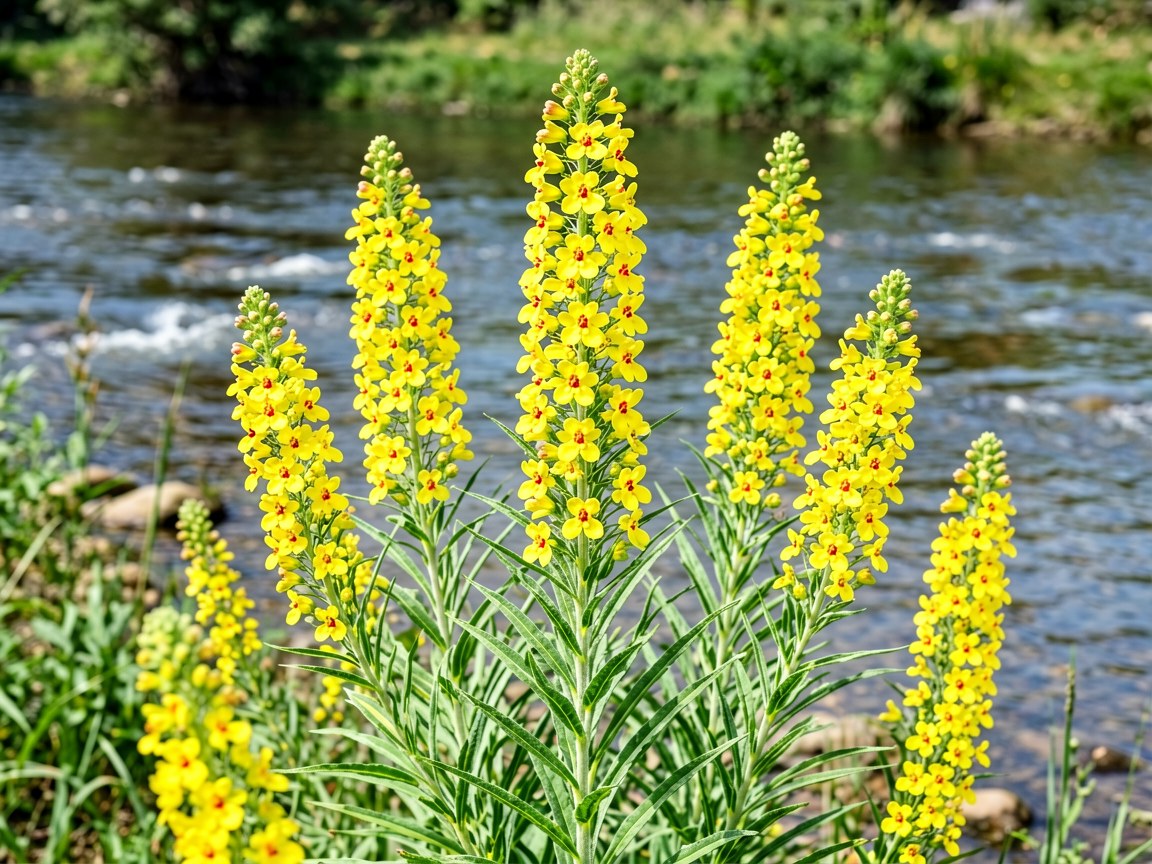
Lysimachia vulgaris | Yellow Loosestrife
Introduction
Yellow loosestrife (Lysimachia vulgaris) is a tall, upright, downy perennial of wet ground, bearing spikes of bright golden-yellow, saucer-shaped flowers that open along the upper part of the stem through high summer. It grows in wet meadows, fens, and at the margins of rivers and ponds, often in dense stands, and it is one of the more conspicuous plants of damp, unimproved ground. Despite the name it is not related to the purple loosestrife, which belongs to an entirely different family, and the two share a name simply because both are tall, showy plants of wet places. The yellow flowers are rich in pollen and modest in nectar, and the plant is one of the more important food sources for a group of specialised bees that collect oils from it rather than nectar.
Taxonomy
Lysimachia vulgaris belongs to the family Primulaceae, the primrose family, which places it with the primroses, the pimpernels, and the creeping Jenny of damp ground, rather than with the purple loosestrife, Lythrum salicaria, which is in the family Lythraceae. The genus Lysimachia contains well over a hundred species distributed through the temperate and subtropical regions, and the name is said to commemorate Lysimachus, a general of Alexander the Great, who was supposed to have discovered the plant; the specific epithet vulgaris means “common”. Its relatives in Britain include the creeping Jenny Lysimachia nummularia and the yellow pimpernel. As a green plant it depends on Photosynthesis, and the tall, leafy, upright stems are designed to raise the flower spikes above the surrounding herbage of wet ground, where they are visible to insects.
Physical Characteristics
The plant is a sturdy, upright, shortly downy perennial, fifty centimetres to a metre and a half tall, arising from a creeping rhizome and often forming large clumps. The stems are erect, usually unbranched, round below and slightly angular above, covered with short, soft hairs, and often reddish-tinged towards the base. The leaves are arranged in opposite pairs or in whorls of three or four around the stem; they are lance-shaped to broadly oval, four to twelve centimetres long, pointed, untoothed, stalkless, and usually marked with scattered, tiny, dark, translucent dots when held up to the light. The flowers are borne in a loose, leafy, pyramidal cluster at the top of the stem and in smaller clusters from the upper leaf axils. Each flower is fifteen to twenty-five millimetres across, with five broad, spreading, golden-yellow petals that are slightly fringed with tiny hairs at the margins, five narrow green sepals edged with red, five stamens whose filaments are fused at the base into a short ring around the ovary, and a single slender style. The fruit is a small, rounded capsule that opens by five valves. Flowering runs from June to August.
Habitat
It grows in wet to damp, moderately fertile, neutral to base-rich ground: wet meadows, fens and marshes, the margins of rivers, streams, canals, and ponds, in ditches, in carr and wet woodland, on riverbanks, and in damp rough grassland and on roadside verges where the ground is wet. It tolerates winter flooding well and grows in shallow standing water at the edges of pools, and it is tolerant of a fair amount of shade. It is a characteristic plant of unimproved, traditionally managed wet grassland. The species is distributed across Europe and temperate Asia, and it has been introduced to North America and New Zealand, where it has naturalised and is regarded as a weed of wet ground in places. It is common through much of Britain and Ireland, though it is scarce in the far north and in the most acidic uplands.
Diet
Yellow loosestrife is autotrophic, photosynthesising in the ample leaves that are spread along the whole length of the stem rather than being concentrated in a basal rosette, and it is a vigorous grower on damp, reasonably fertile ground. It is a fairly demanding plant by the standards of wet grassland and responds to enrichment, though it does not need the high nutrient levels that the coarser competitive species of improved pasture require. It spreads and stores reserves by means of a stout, creeping rhizome that runs through the surface layers of damp soil, and like most plants of waterlogged ground it is able to tolerate low oxygen at the roots. Its chemistry includes saponins and flavonoids, and the plant is notably astringent; it was once used to make a yellow dye, and the whole plant has a somewhat bitter, acrid character that makes it unattractive to most grazing animals.
Reproduction
The flowers open from June to August and are unusual in producing no nectar: they offer pollen only, and they are visited by a variety of bees, flies, and beetles that come to harvest it. Of particular interest are the oil-collecting bees of the genus Macropis, which are closely tied to Lysimachia and which gather fatty oils secreted by glands on the flower rather than nectar, using them to line their nest cells and to provision their young; the bees are entirely dependent on the plant, and where yellow loosestrife disappears the bees go with it. The flowers are self-incompatible, so cross-pollination between different plants is required for good seed set, and because a large clump is often a single clone spread by the rhizome, seed production can be poor. The small seeds are produced in capsules and are dispersed by wind and by water, floating on the surface. Vegetative spread by the branching rhizome is the main means of local increase, and a stand can extend several metres.
Conservation
The species is common, widespread, and not threatened, though it has declined in lowland Britain along with the wet, unimproved grassland and the undrained river margins that it favours. Drainage, the straightening and dredging of watercourses, the conversion of hay meadows to silage, and the tidying of ditches and verges have all reduced its habitat. It remains abundant in the wetter north and west and in districts where traditional management survives, and it is a standard component of the vegetation of fen, marsh, and wet meadow, and one of the species used in classifying and assessing those habitats. Its conservation interest is increased by its association with the oil-collecting bees, which are themselves scarce and local, and which depend on good populations of the plant within their flight range. It is also grown in gardens, particularly in bog gardens and at the edge of ponds, where several selected forms are available.
Fun Facts
- It is not related to the purple loosestrife; the shared name is a coincidence of habitat and appearance.
- The flowers produce no nectar and reward visitors with pollen and with oils.
- A group of rare oil-collecting bees depends on it, gathering oils from the flowers instead of nectar.
- The leaves are dotted with tiny dark translucent glands that show when held up to the light.
- It was once used to make a yellow dye, and the whole plant is astringent and bitter.