 By st20113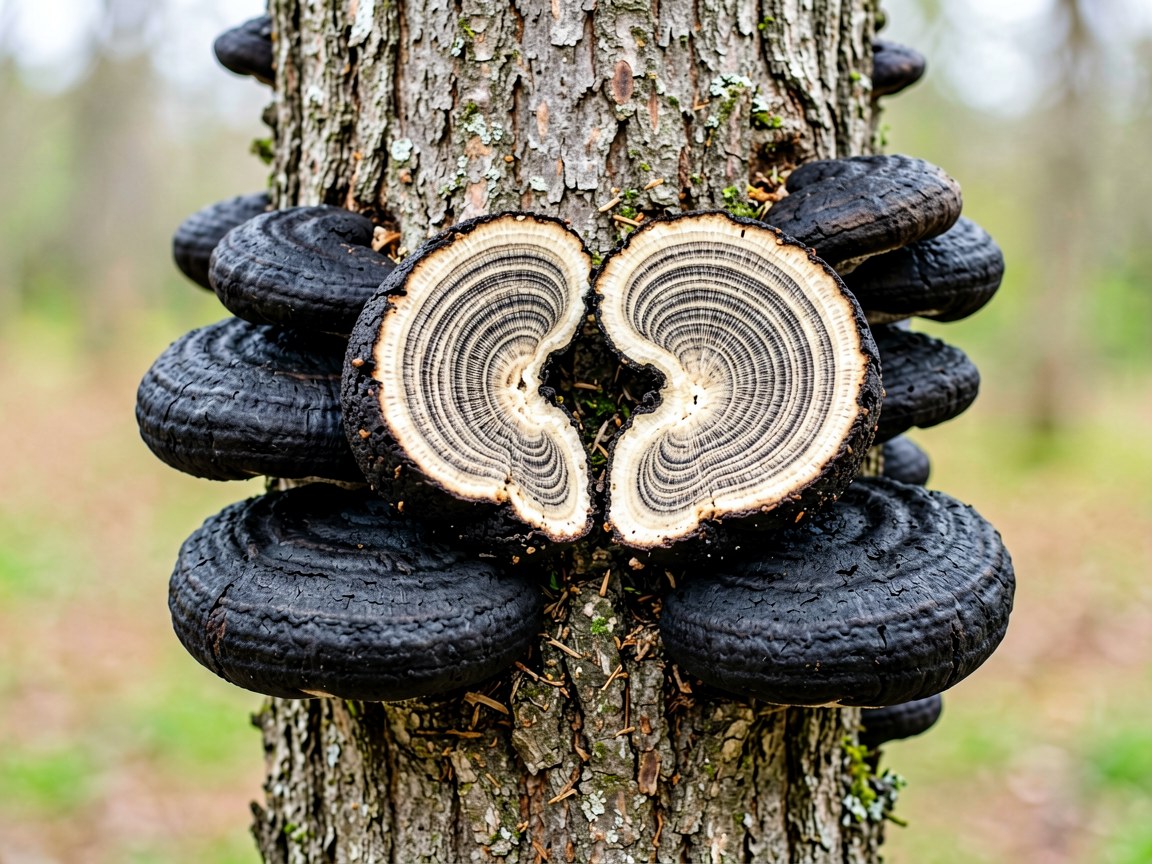
Daldinia concentrica | King Alfred’s Cakes
Introduction
King Alfred’s cakes (Daldinia concentrica) is a hard, rounded, charcoal-black fungus that grows on dead ash and other broadleaf timber and looks, at a glance, like a lump of burnt wood or a small, blackened bun stuck to the trunk. Cut one in half and the illusion vanishes: the interior is made of dozens of fine, concentric, pale and dark zones, like the growth rings of a tree or the layers of an onion, and it is this banding that gives the species both its name and its scientific epithet. The English name comes from the legend of King Alfred and the burnt cakes, which these blackened lumps are supposed to resemble. Dried, they burn slowly and smokily like charcoal, and they were once gathered and used as tinder and as a smudge to keep midges away.
Taxonomy
Daldinia concentrica is an ascomycete, a member of the phylum Ascomycota, in the order Xylariales and the family Xylariaceae — the same family as the candlesnuff fungus and the dead man’s fingers. The genus Daldinia contains a number of similar zoned, wood-inhabiting fungi, and the specific epithet concentrica refers to the concentric internal bands. It was named in honour of Agostino Daldini, a nineteenth-century Italian clergyman and botanist. As a sac fungus it produces its sexual spores inside elongated cells, or asci, with eight spores to each ascus, rather than externally on basidia as the mushrooms such as Amanita muscaria do, and the asci are contained in flask-shaped chambers buried just beneath the surface of the mature fruit body. The dull black exterior is the same material, known as melanised tissue, that makes the whole group so resistant to drying and decay.
Physical Characteristics
The fruit body is a rounded, cushion-shaped or almost spherical lump, usually two to seven centimetres across and one to three centimetres high, attached to the wood by a fairly narrow base and sometimes fusing with its neighbours into a crust. The surface is at first dull reddish-brown to dark purple-brown and slightly velvety with the asexual stage, but it rapidly becomes hard, smooth to slightly lumpy, and uniformly charcoal-black, and it eventually develops a fine, cracked, or slightly pimpled texture as the minute openings of the buried chambers appear. There is no stem. The interior is the diagnostic feature: firm, pale, brownish flesh marked by numerous, very fine, concentric zones of alternating lighter and darker tissue, arranged around the point of attachment like the rings of a tree. The whole structure is hard and woody when dry and rather softer and more brittle when fresh. The spores are dark brown to black, smooth, and lens- or bean-shaped, and they are released in such quantity that a wet fruit body can leave a black spore deposit on the bark beneath it.
Habitat
It grows on dead and dying timber of broadleaf trees, especially ash, and also on beech, oak, birch, hazel, alder, and others; it is particularly characteristic of dead standing trunks, of branches still attached to the tree, and of large logs in the early to middle stages of decay. It is found in woodland, hedgerows, parkland, and gardens wherever there is dead hardwood, and it is generally more abundant on wood that has been dead for a year or two than on very fresh or very rotten material. The species is widely distributed through the temperate and tropical regions of the world, and it is common and widespread throughout Britain and Ireland. It can be found at any time of year, since the fruit bodies are perennial in the sense that they persist and harden rather than decay, and a single trunk may carry them for several seasons.
Diet
It is a saprotroph and, like the rest of its family, a white-rot fungus, able to break down both the cellulose and the lignin of the wood it inhabits and so to reduce the timber to a soft, pale, stringy mass. It colonises wood that is already dead, and it is frequently one of the fungi that follows the first wave of colonisers onto a dead trunk, persisting for several years as the decay proceeds. Because the fruit bodies are hard, dark, and long-lasting, the fungus is far easier to see than the extent of its activity suggests: the mycelium spreads well beyond the visible lumps, and a single dead trunk may be riddled with it long before or after the black cushions appear on the surface. It is not a significant parasite of living trees, though it is occasionally found on a moribund branch that is still attached.
Reproduction
The fungus has two spore stages, as is usual in its family. The first is asexual: young fruit bodies produce a velvety covering of minute, pale-coloured conidia on the surface, and these are dispersed by wind, by rain, and by contact, allowing the fungus to spread quickly and locally. The second is sexual and follows later: the surface of the mature, blackened fruit body develops numerous tiny pimples, each of which is the mouth of a flask-shaped chamber, or perithecium, sunk into the hard outer layer. Inside each chamber the asci develop, and when the spores are ripe they are expelled through the pore at the top, usually in damp weather. The dark spores are then carried by wind and water to new dead wood. A distinctive feature of the species is that the asexual stage and the sexual stage often occur on the same fruit body at different times, so that the same lump changes its appearance and its function over the course of a season or two.
Conservation
The species is common, widespread, and not threatened, and it is one of the fungi least affected by the ordinary management of countryside and gardens, since dead ash, beech, and other hardwood timber is abundant in almost every kind of woodland, hedge, and park. It is frequently recorded and is one of the easier ascomycetes to identify with confidence, particularly when a specimen is cut open to show the banding. It does decline where dead wood is systematically cleared, chipped, or burnt, and where dead standing timber and large logs are removed from woodland. Its presence is an easy indicator that a good supply of dead hardwood is being left in place, and a single trunk carrying a dozen of the black lumps is a small ecosystem in its own right, supporting a wide range of insects and other fungi.
Fun Facts
- The English name refers to the legend of King Alfred and the cakes he supposedly let burn.
- Cut in half, the inside shows dozens of fine concentric rings, like the growth rings of a tree.
- Dried fruit bodies burn slowly and smokily, and were once used as tinder and to smoke out bees.
- It grows most often on ash, and a dead ash trunk is frequently covered in the black lumps.
- It is an ascomycete, producing its sexual spores inside sacs buried in tiny chambers just under the surface.