 By st20113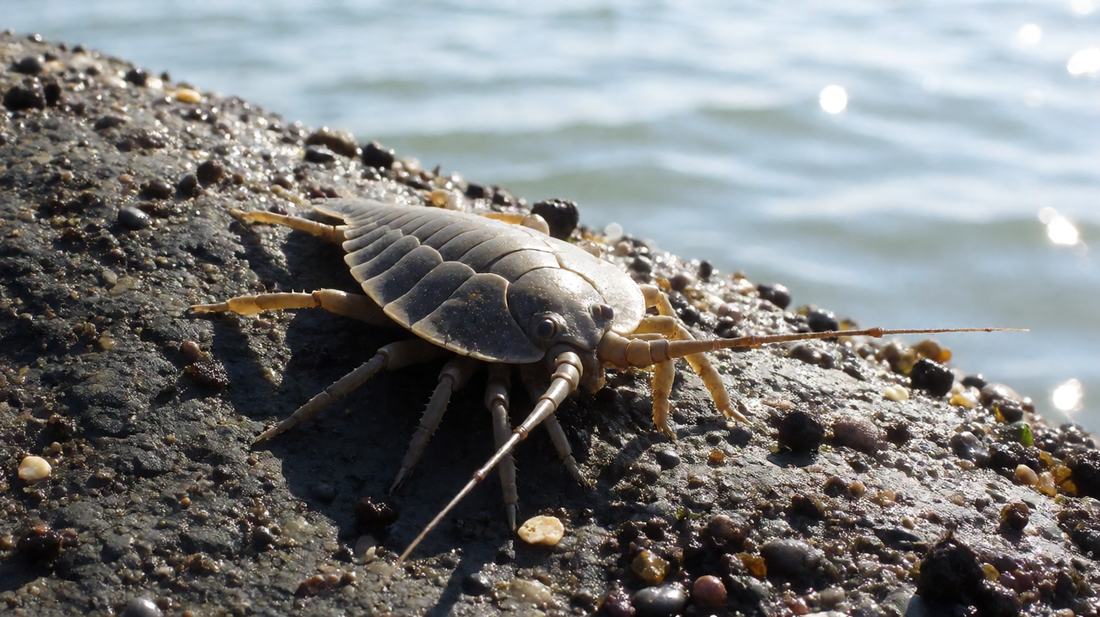
Ligia oceanica | Sea Slater
Species Profile · Ligiidae
Sea Slater
The largest woodlouse in Europe and the only one at home on the seashore, a flattened armour-plated scavenger of the splash zone.
IUCN: Not Evaluated
Range
Length
Eyes
Segments
Status
The shore woodlouse
Europe’s largest woodlouse
The sea slater is the largest woodlouse in Europe and the only one most people meet on the open shore. It lives on hard coastlines just above the tide. In the band that is splashed but not submerged. It is flat, grey-brown and about 3 cm long. With a segmented back like a suit of armour and a pair of very long antennae that sweep the ground ahead. When disturbed it runs. It is one of the fastest woodlice. And catching one by hand takes more speed than most expect.
It is a scavenger of the strandline. It feeds on seaweed washed up and rotting. On algae on the rock. And on any dead animal it finds. In that role it helps recycle the material the sea throws ashore. It is a woodlouse in the strict sense. It belongs to the same group as the pill woodlouse and the garden woodlice. All crustaceans that left the sea for land.
The sea slater is the least committed of them. It can breathe in air but also survive submerged. And it moves up and down the shore with the tide. It has no common name beyond sea woodlouse or sea slater. It is not eaten, not a pest, not dangerous. And almost nobody notices it.
Family tree
Ligiidae, the sea slaters
The sea slater belongs to the order Isopoda and the suborder Oniscidea. The woodlice. It sits in the family Ligiidae and the genus Ligia. Linnaeus named it in 1767 as Oniscus oceanica. It was later moved into Ligia as the group was studied. The genus Ligia holds about 40 species on rocky shores from the tropics to the subarctic. Its members are all shore animals, fast and flat. The sea slater is the species of the northeastern Atlantic. From Norway south to the Mediterranean and on to West Africa. The name Ligia comes from Greek and refers to a shrill sound.
Perhaps the noise the animals make when disturbed in a group. The woodlice are remarkable. They are the only large group of crustaceans that fully colonised dry land. By keeping their young in a brood pouch and evolving ways to breathe air. Most woodlice lost the ability to live under water. The sea slater did not. It keeps gill-like plates on the underside of its abdomen that work as gills. And can use them in air as long as they stay moist. That is why it must live at the sea’s edge. Where the air is damp and the spray is regular.
The ligiids also include species on cliffs and in caves around the Mediterranean. The sea slater is the largest woodlouse in Europe. And a distant relative of the pill woodlouse. The familiar grey garden species of the same order. The pill woodlouse is a fully land animal of the same group. And can roll into a ball. The sea slater cannot: its body is too flat and its tail plates block the roll. The two share the same armour and the same seven pairs of legs. And are easy to tell apart by size.
Flat armour, long antennae
How to identify one
The sea slater is a flat, oval, armoured animal. It reaches about 30 mm in length. This makes it the largest woodlouse in Europe and about three times the length of a pill woodlouse. The body is split into a head. Seven thoracic segments and an abdomen of fused plates. The outer surface is hard and slightly glossy. Formed of overlapping plates that give the armour look. The colour is grey, brownish-grey or olive-green. Usually mottled with darker and lighter patches. And the underside is paler. That mottling is camouflage on wet rock. The head carries a pair of large compound eyes. Each made of more than 40 separate lenses.
That is a large number for a woodlouse and shows the animal relies on sight. Two pairs of antennae are present. The first pair is small. The second pair is very long. Longer than any other woodlouse of the region. Built of a short stem and a long flagellum of many small segments. Those antennae are almost always moving. And act as touch and chemical sensors. The animal lives in cracks and weed. Where it sees little, so the antennae do the work. Seven pairs of legs run along the body. Each ending in a sharp curved claw that grips rock and weed. The tail section carries five pairs of flat.
Leaf-like plates on the underside. Those plates are the gills. Each is made of two branches. And together they take oxygen from water and moist air. The same section ends in a pair of long. Two-branched tails, the uropods. It stick out well beyond the body. Those tails carry sense organs and help the animal dart away. There is no waxy waterproof layer on the cuticle. This is one reason the animal cannot leave the shore. Males and females look alike. And the female carries a brood pouch when she is breeding.
1
2
3
The splash zone
Where it lives
The sea slater lives in the splash zone of hard shorelines. It occupies the narrow band above the high water mark. Wet from spray and the highest tides but usually in the air. It needs rock. It is found at the base of sea cliffs. On boulder and shingle beaches. In crevices on harbour walls and jetties. On sea walls and in the cracks of ruined stonework near the coast. It avoids soft shores. And does not live in sand or mud except in a few sheltered places. Its range covers the northeastern Atlantic.
From Norway and Denmark south through the British Isles. France, Spain and Portugal to Morocco and beyond. And it includes the Mediterranean and Black Sea. It is common around the whole coast of Britain and Ireland wherever there is a hard shore. Its distribution is almost the same as the distribution of rocky coast. It is a social animal in a loose sense. It lives in groups. Often in large numbers under one stone or in one crevice. And the grouping helps hold moisture. An isolated sea slater dries out and dies far sooner than one packed into a crowd. It moves up and down the shore with the tide.
As the water rises it climbs higher on the rock or into a crevice above the waterline. As the tide falls it moves down to feed on the freshly exposed rock and the weed just washed in. It is most active at low tide and at night. In daylight on open rock it is at risk from birds. And it retreats to the dark. The animal is very tolerant. It survives fresh rain, submersion for hours. And a shorter dry spell. That tolerance is what lets it live in the hardest shore zone.
Scavenger of the shore
What it eats
The sea slater is a scavenger and a grazer. Its main food is plant material that has died and begun to break down. It eats the seaweed washed up on the shore. Above all the brown wracks and the green sea lettuces. And also the fine algae on the rock surface. It takes dead animals of almost any kind. Including other crustaceans, worms and fish. It also eats detritus. The loose mix of broken organic material and fine sediment in cracks and under stones. It is not a picky feeder. And takes almost anything edible it finds.
That flexibility is a real advantage in a zone where food arrives in unpredictable batches. A storm throws a mass of weed onto the shore. And the sea slaters appear from every crevice to deal with it. The feeding is helped by strong mouthparts. The mandibles are hard and can cut tough plant tissue. The animal uses its front legs to hold the food and its mouthparts to shred it. It feeds at night and at low tide. When it is safest in the open. The antennae find the food. They detect the chemicals released by decaying weed at low levels. And tell the animal if a piece is fresh or too far gone.
The sea slater is a bioindicator. It builds up heavy metals such as copper. Zinc and cadmium from the algae it eats and from the water. And researchers use the levels in its body to track coastal pollution. It is also food for other shore animals. Shore birds, crabs and larger beetles take it. And its habit of gathering means one find can feed a predator many times. Its numbers can be very high on good rock. With hundreds of animals in a few metres of shoreline.
Eggs on the land
The breeding cycle
The sea slater breeds through the summer. And the pattern is the one all woodlice share. The male and female come together after a courtship in which the male rides on the female’s back and taps her with his antennae. Mating happens around the time of the female’s moult. The male passes sperm. And the female then lays her eggs into a brood pouch. The marsupium, on the underside of her body. The pouch is formed by overlapping plates and holds the eggs in a film of water. The eggs stay in the pouch for several weeks. They hatch into small versions of the adult rather than free larvae. And the young stay in the pouch for a further period before release.
That pattern is called ovoviviparity. The female releases the young rather than laying eggs. And does it when the conditions are right. A female can produce a couple of broods in a season. And the number of young in each is smaller than the number of eggs from a marine crustacean of the same size. The care per young is much greater. The young are pale at first and darken as they grow. They moult repeatedly. And like all crustaceans must shed the whole shell to grow. The moult happens in two stages. The back half first and the front half a day or two later.
This leaves the animal briefly soft and open. Sexual maturity is reached at about 1 year and the lifespan is around 2 years. Though some live longer. That is a long life for a small crustacean. And reflects the low and patchy food of the splash zone. The sea slater has one more breeding edge. Because it broods its young and releases them as small crawlers. It does not need a surface for larvae to settle on. That freedom from a settlement cue is a big part of why woodlice could leave the sea.
Not Evaluated, common
Conservation
The sea slater has not been assessed for the global Red List. And is listed as Not Evaluated. In Britain it has been assessed at national level and is Least Concern. That is the ordinary case for a common, widespread shore invertebrate. It is abundant over a very large range. It lives in habitats that are not in short supply. And it has no commercial value and no fishery. It is not protected by law. And no programme exists for it. None of that means the animal is free from risk.
Its habitat is the narrow strip of hard shore just above the tide. And that strip is under pressure in many parts of Europe. Coastal development. Sea walls and the concreting of natural rock remove the crevices and boulders the species needs. Pollution of coastal water, above all oil and chemical spills. Hits the splash zone first and hardest. Because that is where floating material strands. Litter. And plastic that traps moisture and covers rock, changes the microhabitat. Rising sea levels and more storms will shift the zone itself.
And a sea wall blocks the landward retreat that would otherwise be possible. The species is also a useful monitoring tool. And its very commonness is a reason to watch it. Because it lives in the most contaminated band of the coast. And builds up metals in its body. It can show the early effects of pollution better than a species further offshore. On most European coasts the animal stays abundant. And a search under any large stone on a rocky beach will usually find several. Its future depends less on anything done to the animal than on whether the strip of natural shore it lives in is allowed to stay natural.
Quick hits
Five things to remember
- It is the largest woodlouse in Europe, about three times the length of the familiar garden species.
- Each eye is made of more than 40 separate lenses, and its second pair of antennae is the longest of any European woodlouse.
- Unlike the pill woodlouse it cannot roll into a ball, because its flat body and projecting tail plates get in the way.
- It can breathe both in water and in moist air, using leaf-like gill plates under its tail.
- It carries its young in a brood pouch and releases them as small crawling animals, never as free-swimming larvae.