 By Iris
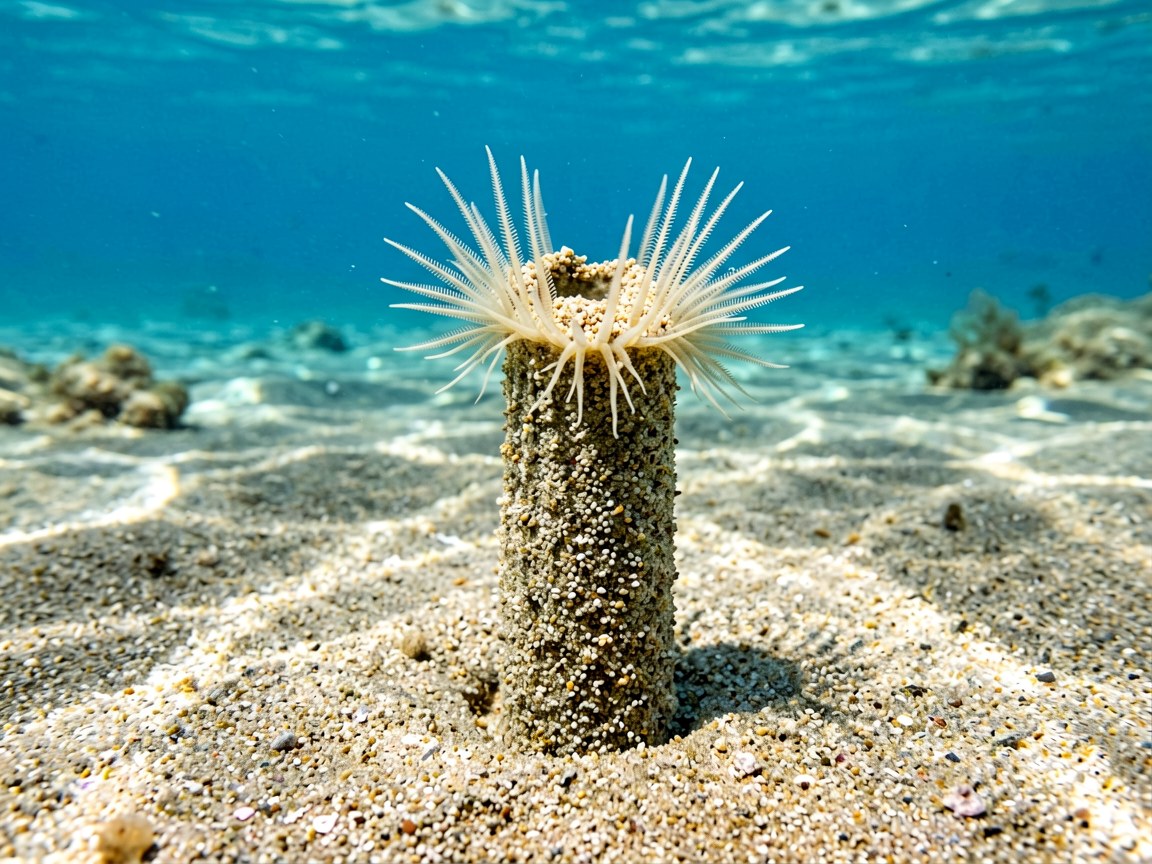
Lanice conchilega | Sand Mason Worm
Introduction
The sand mason (Lanice conchilega) is a tube-building marine worm that turns the seabed into a garden. Living in a tough, sand-grain tube with a fringed top that sticks up above the sediment, it spreads a halo of sticky tentacles to collect food and building material. Where they are numerous, their tubes can carpet hundreds of square metres of sand, stabilising the sediment and creating a home for dozens of other species.
Taxonomy
Lanice conchilega is a polychaete worm in the family Terebellidae, the terebellids or spaghetti worms, known for their dense crowns of feeding tentacles. It belongs to the same annelid phylum as the earthworm, Lumbricus terrestris, sharing the segmented body and bristle-bearing appendages that define the group, though the two worms could hardly look or live more differently: one burrows through soil, the other builds a tower in marine sand.
Physical Characteristics
The body is soft and segmented, up to thirty centimetres long but only a few millimetres wide, and is reddish-pink to orange with paler, banded segments. The head carries a dense crown of long, fine, grooved tentacles that cannot be retracted and a set of small eyespots. Along the body are bristled appendages used to grip the tube wall. The animal itself is rarely seen: what shows above the sand is the tube and the fringe at its mouth.
Habitat
Sand masons live in the lower shore and shallow subtidal, in clean sand, muddy sand, or gravel, from sheltered bays and estuaries out to offshore sands. They occur widely around the coasts of Europe and beyond. Their tubes stand proud of the surface by a centimetre or two, and in dense beds—”sand mason reefs”—there may be thousands per square metre, turning a flat plain of sand into a rougher, more complex habitat.
Diet
They are selective deposit and suspension feeders. The long tentacles stretch out across the sediment surface, catching particles, and their grooved, sticky surfaces carry trapped material along to the mouth. They pick out diatoms, foraminifera, organic debris, and small animals, and they also strain food from the water. The same tentacles gather sand grains and shell fragments, which are sorted and cemented to extend the tube upward as the animal grows.
Reproduction
The sexes are separate and spawning usually occurs in spring and summer, with eggs and sperm released into the water. The larvae drift in the plankton for a period before settling, often attracted to existing tubes, which is why the beds grow and persist. Adults can also rebuild quickly after damage, regenerating lost tentacles and repairing their tube. Individuals are thought to live for several years, and dense beds may persist for many seasons.
Conservation
The species is widespread, often very abundant, and not considered threatened. Its importance lies less in its own status than in what its beds do for everything else: by stabilising sediment and adding structure, they create habitat for a rich community of small crustaceans, worms, and molluscs. Intensive bottom trawling and dredging can flatten these reefs, and because the beds take time to rebuild, they are treated as a sensitive habitat in several marine protected areas.
Fun Facts
- The tube is made of carefully chosen sand grains and shell fragments glued with mucus.
- The fringe sticking out of the top of the tube is why it is called a “sand mason”.
- Its feeding tentacles can stretch several centimetres across the seabed and cannot be pulled back in.
- Dense beds are called reefs and can shelter hundreds of other species.
- It is a close relative of the earthworm, though it lives in a tower in marine sand.