 By st20113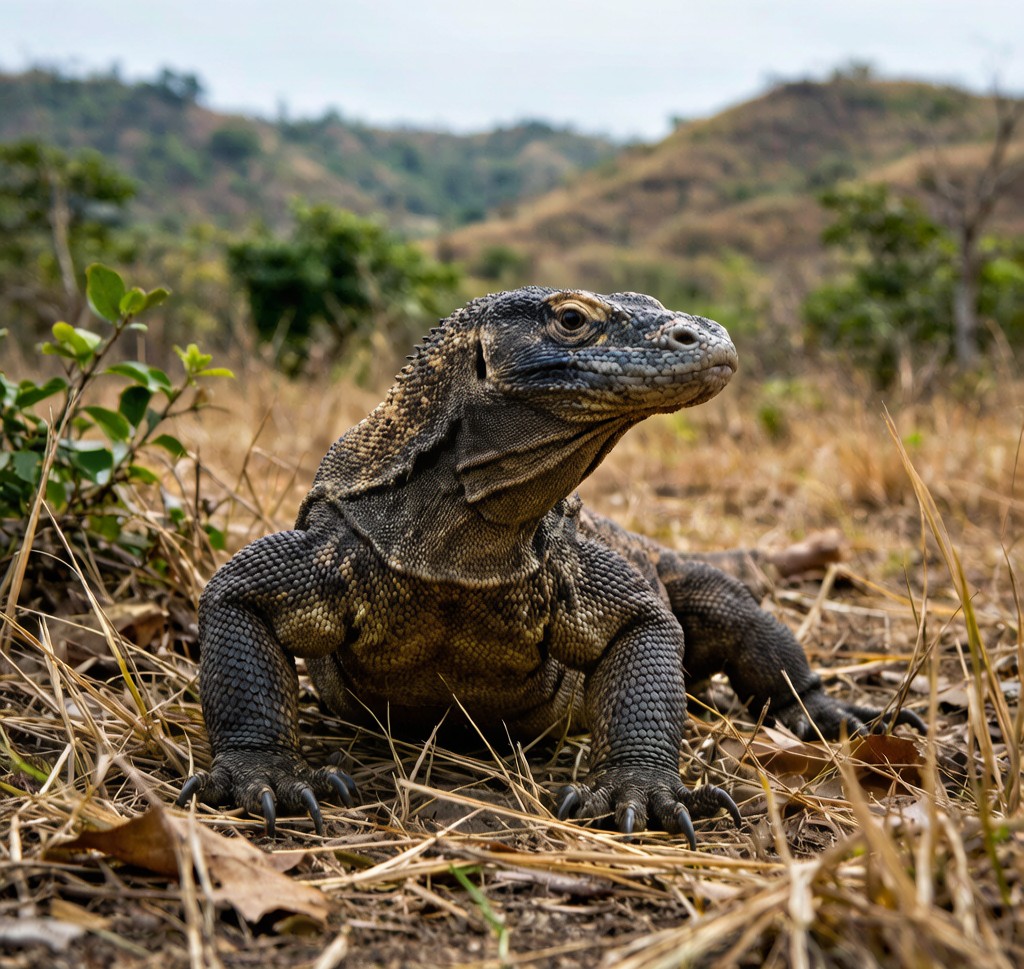
Overview
The Komodo Dragon (Varanus komodoensis) is the world’s largest living lizard – a monstrous, prehistoric-looking monitor lizard that has lived on a handful of remote Indonesian islands for millions of years and has inspired legends of dragons, monsters, and creatures from the deep past. Adult Komodo dragons can reach 3 meters or more in length and weigh up to 70 kilograms, making them not just the largest lizards on Earth but among the most powerful land predators of any kind. The species is found only on five Indonesian islands – Komodo, Rinca, Flores, Gili Motang, and padar – in a total area of approximately 5,000 square kilometers, making it one of the most geographically restricted of all large predators.
The Komodo dragon’s appearance is designed for maximum intimidation: a massive, muscular body covered in rough, scale-covered skin in mottled grey, brown, and green; a long, forked tongue that flicks constantly in and out like a snake; small, beady eyes that give the impression of cold, calculated intelligence; and a thick, powerful tail that can be swung with bone-crushing force. The species’ bite – once thought to be dangerous only because of the septic bacteria in its mouth – has recently been shown to be venomous: Komodo dragons have venom glands in their lower jaw that produce an anticoagulant that prevents prey from clotting blood, causing massive hemorrhage and death from shock and blood loss in even large prey items.
Hunting and Feeding
The Komodo dragon is an opportunistic predator and scavenger that hunts a wide range of prey, from small invertebrates and rodents to deer, goats, water buffalo, and even other Komodo dragons. The species employs a sit-and-wait hunting strategy: a large dragon will locate a prey animal – typically a deer, goat, or pig – by scent, stealth, or simple chance encounter, and then launch a rapid ambush attack, using its powerful legs and claws to bring down the animal. A single bite from a Komodo dragon delivers a potent dose of venom that prevents blood clotting, causing the prey to enter shock from blood loss within hours; the dragon then follows the wounded, bleeding animal at a leisurely pace, sometimes for hours or even days, until it collapses from blood loss and can be consumed at leisure.
The Komodo dragon’s feeding method is both efficient and gruesome: the lizard uses its sharp, curved claws and powerful jaws to tear open the prey, then swallows large chunks of flesh whole – sometimes including bones and organs – using a highly flexible skull and jaw that allow it to accommodate items much larger than its head. After consuming an enormous meal – which can be up to 80 percent of the dragon’s own body weight – the Komodo dragon retreats to a shaded spot to digest, a process that may take several days or even weeks. During digestion, the lizard is particularly vulnerable to attack from other dragons, and individuals will return to the safety of their burrow to complete the process.
Behavior and Reproduction
Komodo dragons are largely solitary animals that come together only to mate and occasionally to feed on large carcasses. Each individual maintains a home range that overlaps with those of other dragons, and encounters between individuals – particularly between males – can be violent and potentially lethal. Male Komodo dragons engage in ritualized combat for access to females: they rise on their hind legs, lock their forelegs around each other, and wrestle until one is pushed to the ground, with the winner claiming mating rights. After mating, the female lays a clutch of approximately 20 eggs in a deep nest burrow she excavates in the ground, and then guards the nest site for several months until the eggs hatch.
One of the most remarkable aspects of Komodo dragon biology is the species’ ability to reproduce through facultative parthenogenesis – a form of asexual reproduction in which an unfertilized egg develops into a normal offspring without mating with a male. This capability – which has been documented in several other monitor lizard species – allows a single female Komodo dragon to establish a population in the absence of males, and may have been an important adaptation for the colonization of isolated islands where founding populations were initially small. However, parthenogenetic offspring are exclusively male, meaning that this reproductive strategy creates populations with a strongly skewed sex ratio that may be unsustainable in the long term.
Conservation
The Komodo Dragon is listed as Endangered on the IUCN Red List, reflecting the species’ extremely restricted range and the serious threats it faces from habitat loss, climate change, and human disturbance. The species’ entire global range is confined to five Indonesian islands covering less than 5,000 square kilometers, and on at least one of these islands (padar) the Komodo dragon has already been driven to local extinction. The primary threats to the species include habitat loss as a result of agricultural expansion, the human settlement of previously wild areas, and the impacts of climate change on the prey populations and fire regimes of the islands.
Climate change poses a particularly serious long-term threat to the Komodo dragon: rising sea levels could inundate the low-lying coastal areas where the dragons hunt and nest, while warming temperatures could alter the distribution of the deer and goat prey populations on which they depend. The Indonesian government has established Komodo National Park – covering Komodo and Rinca Islands and adjacent waters – as the primary protected area for the species, and the park is a major tourist destination attracting visitors from around the world who come to see the dragons in their natural habitat. Well-managed tourism has become an important tool for Komodo dragon conservation, providing economic incentives for local communities to protect the species and its habitat.