 By st20113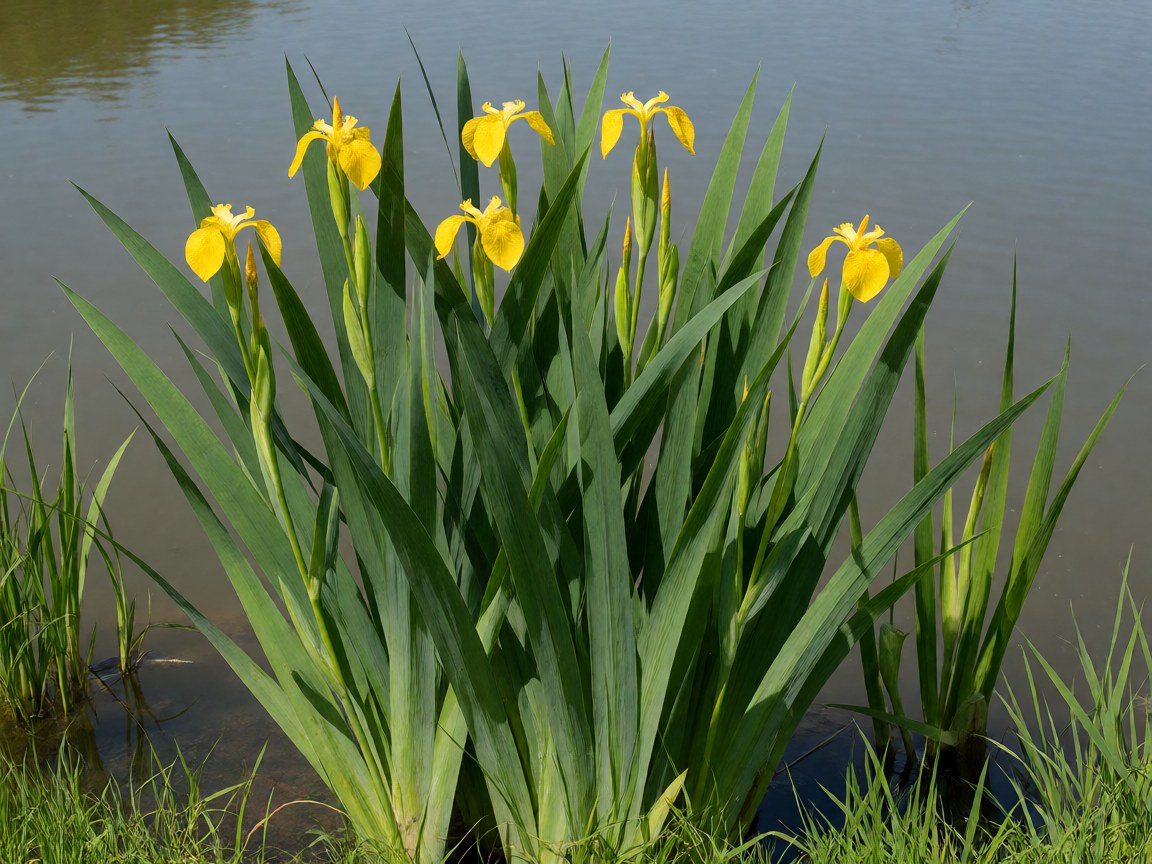
Iris pseudacorus | Yellow Iris
Introduction
The yellow iris (Iris pseudacorus) is the tall, stately waterside plant with sword-shaped leaves and brilliant yellow flowers that lines canals, rivers, ponds, and ditches across Europe. Its drooping outer petals, marked with dark violet-brown veins and a streak of orange at the centre, are unmistakable in late spring and early summer, and the dense clumps of rigid upright leaves are recognisable at any season. Within its native range it is one of the best-loved plants of the water’s edge and a familiar sight from lowland fen to upland stream. Outside it, it is a different matter: introduced to North America, Australia, New Zealand, and southern Africa as an ornamental pond plant, it has escaped and become a serious invasive weed that chokes waterways and is now restricted or banned in several regions. The same vigour that makes it so effective at holding a bank makes it almost impossible to remove.
Taxonomy
Iris pseudacorus belongs to the family Iridaceae, the iris family, which also includes crocuses, gladioli, and freesias, and it is placed in the genus Iris, a large group of some three hundred species found through the temperate northern hemisphere. Within the genus it belongs to the water-loving, beardless irises: unlike the bearded garden irises, its drooping falls carry a raised central ridge rather than a fuzzy beard, and it is naturally adapted to wet ground. Its closest relatives are the blue flag Iris versicolor and the Japanese Iris laevigata, both of which share its liking for standing water. The specific name pseudacorus means “false acorus”: the narrow upright leaves superficially resemble those of sweet flag, Acorus calamus, which grows in the same places, though the two are not related and are easily separated once in flower. As a green plant it depends on Photosynthesis, and the tall, rigid, vertical leaves are arranged to catch light efficiently in the dense stands the plant typically forms.
Physical Characteristics
The plant grows from a thick, creeping, branching rhizome that lies on or just below the surface of the mud, and it reaches sixty to one hundred and fifty centimetres tall. The leaves are erect, stiff, and sword-shaped, grey-green, twenty to ninety centimetres long and one to three centimetres wide, with a conspicuous raised midrib and a fine, slightly glaucous sheen; they fan out in the vertical plane, which is why a clump looks so architectural. The flowers are seven to ten centimetres across and are borne two or three together on branched stems. Each has three large, outward- and downward-curving falls, bright yellow with a central patch of deeper orange and a network of dark violet-brown veins, and three smaller, erect standards of a paler, clearer yellow. There is no beard. The three petaloid style branches arch over the falls, each hiding a stamen beneath it. The fruit is an oblong, three-celled capsule four to seven centimetres long that turns brown and splits to release a mass of flattened, pale brown, corky seeds. Flowers appear from May to July.
Habitat
It grows at the margins of still and slow-moving freshwater: rivers, canals, streams, ponds, lakes, ditches, marshes, fens, reedbeds, and wet woodland, and it will grow in shallow standing water up to about twenty-five centimetres deep as readily as on wet mud. It prefers nutrient-rich, fine sediment — clay, silt, or organic mud — and full sun, and it is tolerant of a wide range of pH and of moderate salinity. Native to Europe, north Africa, and western Asia, it is common throughout Britain and Ireland and is planted widely for bank stabilisation and for ornamental and constructed wetlands. Beyond its native range it has become naturalised across much of North America, Australia, New Zealand, and parts of southern Africa and South America, where it forms dense monospecific stands along watercourses and in wetlands, displacing native vegetation and altering water flow.
Diet
The plant is autotrophic, photosynthesising through its tall, rigid leaves, and it stores large quantities of starch in the thick rhizome, which is what allows a clump to survive winter, flooding, cutting, and fire and to regrow with such speed. It thrives on nutrient-rich sediment and is a heavy feeder of nitrogen and phosphorus, which is precisely why it is used so widely in constructed wetlands and reed-bed treatment systems: the plant takes up nutrients from wastewater, and harvesting the foliage removes them from the system. It has also been studied for phytoremediation, since the rhizome and roots accumulate metals and other contaminants from sediment. It forms associations with mycorrhizal fungi, though these are often less important in permanently saturated ground, and its internal air spaces carry oxygen down to the buried rhizome.
Reproduction
Flowering runs from May to July, and the flowers are visited mainly by long-tongued bumblebees and other bees, which land on the falls and push beneath the style branches in search of the nectar at the base of the flower, brushing the stamen and then the stigma as they do so. The plant is self-compatible but cross-pollination between different clones gives better seed set. The capsules ripen in late summer and release their seeds, which are light, corky, and effectively waterproof: they float, and can drift on water for weeks or even months before washing up on a muddy margin and germinating. Water is therefore the main agent of long-distance spread. Vegetative reproduction is at least as important: the branching rhizome creeps steadily outward, a clump can extend several metres along a bank, and broken fragments float and take root wherever they lodge. These two mechanisms together explain why the species is so difficult to eradicate once established outside its native range.
Conservation
Within its native range the yellow iris is common, widespread, and not threatened, and it is valued both as an ornamental and as a practical plant for stabilising the banks of rivers, canals, and ponds and for treating wastewater. It declines locally where rivers are channelised and dredged and where wetland is drained, and dense shade or heavy grazing will eliminate it, but it recovers quickly whenever wet, open ground is available. In its introduced range the position is reversed: it is regarded as an invasive weed in parts of North America, Australia, and New Zealand, where it forms impenetrable stands that reduce native plant diversity, alter wetland hydrology, and impede drainage and access. Control is difficult and expensive, since cutting or fragmenting the rhizome encourages spread, and effective management usually requires repeated removal of the whole plant combined with restrictions on planting and on the movement of machinery and plant material.
Fun Facts
- The specific name means “false acorus”, because the leaves resemble those of sweet flag.
- The seeds are corky and waterproof and can float for weeks before washing up on mud and sprouting.
- The fleur-de-lis, the heraldic emblem of France, is widely thought to have been based on a yellow iris.
- A black dye was once obtained from the rhizome with iron salts, and a yellow dye from the flowers.
- In parts of North America it is classed as a noxious invasive weed, and planting it is restricted.