 By st20113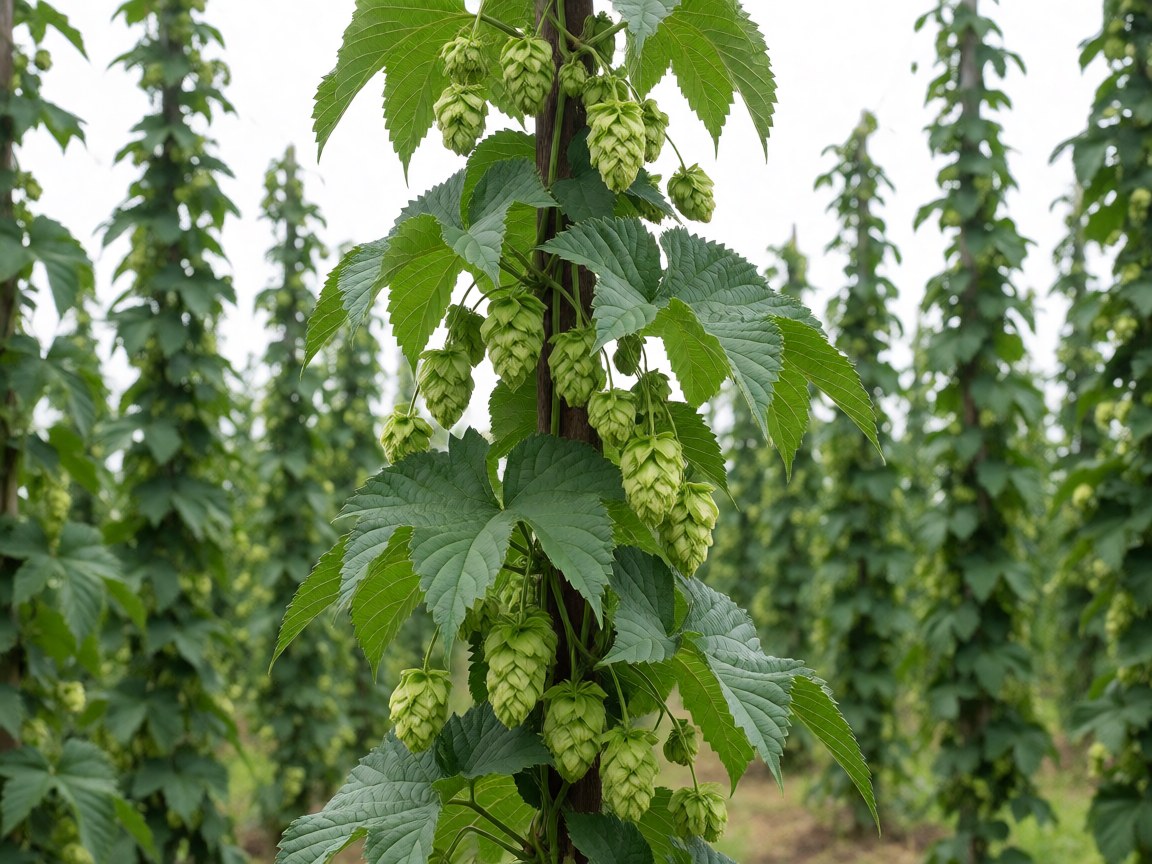
Humulus lupulus | Hop
Introduction
The hop (Humulus lupulus) is the twining vine behind beer, a vigorous climbing perennial whose female flower cones have been used to bitter, flavour, and preserve beer for well over a thousand years. Wild hops scramble up hedgerows, woodland edges, and riverbanks across the northern hemisphere, but the plant is far better known from the tall wire-worked gardens of the hop fields, where strings carry the bines six metres or more into the air. The “bine”—not a stem in the strict sense but a rough, hairy, clockwise-twining shoot—grows with startling speed in early summer, and the papery cones that follow are, in fact, the female flower clusters. Their golden dust of lupulin glands carries the resins and oils that give beer its bitterness and aroma, and the same compounds make the plant useful well beyond the brewery. Few wild plants have been so thoroughly reshaped by a single human industry: the hedgerow vine and the cultivated crop are the same species, separated mainly by centuries of selection for resin content, disease resistance, and cone shape.
Taxonomy
Humulus lupulus belongs to the family Cannabaceae, the hemp family, a small group that also includes hemp and the hackberries, and it is the closest relative of cannabis among Europe’s wild plants. The genus Humulus contains only a handful of species, and H. lupulus is the only one native to Europe; the others are Asian and North American. It is a dioecious perennial vine, with male and female flowers on separate plants, and only the female cones are of commercial value. Several wild varieties are recognised across Europe, Asia, and North America, and the countless cultivated hop cultivars grown for brewing—from the spicy, floral Saaz and Hallertau types to the intensely citrus-scented American Cascade and Citra—are all selections of this one species. As a green plant it depends on Photosynthesis, and the vigorous bine is built to do exactly that: it climbs fast and fixes itself firmly with stiff, downward-pointing hairs so that its leaves can reach full sun above the surrounding vegetation, outcompeting neighbours by overtopping them rather than by tolerating shade.
Physical Characteristics
The plant dies back to a woody rootstock each winter and sends up new bines each spring. Those bines are annual, rough to the touch, square-ish in section, and covered in stiff, reflexed hairs that act like climbing hooks; they twine clockwise and can grow twenty centimetres or more in a day at the peak of the season, reaching six metres or higher. A single crown may produce several bines, and in cultivation the strongest are trained up strings while the rest are stripped off. The leaves are opposite, broadly heart-shaped at the base, usually palmately three- to five-lobed with toothed edges, dark green and coarsely rough above and resinous beneath. Male flowers are small, greenish, and borne in loose drooping panicles; a single male plant can release enough pollen to be detected kilometres away. Female flowers are clustered into short, drooping, catkin-like spikes that develop into the familiar ovoid cones, three to six centimetres long, made of overlapping papery bracts; between them sit the yellow lupulin glands, a fine resinous powder that carries the alpha acids (chiefly humulone), the beta acids (lupulone), and a bouquet of essential oils including myrcene, humulene, and caryophyllene. The alpha acids are not bitter in themselves: bitterness appears only when they are boiled and chemically transformed, which is why hops are added to the kettle rather than to the finished beer.
Habitat
Wild hop grows in hedgerows, woodland margins, damp scrub, and on riverbanks and floodplains, favouring moist, well-drained, nitrogen-rich soils and partial sun with its roots shaded and its head in the light. It is native across much of Europe, western Asia, and North America, and it is naturalised well beyond that range wherever it has escaped from cultivation. In Britain it is a characteristic plant of wet, lowland hedgerows and of the fen-edge scrub where there is enough support to climb, and it is often one of the first species to scramble over an unmanaged willow or alder. Commercially it is grown in cool temperate regions with long summer days—the classic hop districts of Kent, Bavaria, Oregon, and New Zealand all share the combination of fertile soil, plentiful water, and a long, bright growing season. Hops are remarkably sensitive to day length: most cultivars will not flower properly unless summer days reach a critical length, which is why the crop is confined to a fairly narrow band of latitude in each hemisphere.
Diet
Hop is autotrophic and unusually fast-growing, which demands a great deal of both light and nutrients. Its large, rough leaves are spread across the upper part of the bine to catch full sun, and it is a heavy feeder: commercial crops are among the most fertiliser-demanding of all, and in the wild the plant’s liking for nitrogen-rich ground is why it thrives on disturbed, enriched soils such as hedgebanks and riverside scrub. Water is taken up by a deep, fleshy rootstock that also stores the reserves needed to drive the bine’s explosive spring growth, and the plant partners with arbuscular mycorrhizal fungi that help it scavenge phosphorus from the soil. Growers manage the crop’s appetite carefully, since too much nitrogen at the wrong moment produces lush leaf at the expense of cone quality. The resins and bitter acids it produces are secondary compounds, made from the same photosynthetic sugars, and are thought to defend the developing cones against insects, fungi, and browsing mammals; the same chemistry that protects the plant is what makes it antibacterial against the spoilage bacteria that would otherwise sour beer.
Reproduction
Because the sexes are on separate plants, reproduction depends on wind carrying pollen from male to female flowers, and the small, greenish male panicles shed enormous quantities of it in late summer. Sex is determined by chromosomes, with females carrying two X chromosomes and males an X and a Y. Once pollinated, the female spikes swell into cones, the bracts enlarge, and the lupulin glands inside them develop their full complement of resins; the seeds are small, hard, and dispersed mainly by falling with the cone or being carried in soil and on machinery. In the wild this is straightforward; in cultivation it is deliberately avoided, since growers plant only female clones and seedless cones are preferred for brewing—a stray male plant in a hop garden can ruin a crop by setting seed, and one of the grower’s annual tasks is to walk the rows and rogue out any males that appear. The plant also spreads vegetatively with great ease, by rhizomes and by layering, and a wild hop in a hedgerow is usually a sprawling clonal patch rather than a single individual. Commercial hop gardens are planted from cuttings or rhizome pieces for exactly this reason: every plant in a garden of one cultivar is genetically identical.
Conservation
The species is widespread, abundant, and not threatened, and it is increasing in places where riverbank scrub and untrimmed hedgerows are left alone. The conservation interest lies less in the plant itself than in what it supports: hop is the sole food plant of the caterpillars of several moths, including the hop-looper, and it is a favourite of the comma butterfly, whose ragged-winged adults are often seen near hop in hedgerows and whose spiky, bird-dropping-like caterpillars feed on the leaves. Hop gardens themselves, with their tall poles and wirework, are a distinctive and much-reduced landscape feature in traditional growing districts, and the craft of hand-picking and oast-drying has largely disappeared with mechanisation; the conical oast houses of Kent are now mostly converted dwellings. In cultivation the main threats are the downy mildew and powdery mildew fungi and the damson-hop aphid, all of which are managed by resistant cultivars and careful spraying, and climate change is beginning to push traditional growing districts polewards as summer heat and drought become more frequent. Wild populations also act as a genetic reservoir, and breeders regularly return to wild germplasm from riverbanks in Europe and North America in search of disease resistance and novel aroma compounds.
Fun Facts
- Only the female plant produces the cones used in brewing; growers remove male plants entirely.
- The climbing shoot is a “bine”, not a stem: it twines by stiff hairs rather than by tendrils.
- The yellow powder inside the cone, lupulin, carries the bitter acids and aromatic oils.
- Hops were used to preserve beer long before their bitterness was understood—the resins inhibit spoilage bacteria.
- The plant is a close relative of hemp and cannabis, in the same small plant family.