 By st20113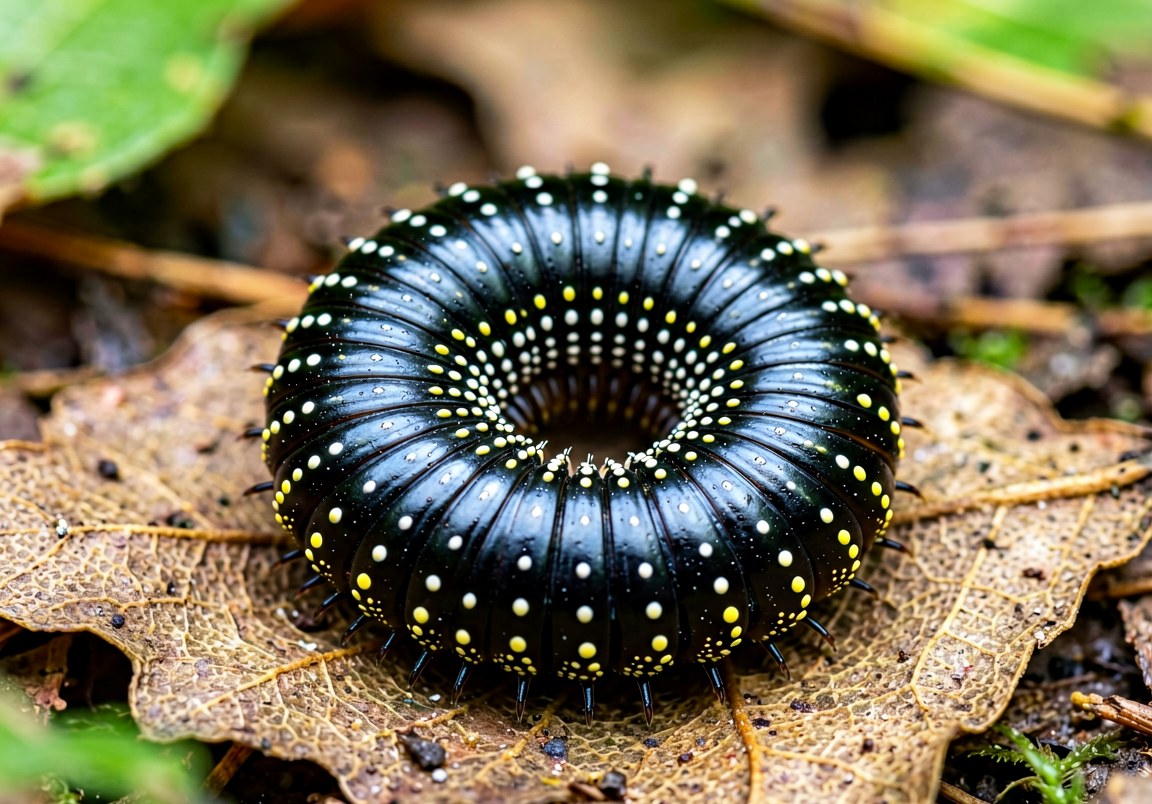
Glomeris marginata | Pill Millipede
Introduction
The Pill Millipede (Glomeris marginata) is a small, shiny, black millipede, about two centimetres long, that can roll itself into a neat little ball like a pill woodlouse. Common under stones and in leaf litter across Britain and Europe, it is easily mistaken for its crustacean cousin, but it is a true millipede, and the confusion is one of the nicer puzzles of the garden floor.
Where the pill woodlouse is an armoured crustacean, the pill millipede is a slow, plant-eating arthropod that recycles dead matter and defends itself with a bad-tasting secretion as well as with its roll. Small, glossy and retiring, it is a quiet member of the soil community and a good example of how two unrelated animals can arrive at the same solution to the problem of being small and edible.
Taxonomy
The Pill Millipede is a member of the class Diplopoda, the millipedes, and the family Glomeridae, described by the German zoologist Carl Ludwig Koch in 1844. Like the Lumbricus terrestris and other soil animals it lives among dead plant matter, but where the earthworm works below ground the pill millipede works at the surface of the litter. It is a millipede, not an insect or a crustacean, and it bears two pairs of legs on most segments rather than the single pair of a centipede.
The genus Glomeris holds a handful of round-backed, ball-rolling millipedes of the northern temperate zone, and Glomeris marginata is the commonest in European gardens. Its ability to conglobate, rolling into a ball, is shared with the pill woodlouse but evolved separately in the two groups.
Physical Characteristics
The body is a short, broad, domed tube of a dozen or so shiny black segments edged with a pale margin, and it is capped at both ends so that, when rolled, it forms a smooth, featureless sphere. Each segment carries two pairs of short legs, so a grown animal has around thirty to forty legs in total, far fewer than the long snake millipedes.
The head is small and tucked under, with short antennae and simple eyes, and the cuticle is hard and polished. Along the sides run the openings of defensive glands that can release a yellowish, pungent fluid, and the combination of rolling and smelling bad makes the pill millipede a difficult mouthful. It moves with the same rippling gait as other millipedes, but far more slowly.
Habitat
Pill Millipedes live in the litter layer and the top soil: under stones, logs, bark and dead leaves in woodland, hedgerows, gardens and parks, wherever the ground stays damp and there is decaying matter to eat. They are most active in mild, humid conditions and by night, hiding by day in the tight spaces of the litter.
They are found across Britain and temperate Europe and are common in calcareous and neutral soils, often turning up in the same places as the pill woodlouse. A mulch of leaves or a stack of logs is enough to support them, and they are a regular small resident of the garden floor.
Diet
The diet is dead and decaying plant material: fallen leaves, rotting wood and soft humus, which the pill millipede chews and passes to its microbial gut flora, returning the nutrients to the soil. It is a recycler rather than a pest, and it poses no threat to living plants worth mentioning.
In the food web it is prey for ground beetles, shrews, toads and birds. The common-toad-bufo-bufo-3 and other amphibians that forage the litter will take millipedes, and the pill millipede’s defences, rolling and secretion, are its answer to being found.
Reproduction
Mating is indirect, as in other millipedes: the male places a packet of sperm on a small silk pad and the female takes it up, then lays her eggs in the soil or in a rotting log. The young hatch as tiny, pale, few-segmented versions of the adult and add segments and leg pairs at each moult as they grow.
The species is slow to mature and may live for several years, moulting repeatedly even as an adult. The small, shiny black balls found under stones in summer are usually these millipedes at rest or in defence, and a population builds up gradually where litter and moisture persist.
Conservation
The Pill Millipede is common and of no conservation concern, and it benefits from the same leaf litter and dead wood that sustain so many soil animals. Its only real vulnerability is the loss of damp, undisturbed cover through paving, tidying and soil poisons.
Because it is a small but steady recycler and a prey item for toads and beetles, it is part of the quiet engine of the soil. Leaving leaves to rot and logs to lie keeps pill millipedes, and the recycling they perform, in good supply, and it is a neat reminder that two unrelated creatures can evolve the very same trick of rolling into a ball.
Fun Facts
- It looks like a pill woodlouse but is a millipede, with two pairs of legs on each segment rather than seven pairs.
- It can roll into a perfect little ball, a trick it evolved separately from the pill woodlouse.
- When rolled up it oozes a bad-tasting fluid from pores along its sides as extra defence.
- It is a recycler, chewing dead leaves and returning their goodness to the soil.
- The young hatch with only a few segments and add more, with more legs, at every moult.