 By st20113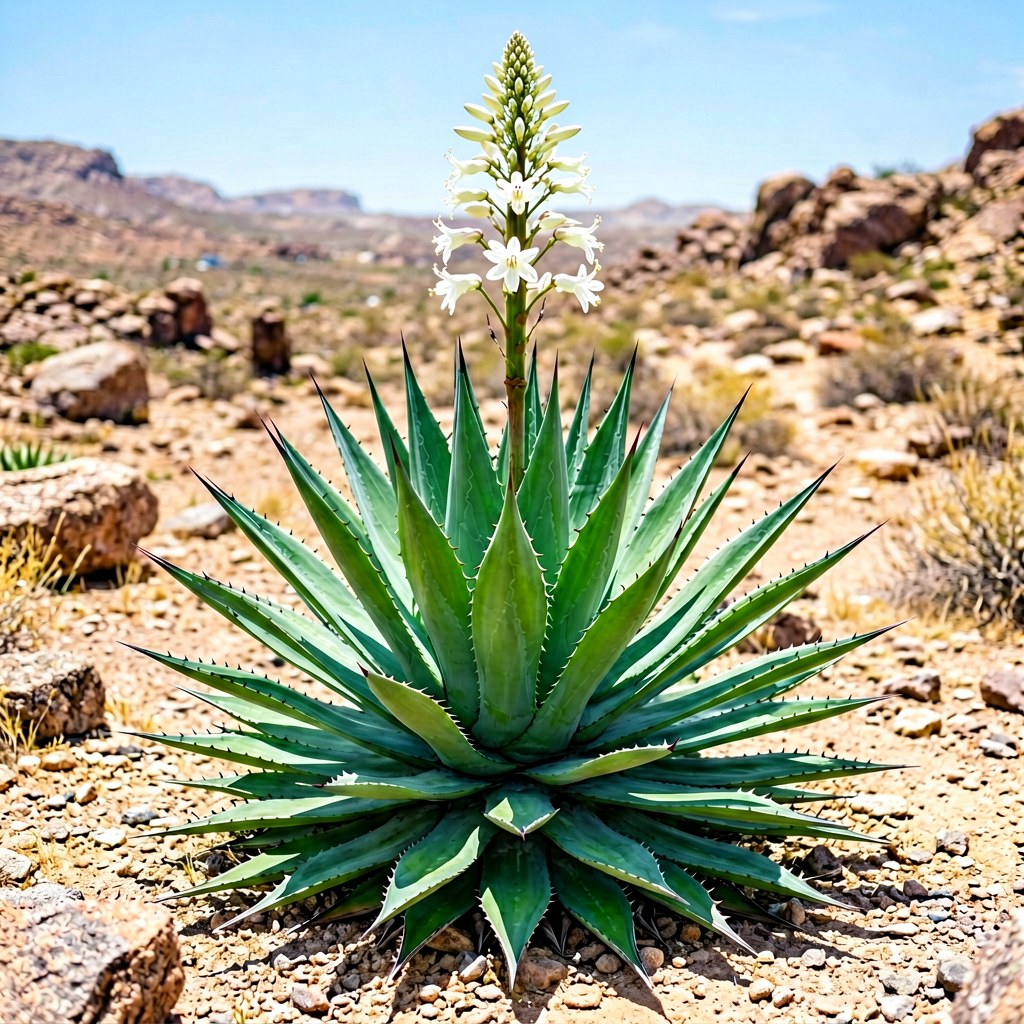
Agave americana | Century Plant
Introduction
The century plant (Agave americana) is a striking succulent renowned for its massive rosette of spiny, blue-gray leaves and for the dramatic flowering event that gives the species its common name. Despite the folklore that it blooms only once a century, a healthy plant typically flowers after ten to thirty years, then dies, having expended its entire energy reserve in a single monumental stalk. Native to arid and semi-arid regions of Mexico and the southwestern United States, it has been spread by humans across warm dry landscapes worldwide as an ornamental and a fiber and beverage crop. The genus Agave comprises more than two hundred species, many of which are similarly rosette-forming and adapted to seasonal drought. Agave americana forms colonies through underground rhizomes and basal offsets, creating bold sculptural masses in xeriscape gardens. Its architectural presence, tolerance of poor soils, and minimal water needs have made it a signature plant of Mediterranean and desert-style landscaping. Beyond decoration, the plant has sustained human communities for millennia as a source of strong leaf fibers, fermented drinks, and traditional medicines.
Taxonomy
Agave americana was described by Carl Linnaeus in 1753 in his landmark work Species Plantarum, where he established the genus name from the Greek word agavos, meaning noble or admirable, a reference to the plant’s imposing form. It belongs to the family Asparagaceae in the modern APG classification, placed in the subfamily Agavoideae, a group once treated as the separate family Agavaceae before molecular studies merged it into the broader asparagus family. The genus Agave is part of the order Asparagales and is distinguished from related genera by its succulent rosette habit, fibrous leaf margins, and monocarpic inflorescences. Close relatives include Agave tequilana, the blue agave used for tequila, and numerous desert species of the southwestern United States and Mexico. Gardeners comparing arid succulents will notice that the better-known [Saguaro Cactus](https://www.gloencyc.com/saguaro-cactus/) shares the same harsh desert ecology and a similar water-storing strategy, though it is an entirely different family of flowering plant. Modern phylogenies support Agavoideae as a cohesive clade within Asparagaceae and separate it clearly from the aloes.
Physical Characteristics
Agave americana forms a basal rosette of thirty to sixty thick, fleshy leaves that radiate from a short central crown, with each leaf measuring 1 to 2 meters long and 15 to 25 centimeters wide at the base. The leaves are glaucous blue-green to gray, edged with hooked marginal spines roughly 3 to 6 millimeters long, and tipped with a dark terminal spine that can exceed 2 centimeters. A waxy cuticle and sunken stomata reduce water loss, while the leaf interior stores water in specialized parenchyma tissue. After years of vegetative growth the plant sends up a flowering stalk 5 to 9 meters tall, sometimes branching near the top into a candelabra of yellow-green blooms. The individual flowers are tubular, about 7 to 10 centimeters long, and rich in nectar. Mature rosettes span 2 to 4 meters across and sit on a shallow, brittle root system anchored by contractile roots that pull the crown to an optimum depth. The whole plant is armed and should be sited away from footpaths where people or livestock might brush against the spines.
Habitat
In its native range Agave americana inhabits rocky slopes, scrublands, and open chaparral from central Mexico northward into Texas and scattered parts of the southwestern United States, thriving between 500 and 2500 meters elevation. It favors full sun, well-drained calcareous or volcanic soils, and a pronounced dry season that restricts competition from thirstier plants. The species is highly tolerant of drought, reflected heat from stone, and brief frosts, though prolonged freezing damages the leaves. Because it stores water in its leaves, it survives months without rain and resumes growth when moisture returns. Beyond Mexico it has naturalized across the Mediterranean, parts of Australia, South Africa, and the western United States, where it colonizes disturbed roadsides and abandoned fields. It performs poorly in humid, waterlogged ground, which invites root rot and fungal leaf spots. Ecologists note that its success tracks landscapes with hot, dry summers and mild winters similar to its homeland.
Diet
As a photosynthetic autotroph, Agave americana manufactures its own food using a specialized pathway known as crassulacean acid metabolism, or CAM, which is an adaptation to arid environments. At night, when temperatures drop and humidity rises, the plant opens its stomata and takes in carbon dioxide, converting it to malic acid stored in the leaf vacuoles; by day the stomata close to conserve water while the acid is decarboxylated and fixed by the Calvin cycle into sugars. This temporal separation of gas exchange minimizes water loss and lets the agave thrive where C3 and C4 plants would desiccate. The sugars fuel growth of the rosette and, eventually, the towering flower stalk. Mineral nutrition comes from the soil through a shallow but widespread root network that scavenges nitrogen, phosphorus, and potassium from sparse desert soils; mycorrhizal associations enhance uptake. During the long vegetative phase, carbohydrates accumulate in the central heart, which is the part harvested for traditional syrup and fermented beverages.
Reproduction
Agave americana is monocarpic and semelparous, meaning the rosette flowers once and then dies, channeling all accumulated carbohydrates into reproduction. Prior to flowering the plant produces abundant basal offsets, or pups, on underground rhizomes, so the genetic individual persists as a clonal colony even as the original rosette perishes. Sexual reproduction begins when a towering stalk emerges and bears hundreds to thousands of yellow flowers over several weeks in summer. The flowers are protandrous, with anthers maturing before stigmas, which encourages cross-pollination by bats, moths, bees, and hummingbirds that visit for nectar. In its Mexican homeland the greater long-nosed bat is a principal pollinator, though in regions lacking this bat, insects and birds fulfill the role. Each fertilized ovary develops a slender capsule containing numerous flat black seeds that disperse on wind or by gravity. This dual strategy of clonal persistence and episodic sexual reproduction suits an unpredictable desert climate.
Conservation
Agave americana is not globally threatened and is widely cultivated, yet several wild populations in Mexico face pressure from land conversion, overharvest of hearts for distilleries, and climate shifts that alter flowering phenology. The species is not listed on the IUCN Red List as threatened, but local declines have prompted nurseries and communities to promote sustainable cultivation rather than wild collection. In parts of South Africa and Australia the plant has naturalized so thoroughly that it is classed as an environmental weed, and control programs remove roadside clumps to protect native vegetation. Conservation value also attaches to its pollinators: the long-nosed bats that visit agave flowers are themselves endangered, and preserving agave stands supports bat populations across the migratory corridor. Botanical gardens maintain living collections that preserve genetic variation among Mexican ecotypes. Public education emphasizes that cultivated agaves should be sourced from responsible nurseries, not dug from wild populations, to keep wild stands intact.
Fun Facts
- Despite its name, the century plant usually blooms after only ten to thirty years, not a hundred, and the “century” label is pure folklore.
- The flowering stalk can shoot up several centimeters per day, eventually towering as high as a three-story building before opening its yellow flowers.
- Agave americana is the parent source of pulque, a fermented drink consumed in Mexico for more than two thousand years.
- The plant’s sharp terminal spine was once used by indigenous peoples as a needle, and its fibers were spun into rope and sandals.
- A close relative, Agave tequilana, is the only agave permitted for true tequila, while A. americana is used mainly for ornament and fiber.