 By st20113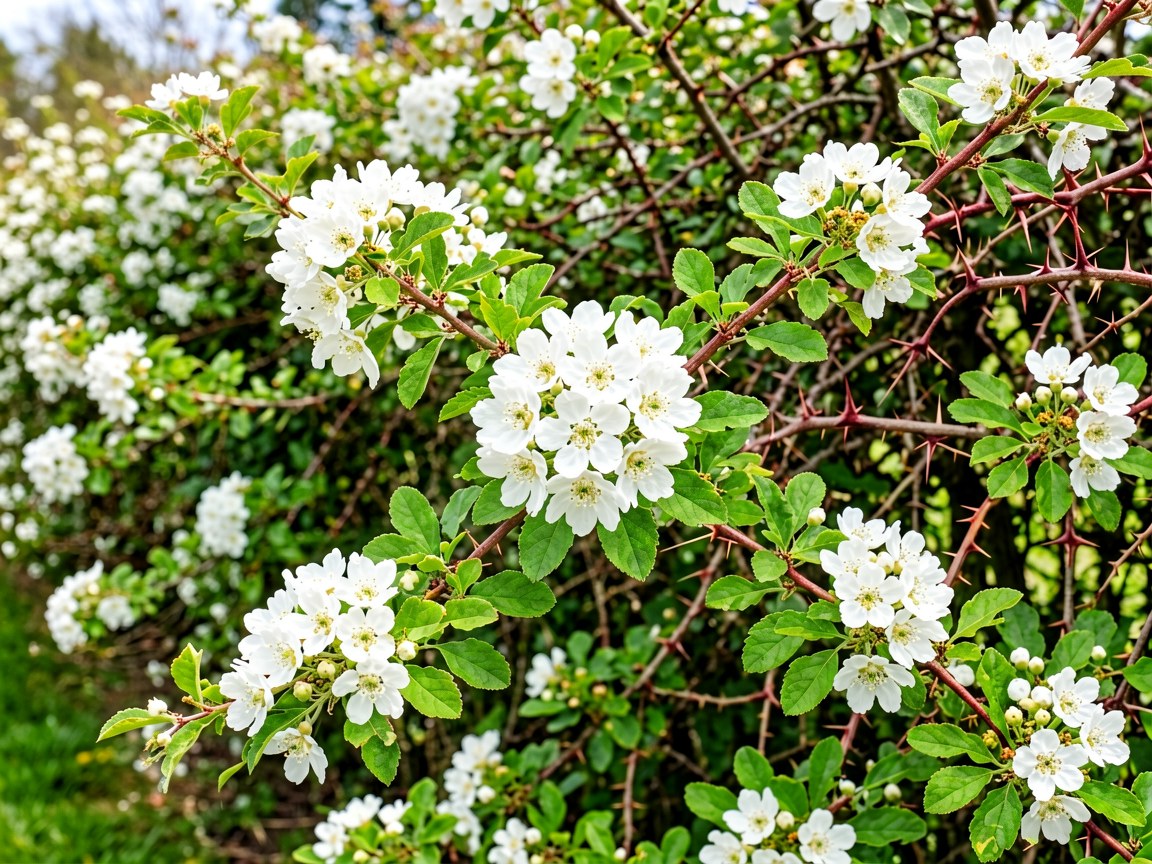
Crataegus monogyna | Hawthorn
Introduction
Hawthorn (Crataegus monogyna), known in many places simply as “may,” is a thorny deciduous shrub or small tree whose clouds of creamy-white blossom transform hedgerows every spring. Its dense, impenetrable growth has made it the classic livestock-proof hedge across Europe for centuries, while its red autumn berries feed flocks of wintering birds. Few plants are as closely woven into the farmed landscape, or into European folklore.
Taxonomy
Crataegus monogyna belongs to the family Rosaceae—the rose family—within the order Rosales, the same family that includes apples, cherries, and rowans. The genus name comes from the Greek for “strong,” referring to its hard wood, and the species name monogyna means “single-seeded,” describing the single stone inside each berry. Like all green plants it is powered by Photosynthesis, which fuels the rapid spring growth that makes it such effective hedging.
Physical Characteristics
Hawthorn usually grows 5–10 meters tall, though it is most often seen clipped into hedges. Its bark is grey-brown and fissured, and its branches bear sharp, straight thorns 1–2 cm long. The leaves are small, 2–4 cm, deeply lobed almost to the midrib. In May the tree covers itself in dense clusters of five-petaled white or faintly pink flowers with a distinctive, slightly almond scent. These give way to oval, glossy dark red berries called haws, each containing a single hard stone.
Habitat
This species is a pioneer of open, disturbed ground and is the backbone of hedgerows, scrub, woodland edges, and old pasture across Europe. It tolerates a very wide range of soils from chalk to clay, withstands exposure, wind, and drought, and responds extremely well to cutting and layering. Its adaptability is why it was chosen above all other plants to enclose fields, and why it now defines so much of the European countryside.
Diet
Hawthorn is a photosynthetic plant, producing its own food from sunlight, water, and carbon dioxide and drawing minerals from the soil. It takes nothing from other organisms. Ecologically it gives a great deal back: its May blossom is one of the richest spring nectar and pollen sources for bees, hoverflies, and beetles, and the autumn haws sustain fieldfares, redwings, and blackbirds through the winter.
Reproduction
The flowers are insect-pollinated, with flies and bees doing most of the work, and the fertilized blossoms develop into haws by late summer. Each haw holds a single seed, which is dispersed when birds eat the fruit and pass or regurgitate the stone elsewhere. Hawthorn also spreads by layering, where low branches root where they touch the ground, and it regrows vigorously from cut stumps, which is what makes a laid hedge so durable.
Conservation
Hawthorn itself is abundant, but the hedgerows it dominates have been lost at a dramatic rate through agricultural intensification, and with them the corridors that connect fragmented wildlife habitats. Conserving and restoring hedgerows—by laying rather than flailing, and by allowing hedgerow trees to mature—is one of the most effective things that can be done for farmland biodiversity. A single mature hedgerow hawthorn can support hundreds of insect species.
Fun Facts
- Its other name, “may,” comes from the May blossom that appears across the countryside each spring.
- The haws are a critical winter food for migrating fieldfares and redwings.
- Because it responds so well to cutting, it is the traditional plant of “laid” hedges that can last for centuries.
- A mature hawthorn can support more than 300 species of associated insects.
- Folklore holds that bringing hawthorn blossom indoors brings bad luck—one of many superstitions attached to this tree.