 By st20113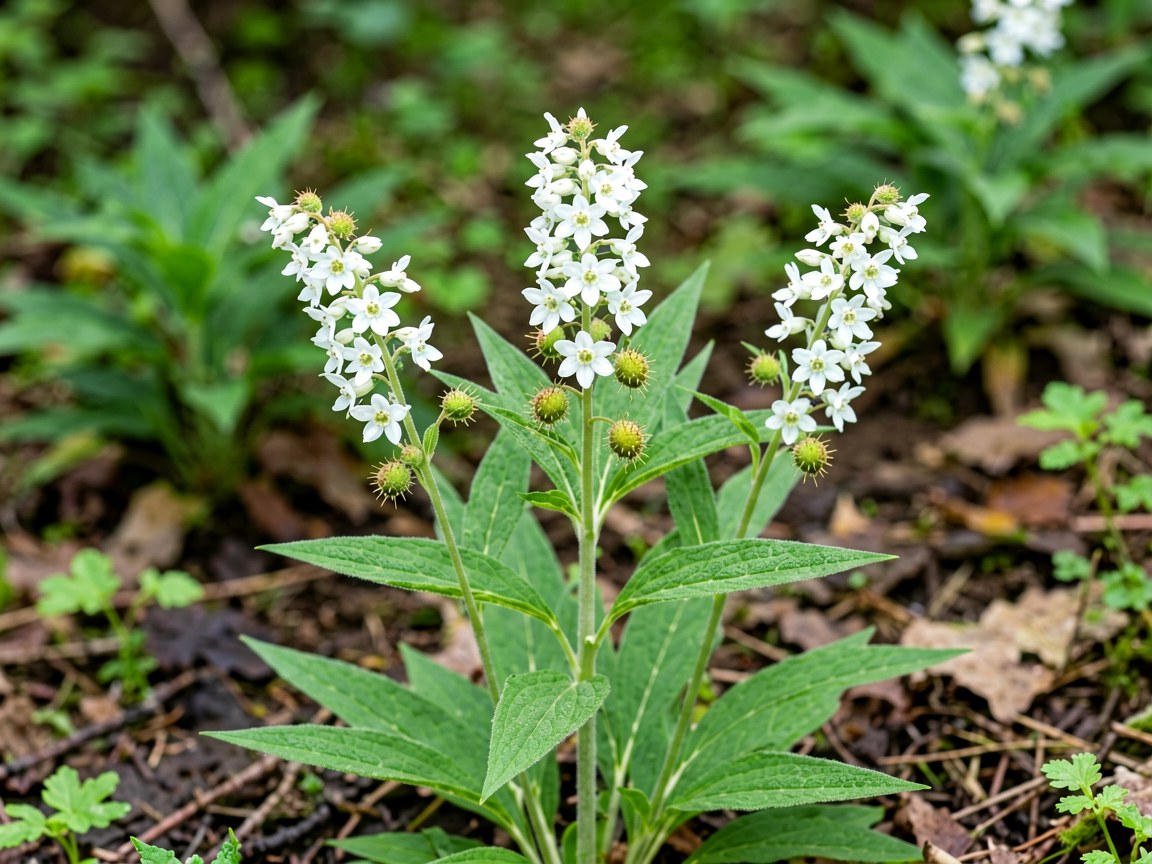
Circaea lutetiana | Enchanter’s Nightshade
Introduction
Circaea lutetiana, the enchanter’s nightshade, is a slender, rather inconspicuous perennial of the evening-primrose family (Onagraceae) that grows in the cool, damp shade of woodland, hedgerows and other sheltered, shady places across Europe and western Asia. It is a plant of two metres at most, more often half that, with a pair of opposite, pointed, softly hairy leaves and loose spikes of small, two-petalled white flowers that open in summer, followed by distinctive burr-like fruits covered in hooked bristles. Despite the name “nightshade” it is not poisonous and has nothing to do with the true nightshades of the potato family; the common name comes instead from the resemblance of the round fruit to that of black nightshade and from an old association with Circe, the enchantress of classical myth, whose name the genus honours. It is one of two common enchanter’s nightshades in Europe, the other being the smaller, more slender Circaea alpina of wetter, more northern woods. Like all green plants it lives by the process of Photosynthesis, drawing energy from shade-filtered light to build the leaves and roots that let it persist and spread in the gloom.
Taxonomy
Enchanter’s nightshade belongs to Circaea, a small genus of perhaps half a dozen species in the family Onagraceae, the evening-primrose family, which also includes willowherbs, fuchsias and evening primroses. The genus is confined to the Northern Hemisphere, with species in the cool woods of Europe, Asia and North America, and several of them hybridise where their ranges meet. The specific epithet lutetiana means “of Lutetia,” the Roman name for Paris, reflecting the plant’s long familiarity to European botanists. The most likely confusion is with Circaea alpina, which is smaller in all its parts, has hairless or nearly hairless leaves, and favours damper, more northerly woodland; the two sometimes grow together and produce the intermediate hybrid Circaea × intermedia. Within Onagraceae the enchanter’s nightshades are set apart by their paired, rounded, burr-like fruits and their two-petalled flowers, quite unlike the four-petalled blossoms of the willowherbs. The genus name is a direct nod to Circe, the sorceress who in the Odyssey turned men into swine, an allusion to the plant’s reputed magical or pharmaceutical use in earlier times.
Physical Characteristics
The plant is a hairless to softly hairy perennial, usually thirty to eighty centimetres tall, with a slender, often reddish, loosely branched stem that is slightly squared or winged near the nodes. The leaves are opposite, pointed oval to heart-shaped, four to ten centimetres long, with a distinctly toothed margin and a short stalk, thin and softly hairy, a fresh medium green above and paler beneath, and arranged in pairs up the stem. The flowers are small, about four to six millimetres across, with two white, deeply notched petals and two small sepals, carried in loose, one-sided, leafy spikes at the top of the stem and in the upper leaf axils from early summer into late summer. Each flower has two stamens and a single style, and is faintly scented. The fruit is the give-away feature: a small, downward-curving, pear-shaped or rounded capsule, about three to four millimetres long, covered in rows of hooked bristles that catch readily on animal fur and human clothing. The roots are slender and creeping, sending out underground runners that give rise to new shoots some distance away.
Habitat
Enchanter’s nightshade is a plant of shade and moisture, and it is above all a woodland species, favouring the deep, humus-rich, neutral to slightly acid soils of deciduous and mixed woods, especially under ash, elm and oak where the canopy is not too dense. It also grows in tall hedgerows, the margins of copses, on shaded banks, in lush roadside verges and in other sheltered, semi-natural places that escape summer drought. It is shade-tolerant to a remarkable degree, able to keep growing and even flower in the dim light beneath a closed canopy where few other flowering plants can, and it is often one of the few herbs in flower in dense woodland in high summer. Across its European range it follows damp lowland and upland woods and is absent from the driest and most exposed habitats; it extends eastwards into western and central Asia and has been introduced to North America, where it is naturalised in shady places. It indicates, in a quiet way, ground that has not been ploughed or heavily grazed, and it is a useful indicator of ancient, continuous woodland cover.
Diet
As a green plant it feeds itself, taking carbon dioxide from the air and water and minerals from the soil and using sunlight to build sugars through photosynthesis; it asks nothing of other living things for its own nutrition. Its flowers, though small, produce nectar and pollen and are visited by a range of small insects, especially solitary bees, hoverflies and minute flies that can reach the accessible, open blooms. The petals are white and the flowers are held clear of the foliage, making them visible in shade to the short-tongued insects that pollinate them. The leaves are eaten by the caterpillars of a few moth species and by various sap-sucking and chewing invertebrates, and the foliage, being soft and moisture-rich, is sometimes taken by slugs and snails in damp summers. The plant is not known to be grazed heavily by mammals, and its shade habitat protects it from most browsing; deer and rabbits generally pass it by in favour of more nutritious, sunlit plants.
Reproduction
Enchanter’s nightshade reproduces both by seed and by vegetative spread, and in practice the latter is the more important means of increase. The flowers are insect-pollinated, and once fertilised each produces the characteristic burr-like fruit armed with hooked bristles. These bristles are a dispersal device: the fruits stick to the fur of passing mammals and to the feathers of ground-feeding birds, and to the clothing of people walking through woodland, so the seed is carried well away from the parent. The seed itself is a small, single, hard nutlet that can lie dormant in the soil for some time before germinating in disturbed, moist ground. Vegetative spread is achieved by slender, creeping underground stems, or rhizomes, that run just below the surface and throw up new shoots a short distance from the original plant, gradually building a loose colony. Because the rhizomes persist and the seed bank is long-lived, the plant is tenacious once established and can persist in a wood for decades, spreading slowly through the shaded leaf litter.
Conservation
Within its native European range enchanter’s nightshade is common and secure, and it is assessed as a species of least concern across most of its distribution. Its main vulnerability is the loss and fragmentation of broadleaved woodland, the drainage and conversion of damp shady ground, and the “tidying” of hedgerows and rides that removes the scrubby, half-shaded margins it favours. Because it spreads mainly by rhizome and is slow to colonise new sites, it does not recover quickly when a wood is felled or a hedgerow is grubbed out, even though it may persist for years as dormant rhizomes and seed. It benefits from sensitive woodland management that retains a continuity of canopy and a well-developed shrub and field layer, and from the omission of intensive grazing in damp woods. It is not legally protected in most countries, but it is one of the species used by ecologists as an indicator of ancient woodland, so its presence carries a quiet conservation signal about the history of a site.
Fun Facts
- The genus is named after Circe, the enchantress of Greek myth, a reference to a supposed use of the plant in love potions and charms.
- It is not a true nightshade and is not poisonous, despite the misleading common name.
- The fruit is a small burr covered in tiny hooks that stick to clothing and animal fur, a clever ride for the seed.
- It can flower and set seed in surprisingly deep woodland shade where most other wildflowers cannot.
- Because it spreads by creeping underground stems, a single plant can slowly form a colony over many years without ever seeding much at all.