 By st20113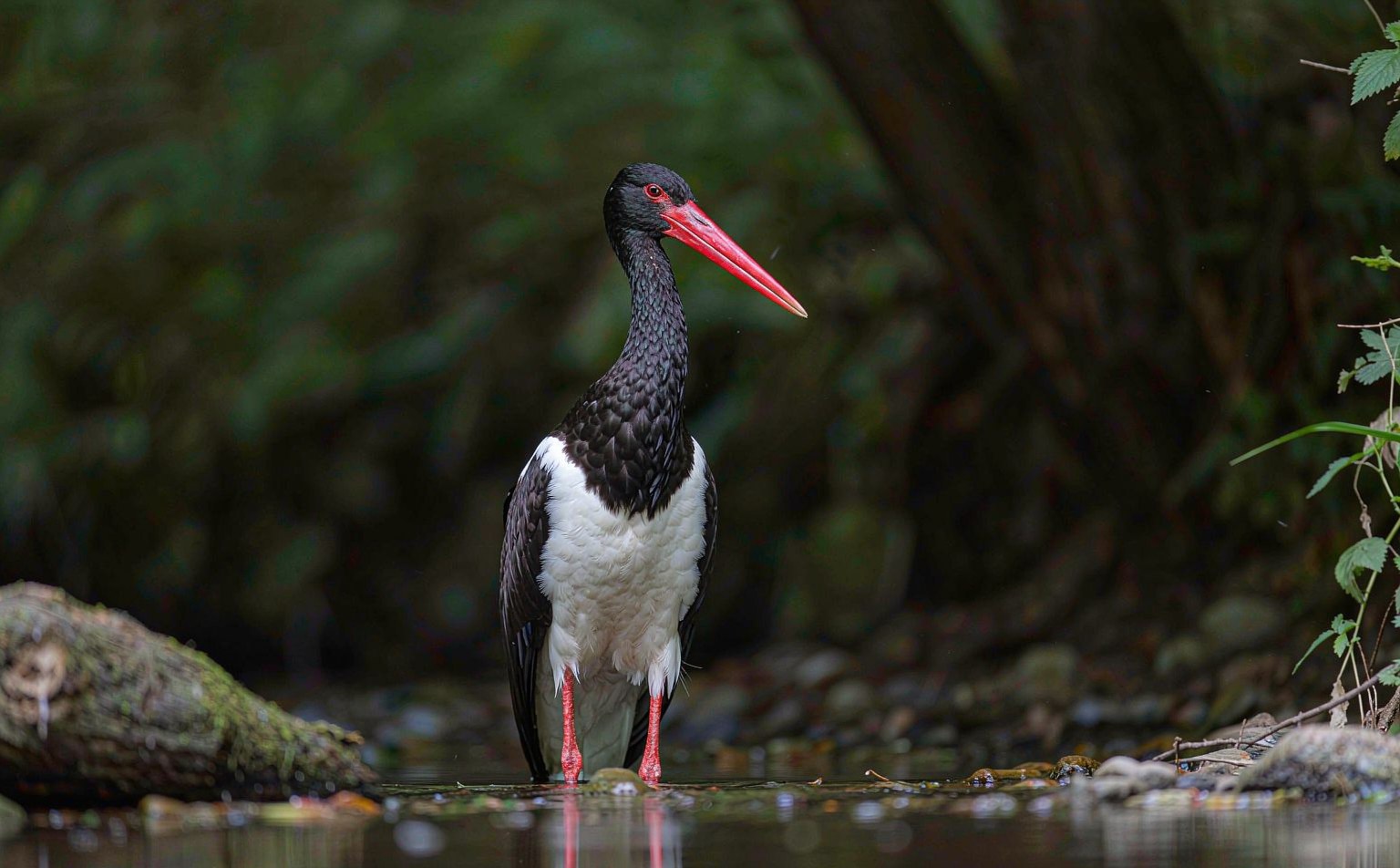
Ciconia nigra | Black Stork
Introduction
The black stork, Ciconia nigra, is a large, striking wading bird of undisturbed wetland and forest across the Iberian Peninsula, central and eastern Europe, and temperate Asia. Glossy black above with a brilliant white belly and red bill and legs, it is far more secretive than its familiar relative the white stork, nesting in tall trees in remote woodland and shunning human settlements. Its shyness and reliance on wild habitat make it a symbol of pristine wetland and forest mosaics.
Though less numerous and far less visible than the white stork, the black stork occupies a remarkably wide range and undertakes one of the most remarkable migrations of any European bird.
Taxonomy
Ciconia nigra was described by Carl Linnaeus in 1758. It belongs to the family Ciconiidae and the genus Ciconia, which also includes the White Stork. The two species share the same general form but differ sharply in colour and tolerance of people, the black stork being the forest-dwelling, solitary counterpart.
Physical Characteristics
The black stork stands 95–110 cm tall with a wingspan of 145–165 cm and a weight of 2.3–3.2 kg. Adults are unmistakable: iridescent black plumage with green and purple sheen on the upperparts, a pure white belly and undertail, and vivid red bill and legs. The eye is dark with a red orbital ring. In flight the contrast of black wings and white belly is striking, and the long neck and legs are fully extended.
Juveniles are duller, with brownish-black plumage and greyish-green legs and bill that gradually redden with age. Both sexes are alike. The bird’s silent nature — it rarely vocalises except at the nest — adds to its elusive reputation.
Habitat
Black storks favour large tracts of mature forest interspersed with shallow wetlands, rivers, lakes, marshes, and floodplain meadows. They require old trees with sturdy branches for nesting, and quiet, fish-rich waters within a few kilometres for feeding. Human disturbance is poorly tolerated, so they avoid cultivated lowlands and settled areas.
The species is migratory across most of its range, wintering in sub-Saharan Africa, the Indian subcontinent, and southeast Asia. Stopover sites with safe roosting and abundant prey are critical to the success of these long journeys.
Diet
The diet is dominated by fish, particularly small to medium species of clear, shallow water, supplemented by amphibians, reptiles, crustaceans, insects, and occasionally small mammals and birds. Black storks forage by slow wading and precise stabbing, often in shaded forest pools where fish are concentrated. They prefer unpolluted water with good visibility, making them sensitive to habitat degradation.
Unlike the white stork’s broad opportunistic feeding, the black stork is more specialised, selecting clean, productive wetlands. This dietary reliance underscores its role as an indicator of healthy aquatic ecosystems.
Reproduction
Breeding occurs in spring in the northern parts of the range. The nest is a large structure of sticks built high in a mature tree, sometimes on cliffs, and is reused and enlarged across years. The female lays three to five white eggs, incubated by both parents for about five weeks. The chicks are fed by regurgitation and fledge after roughly two months.
Both adults share nesting duties, and the pair is generally monogamous for the season. The remoteness of nest sites helps shield young from predators, though deforestation and recreation near breeding areas can cause abandonment.
Conservation
The black stork is listed as Least Concern globally but is considered threatened or near-threatened in parts of Europe, where wetland loss, forest fragmentation, and disturbance have reduced breeding populations. Key European strongholds include Spain, Poland, and the Balkans, supported by protected forests and wetland reserves.
Conservation centres on safeguarding extensive forested wetlands, restricting development near nest sites, and protecting international migration corridors and African wintering grounds. Because the species needs both wild forest and clean water, its recovery is a strong measure of overall wetland and woodland health.
Fun Facts
- The black stork is almost silent, unlike the noisy, bill-clattering white stork.
- Its red bill and legs contrast vividly with glossy black plumage.
- It nests in remote forest trees and actively avoids human settlements.
- Some individuals migrate thousands of kilometres to winter in sub-Saharan Africa.
- It serves as a living indicator of clean, unpolluted wetland ecosystems.