 By st20113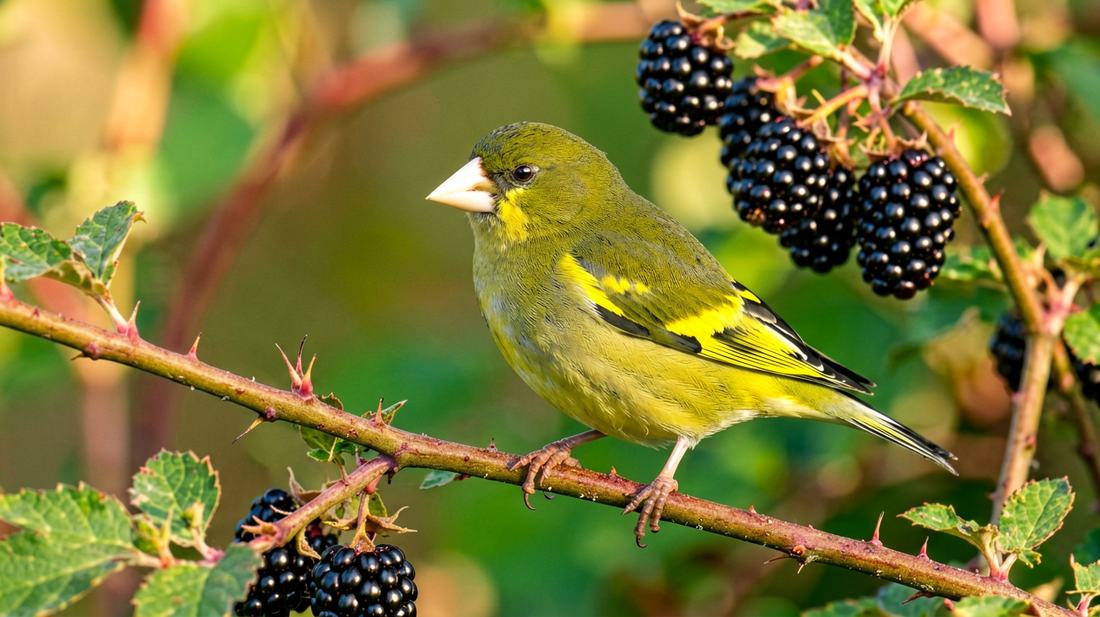
Chloris chloris | European Greenfinch
Species Profile · Fringillidae
European Greenfinch
A chunky, olive-green seed cracker of gardens and farmland, whose British numbers fell by about a third after a feeder-borne disease took hold.
IUCN: Least Concern
Range
Length
Weight
Broods
UK trend
The garden seed eater
Bold, bright and plentiful
The European greenfinch is a chunky, thick-set finch. It is a member of the finch family. It is one of the best-known garden and farm birds of Europe. It is easy to see why people like it. The bird is large and bright. It is tame. It has a loud, musical twittering song. It sings from a tall tree or a television aerial. It also sings from the top shoot of a conifer. It comes quickly to a bird table for sunflower hearts and peanuts. Bird keepers once crossed the greenfinch with the canary. The cross gave a fertile hybrid.
The hybrid was prized for its song. The adult male is an olive-green bird. He has a bright yellow patch on the edge of the wing. A yellow flash shows on the outer tail feathers. His bill is heavy, pale and shaped like a cone. The female is a duller, greyer green with a brown wash. Her flanks are streaked. The young bird is streaked and brown. It looks little like its parents until it moults. The species is a seed eater of the most committed kind. Its bill is strong. Its gut is short and muscular.
Together they let it shell and digest the seeds of many plants. The most important are the sunflower and the rose. Others are the knapweed, the dandelion, the charlock and the oilseed rape. The nettle matters too. The bird also eats the seeds of many garden shrubs and trees. It is well suited to the yearly seed crop of gardens and allotments. It does just as well on waste ground and farmland. So it has been able to live beside people in almost every part of Europe. It manages from the middle of a city to the middle of a bare arable field. In recent years it has become one of the clearest cases of a common bird cut down by an infectious disease. That disease is spread at the very feeding stations that people put out for it.
Family tree
Chloris, out of Carduelis
The European greenfinch sits in the genus Chloris. This is a small group of 3 to 6 species of green and grey finches. They live through Europe, North Africa, the Middle East and Central Asia. The bird belongs with the chaffinches, the serins, the siskins and the linnets. It also belongs with the redpolls, the bullfinches and the goldfinches. Together they make up the subfamily Carduelinae of the finch family. That is a large group that mostly eats seeds. Its members share a strong bill shaped like a cone. They feed their young on a soup of seeds rather than on insects.
They also tend to roam in flocks outside the breeding season. The greenfinch was long placed in the genus Carduelis. The goldfinch, the siskin, the linnet and the redpoll were in there too. That genus was later taken apart on the basis of molecular evidence. This was one of the bigger changes in the modern naming of finches. Birds that had been grouped for a similar bill and a similar diet turned out to fall into several clear lines. The greenfinch is now thought to be closer to the desert finches and to the trumpeter finch. It is less close to the goldfinch, with which it was once grouped. The link with the goldfinch, Carduelis carduelis, is still a useful comparison.
The 2 species often share the same gardens and the same weedy fields. They split the seed crop between them. The goldfinch has a slender bill. It takes the small seeds of the thistle and the teasel from the seed head. The greenfinch has a heavy bill. It takes the larger, harder seeds of the sunflower, the rose and the knapweed. The gap between the 2 bills shows how the feeding gear decides what a finch can eat.
A bill made for sunflower seeds
How to identify one
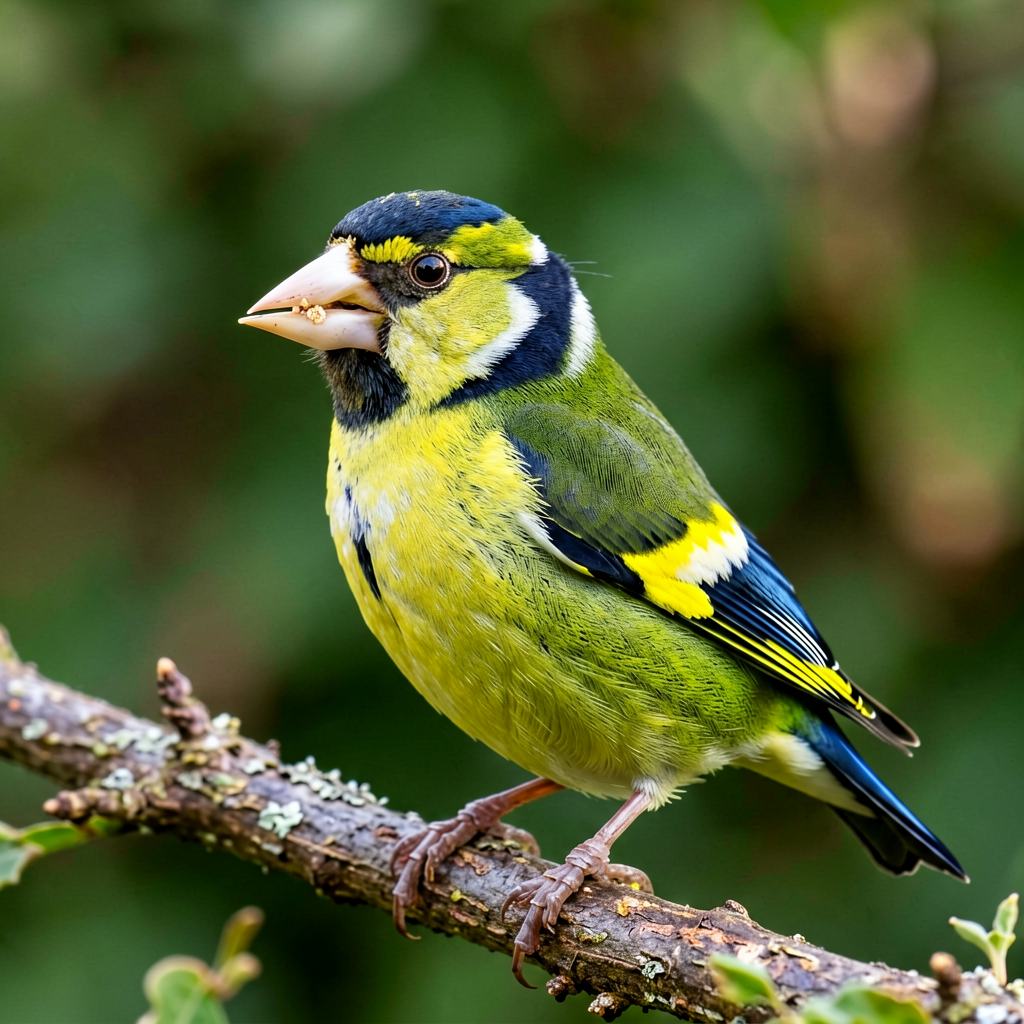
The European greenfinch is a stout finch with a broad chest and a short tail. It is between 14.5 and 16 centimetres long. Its wingspan is between 24 and 28 centimetres. Its body mass is about 25 to 32 grams. Its heavy, pale, cone-shaped bill is between 11 and 13 millimetres long. Its depth is more than half its length. The bill and the strong muscles that close it let the bird crack a sunflower seed in one movement. The bird can also deal with the small hard seeds of the rose and the hawthorn. Most other garden birds cannot. The adult male in breeding plumage is a fine bird. His head, mantle, back and breast are a rich olive-green. The colour turns brighter and more yellow on the rump and the upper tail coverts.
A grey wash covers the ear coverts and the sides of the neck. A bright yellow patch sits on the edge of the wing. It is made by the outer webs of the primaries and the yellow edges of some coverts. The outer tail feathers have a yellow base. The belly is a pale greyish-white. The bill is pale horn or pinkish. The legs are pale pinkish brown and the iris is dark brown. The female is duller and greyer than the male. An olive-green wash mixes with brown on her upper parts. Faint dark streaks mark the mantle and the flanks. Her yellow wing patch is much less clear. The first-year male does not gain the full adult plumage until his first winter moult.
So sexing birds at a bird table in autumn depends on small differences of colour. Those differences are easily misjudged. The young bird is a heavily streaked brown bird. It has a faint yellow edge to the wing feathers and a dark bill. It can be told apart from the similar young linnet and siskin. The greenfinch has a heavier bill and broader, darker streaks below. It also has yellow in the wing, and it is larger. The flight is bouncy and undulating, with the wings half closed between beats. The bird is often seen in small flocks. They twist and turn in the air above a weedy field. Then they drop down onto the seed heads.
1
2
3
Gardens, weedy fields and farmland
Where it lives
The European greenfinch is a bird of open woodland and woodland edge. It also lives in farmland and hedgerow. It uses scrub, orchard, garden, allotment, park and churchyard. Waste ground suits it too. It is a species of the mix of trees, bushes and open ground that is full of seed. That mix is made by human land use. It is not a bird of the closed forest. It needs tall song posts and nesting trees. It also needs the weedy ground on which it feeds. The species is found all through Europe, from the Mediterranean to the north of Scandinavia.
It ranges from the Atlantic to the Urals and beyond. It lives in the mountains of North Africa and in the Middle East and Central Asia. Other populations are now settled in New Zealand and Australia. They also live in Uruguay, in Argentina and in parts of southern South America. Settlers released the bird in the 19th century. They wanted the new country to sound like the old one. In Britain the species is a common resident of lowland England and Wales. It is also common in southern Scotland. It is scarcer in the north and west and in the uplands. Its numbers depend on weed seeds in autumn and winter.
They also depend on the food put out in gardens. The species has become more urban over the last few decades. It has also become more tied to feeders. That is because the weeds of farmland have been removed with herbicide. The bird is largely resident in the milder parts of its range. The northern and eastern populations move south and west in winter. In some years Britain gets a large influx of greenfinches from the continent in autumn. That is why the count at a garden feeder may jump in November.
Seeds, then insects
What it eats
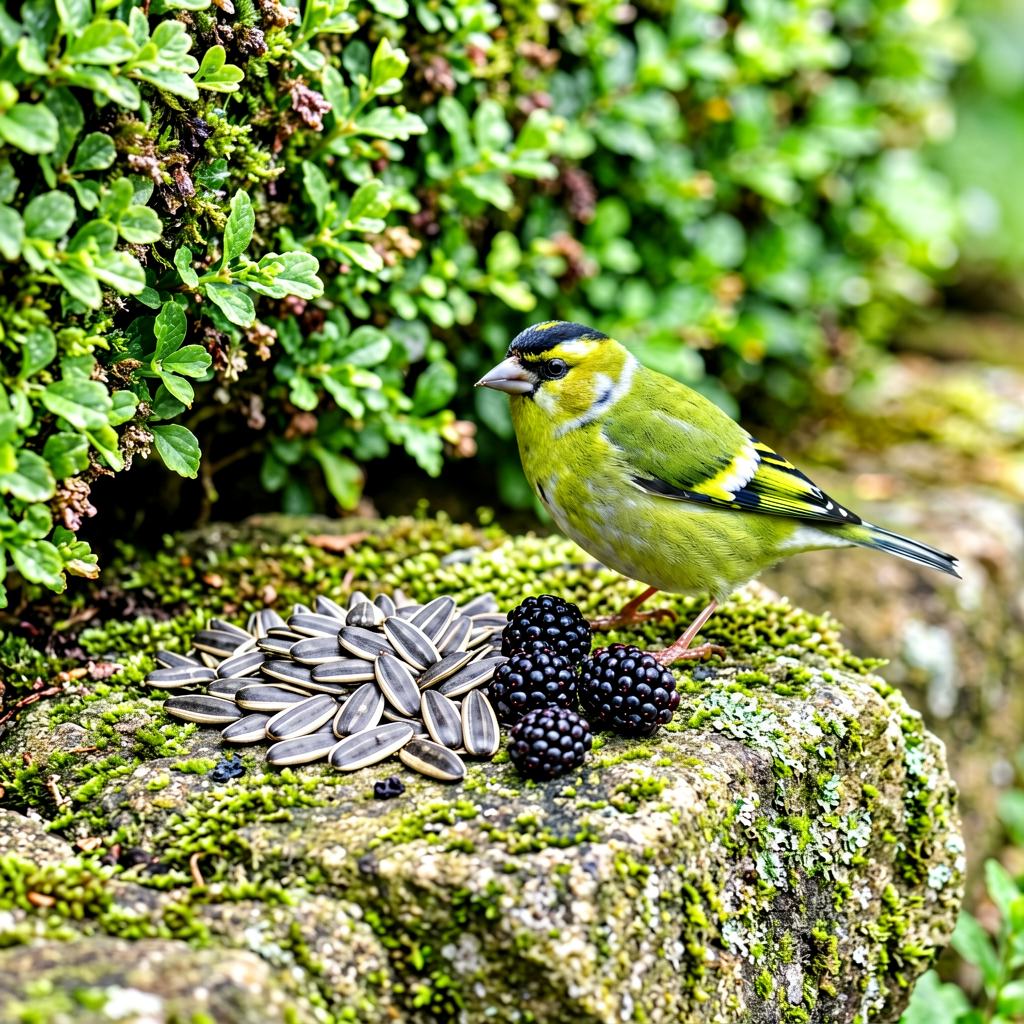
The European greenfinch is above all a seed eater. Its seeds include the achenes of the sunflower and of the knapweed. It eats the seeds of the dandelion, the thistle, the teasel and the burdock. It takes the seeds of the charlock, the turnip and the oilseed rape. It eats the other crucifers of farmland as well. It takes the seeds of the nettle, the fat hen and the chickweed. Those are the weeds of gardens and waste ground. It eats the seeds of grasses and of cereals. It also takes the small hard achenes of the rose and the hawthorn.
It eats the buds, shoots and young leaves of a good many trees and shrubs. It takes much of its food from the ground. There it feeds on seeds that have fallen onto bare earth and tracks. It also uses the edges of fields. It now leans more and more on the sunflower hearts, peanuts, black sunflower seeds and nyjer put out in garden feeders. That habit has greatly raised its numbers in towns and suburbs. It has also had a serious result for the health of the population. In the breeding season the birds add a number of insects to the diet. The adults take aphids, caterpillars and small beetles when they feed the young.
The young are fed for the first few days on a soup of part-digested seeds. The parents bring it back up into their throats. That is the way of the whole finch family. It lets them raise a brood on a diet that a newly hatched chick could not otherwise use. The species is a strong and aggressive feeder at a bird table. It will push aside most other small birds at a hanging feeder. It is also a regular visitor to the flower heads of the sunflower and the rose in a garden. There it does a fair amount of damage before the seed crop has ripened.
A cup in a dense bush
The breeding cycle
The European greenfinch pairs for life. It usually raises 2 broods in a season and sometimes 3. The breeding season begins in April and may run into August. In early spring the male puts on a striking display flight. He circles slowly above his territory on stiffly vibrating wings while he sings. The flight is often called bat-like, because the wing beat is so slow. The nest is a neat, solid cup of grass, moss, plant stems and rootlets. Twigs go into it too. It is lined with hair, wool, feathers and fine rootlets.
It is placed in a dense bush, a hedge, a conifer or an ivy-covered wall. A climbing rose or a hanging basket will do as well. The site is usually between 1 and 3 metres above the ground. Both birds help to build it. The clutch holds between 4 and 6 eggs, sometimes 7. They are laid in late April or in May. The female sits on them alone for between 12 and 15 days. The male brings her food while she sits. The young are fed by both parents on the seed soup and on insects.
They leave the nest at between 13 and 16 days of age. The female often starts a second clutch while the male is still feeding the first brood. The family groups join the loose flocks that form in autumn. Those flocks may gather in large numbers at a good patch of weed seed. A garden feeder will draw them as well. Ringing records show that a bird may live for 5 years and now and then for more than 10. Many young birds die in their first year, and the population is very quick to suffer from disease.
The feeder that spread a disease
Conservation
The European greenfinch is listed as Least Concern on the global Red List. Its world population is counted in tens of millions of pairs. So the species as a whole is in no danger. Yet its recent history in Britain and in parts of northern Europe is a warning. It shows how fast the fate of a common bird can turn. The greenfinch was one of the commonest garden birds of Britain until 2005. Then a wave of a tiny parasite, Trichomonas gallinae, broke out in the population. It began to spread through the very feeding stations that had helped to make the species so numerous. It killed large numbers of birds.
The disease blocks the throat and the crop. It passes on dirty food, water and surfaces. The British population fell by about a third within a few years. There are signs of a comeback in some areas. But the bird has not returned to its old numbers. The lesson of the outbreak is plain. Extra food can crowd birds together at levels far above the wild norm. That sets up the fast spread of disease. Research has produced some plain advice.
Clean feeders on a regular basis. Do not let food pile up on the ground below them. Use a number of small feeders rather than one big one. And stop feeding for a fortnight if you see a sick bird with a swollen throat. On top of the disease, the species has lost the weedy stubbles and rough margins of farmland that once gave it winter food. Its future depends on keeping a supply of seed in the countryside. It also depends on the care with which the birds are fed in gardens.
Quick hits
Five things to remember
- The greenfinch is one of the few birds whose numbers were cut by a disease, trichomonosis, that is spread above all at garden feeders. The British population fell by about a third after the outbreak began in 2005.
- It was long placed in the same genus as the goldfinch. Molecular work showed that the 2 are not close kin at all, and the greenfinch now sits in the genus Chloris.
- Greenfinches were taken to New Zealand, Australia and South America by 19th-century settlers who wanted the new country to sound like the old one. They are now settled there.
- The male puts on a slow, bat-like display flight above the nesting territory. He circles on stiffly vibrating wings while he sings.
- The young are not fed on insects or whole seeds. They take a soup of part-digested seeds that the parents bring back up into their throats, a habit that is the way of the whole finch family.