 By Iris
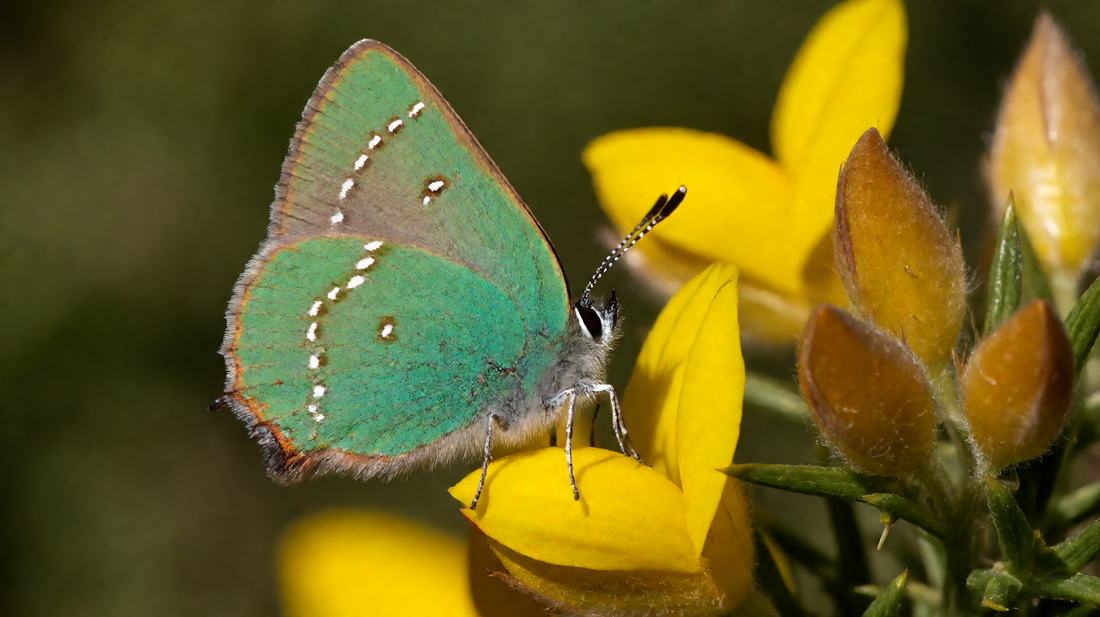
Callophrys rubi | Green Hairstreak
Species Profile · Lycaenidae
Green Hairstreak
The only truly green butterfly in Europe — a spring insect whose wings are coloured by the structure of their scales rather than by any pigment.
Declining in the lowlands
Range
Wingspan
Colour
Flight
Pupa
The only green butterfly
A leaf that flies in spring
The Green Hairstreak is the only truly green butterfly in Europe. It is small and easy to overlook, but once it is found it cannot be mistaken. The wingspan is only 26 to 34 mm. The underside of the wings is a bright emerald green. The colour shifts as the light moves across it.
One fine line of white dots breaks the green into small panels. The upper side is a plain dark brown, and almost nobody sees it. The butterfly nearly always rests with its wings closed. In that pose it looks like a small green leaf. The white line hides the outline, because it looks like the vein of a leaf.
This is a butterfly of spring. It comes out in April and is gone by the end of June. In the north it is one of the first butterflies of the year. It lives across most of Europe and much of Asia, and it reaches north Africa. Heathland, scrub and old railway cuttings all suit it.
Family tree
Lycaenidae, the blues and coppers
The Green Hairstreak sits in the family Lycaenidae. That family holds the blues and the coppers. Its genus is Callophrys. Linnaeus named it in 1758, and he placed it in the old genus Papilio. The family is very large. It holds about 6000 species, so it is the second largest family of butterflies in the world. Its members are small, and most of them are blue, copper or brown above. Nearly all of them share 2 habits.
The young feed on the flowers and buds of plants, and they do not feed on the leaves. They also have special glands. Those glands make a sweet liquid, and ants come to drink it. The ants guard the young in return, and this partnership has a name of its own. The Green Hairstreak shares the habit with the blue butterflies. Its link with ants is weaker, though. The genus Callophrys holds small butterflies. Most of them have short tails or none at all.
The green of this species is unusual for the family. Its genus name comes from the Greek for beautiful eyebrows. The species name refers to the bramble, which the young will eat. The Green Hairstreak shares its family with the Common Blue. That species is blue above and grey beneath. It leans on ants far more. Both sit in the same family, and both feed their young on flowers.
Green beneath, brown above
How to tell one
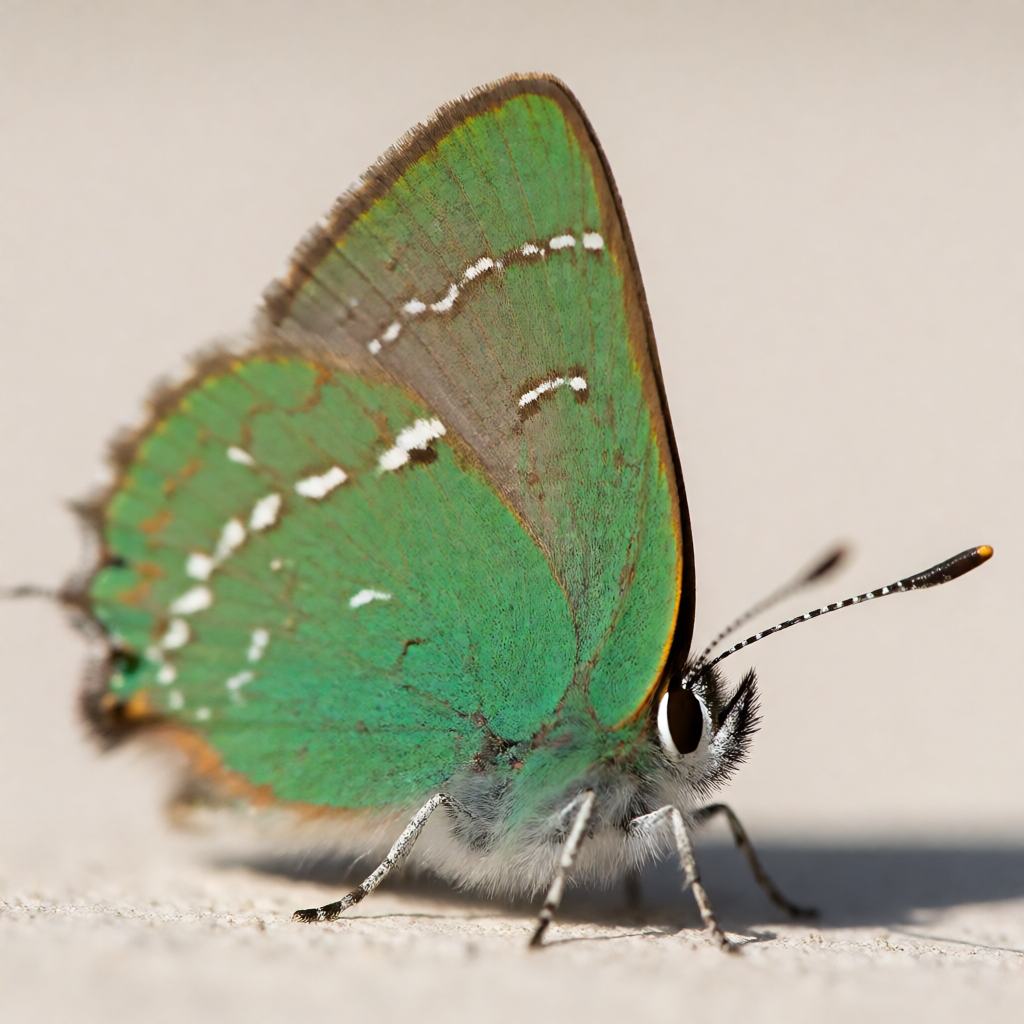
The adult has a wingspan of 26 to 34 mm. That makes it one of the smaller European butterflies. The upper surface is a plain dark brown with a faint olive tint. The male has no blue in his wings at all. The underside is the part that matters. It is a bright emerald green, and the colour is not a pigment. It comes from tiny ridges on the scales. Those ridges bend the light.
This kind of colour is called structural colour. The same trick gives a blue butterfly its shine. The colour comes from structure, not from pigment. So it moves with the angle of the light, and it never fades. A fine broken line of white dots runs across the green. On the hindwing the line may form a small W shape. A few small dark spots sit near the edge of the hindwing. Each spot has a pale ring, so it looks like an eye.
Those spots may draw a hungry bird away from the body. The body is furry and greenish. The antennae are dark with pale rings, and the legs are banded in white and black. The young is green and shaped like a slug. It has no visible legs, and it carries fine pale bristles. The pupa is small, brown and rounded, and it rests on the ground.
1
2
3
Heath, scrub and old cuttings
Where it lives
The Green Hairstreak lives in open and half-open places. It does best where several kinds of low plant grow together. Heathland, bog edges, chalk downland and scrubby grass all suit it. It also uses old railway lines and the sunny sides of hedges. In the mountains of central Europe it climbs to about 2500 metres. There it is a butterfly of the alpine scrub.
Its needs are simple. It wants warmth and low bushes. It also wants a good scatter of the plants its young will eat. It does not travel far. It spends most of its life near the place where it hatched. The butterfly often sits on the top of a small bush, or on a stem in the sun.
From there it makes short flights to drive intruders away. It is small and green, so the best way to find it is to watch for a green flicker. A resting insect is very hard to see. The species has become scarce in parts of western Europe. The main reason is the loss of rough ground and low scrub.
Nectar, and an unfussy larva
What it eats
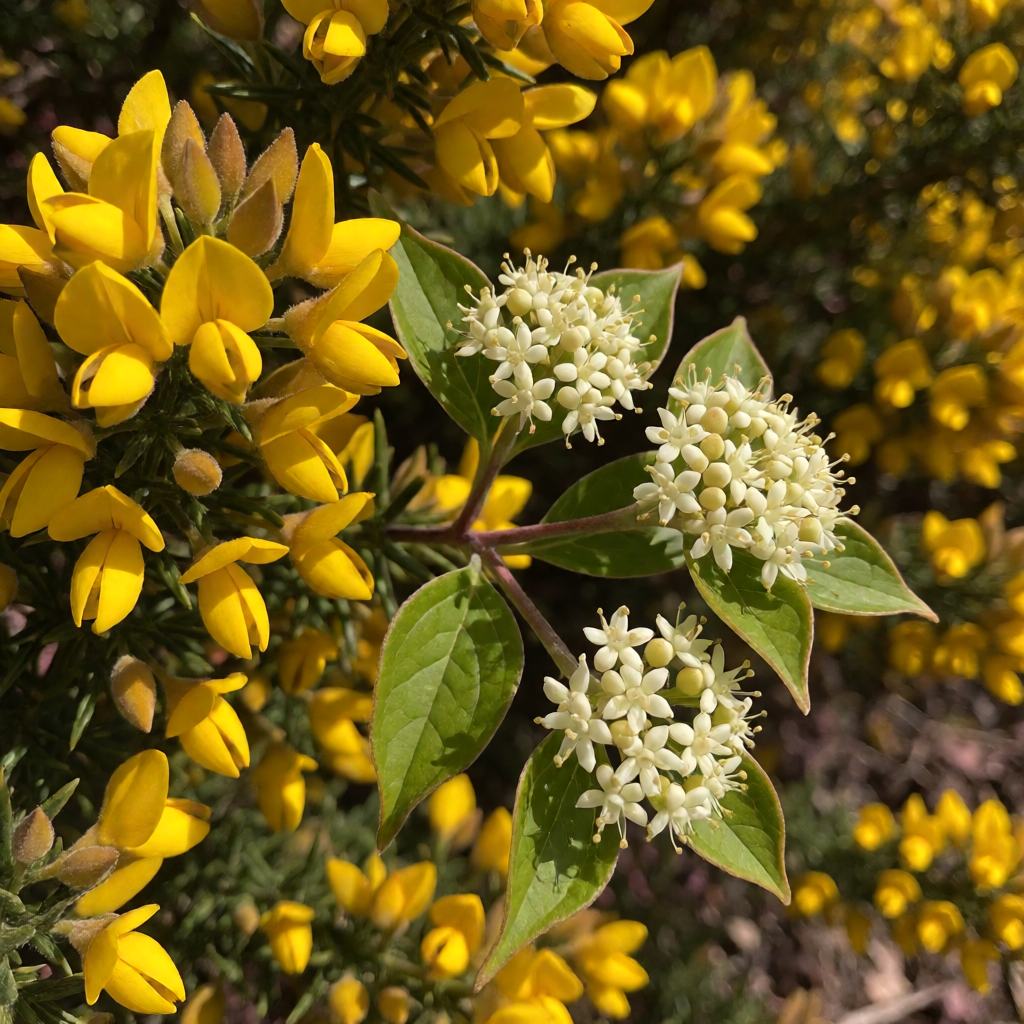
The adult feeds on nectar and on honeydew. It takes these from a small set of flowers and leaves. Bramble is one of the most important sources. The butterflies also visit gorse, hawthorn, buttercup and dandelion. They take the small flowers of heath plants as well. Honeydew is the sweet liquid that aphids leave on leaves. It is valuable food in early spring, when few flowers are out.
The young have a very different diet. This is where the species is remarkable. Almost every other European butterfly is limited to one plant family. Some are limited to one or 2 plants. The Green Hairstreak will eat a very long list of species, and those species come from many families. In Britain the list includes gorse, broom, dogwood, buckthorn, rock rose, bilberry and heather. The female lays her eggs one at a time.
She places them on the flower buds of a plant. The small larva feeds on the buds and the flowers, and it also eats the new leaves. It rarely eats the older leaves. This habit lets the species use many different hosts. Almost any shrub will offer soft new growth in spring.
One brood, two winters below
The breeding cycle
The Green Hairstreak has 1 brood a year. Its whole season is packed into a few weeks. The adults come out in April in the south of its range. In the north they appear in May or June, and they fly for about 6 weeks. The male finds a female by sight and by scent. The pair mate after a short flight. The female then searches for the right plant.
She lays her eggs one at a time. She chooses a plant that is in bud rather than in full leaf. A single female may lay well over 100 eggs. She places them singly, and on different plants. The eggs are pale green at first, and they turn grey before they hatch. The young larva comes out after 1 or 2 weeks. It feeds on the buds and flowers, and it grows through several stages.
The species passes the winter as a pupa. When the larva is fully grown it climbs down to the ground. It changes into a pupa among the dead leaves and moss. The pupa may stay in this state for 1 winter or for 2. That is one reason the numbers change from year to year. The adult itself lives for only about 2 weeks.
Still common, but losing rough ground
Conservation
The Green Hairstreak has not been assessed as threatened worldwide. It is still common across much of Europe and Asia. Local declines have been severe though. They are worst in Britain, the Netherlands, Belgium and parts of Germany. The reason is the loss of low, rough, half-open ground. Heathland has been planted with conifers or built over. Wet flushes and bogs have been drained.
The rough edges of fields and woods have been cleared and sprayed. Grazing by sheep or cattle is sometimes too heavy. Then the low bushes and tall flowers are eaten down to the ground. The species goes. Where grazing stops altogether, scrub grows up into dense woodland. The butterfly is lost in the other direction. The answer is a middle way.
Light grazing or cutting on a cycle will keep some low scrub. It will also keep some open ground. That is what conservation managers now aim for. The butterfly also benefits from the care of roadside verges. Railway embankments often hold the last strong numbers in the lowlands.
Quick hits
Five things to remember
- The green of the wings is not a pigment. It is a trick of light on tiny ridges, so it never fades.
- It eats plants from many different families, which makes it the least fussy of the European butterflies.
- The butterfly almost always rests with its wings closed. The plain brown upper side is hardly ever seen.
- The pupa can lie on the ground for 1 winter or for 2. That is one reason the numbers change so much.
- Its relatives make a sweet liquid that draws ants in. The ants guard the young in return.