 By st20113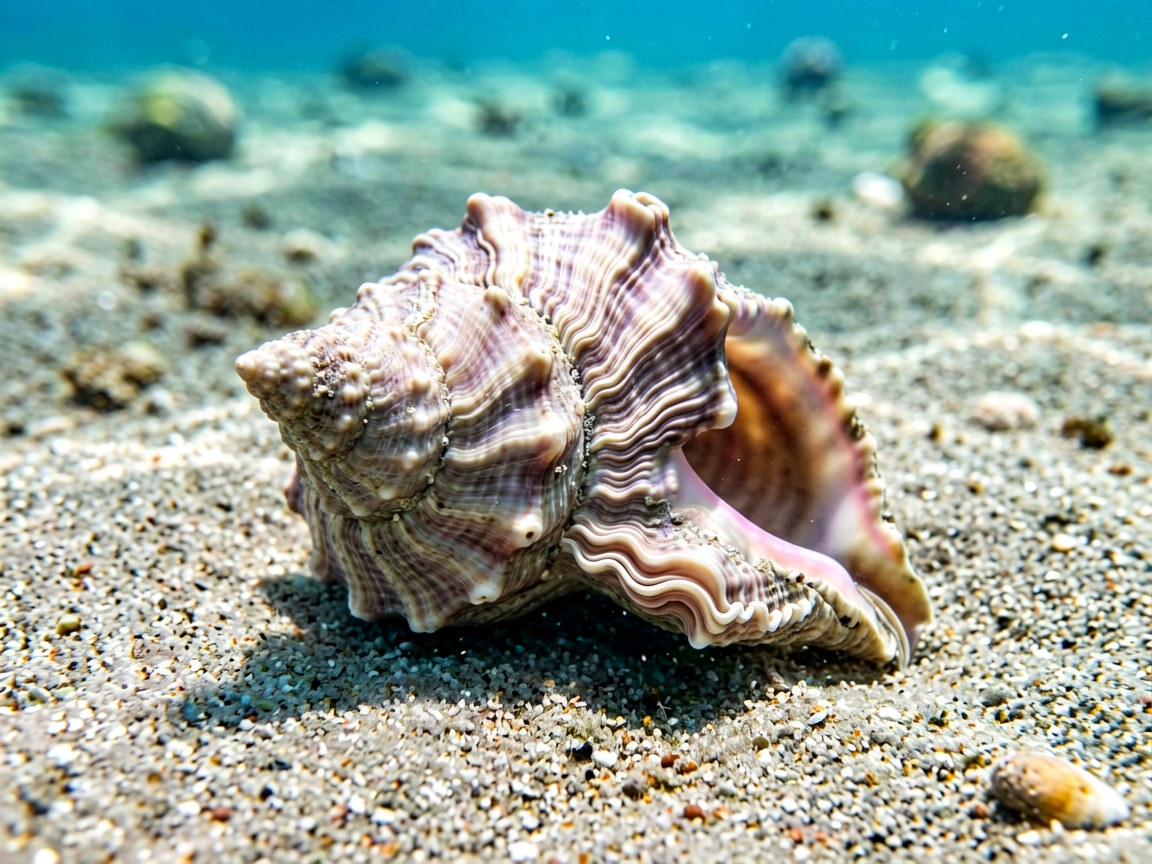
Buccinum undatum | Common Whelk
Introduction
The common whelk (Buccinum undatum) is a large, robust sea snail of the North Atlantic, its heavy, wavy-ridged shell washing up on beaches in their hundreds. A scavenger and predator of the seabed, it plays the role of underwater cleaner, locating dead and dying animals by scent and rasping into bivalves with a file-like tongue. Commercially fished in baited pots across northern Europe, it is also familiar to beachcombers through its distinctive clusters of empty egg cases.
Taxonomy
Buccinum undatum belongs to the family Buccinidae—the true whelks—within the class Gastropoda and the phylum Mollusca, the same great group of invertebrates that includes Octopus vulgaris (Common Octopus). The genus name Buccinum comes from the Latin for a curved war trumpet, a reference to the shell’s shape, while the species name undatum means “wavy,” describing the undulating ridges that run around each whorl.
Physical Characteristics
The shell is thick and solid, typically 5–11 cm tall, with seven or eight rounded whorls and a pointed spire. Its surface is sculpted with spiral ridges crossed by wavy vertical folds, giving the shell a characteristic rippled, corded texture. Color ranges from dirty white through pale grey to yellowish-brown, often with darker bands. The animal itself is pale, with a large muscular foot, a long extendable siphon for channeling water over its gills, a keen sense of smell, and a hard, oval operculum that seals the shell opening when it withdraws.
Habitat
This species lives on the seabed from the lowest shore down to depths of around 1,200 meters, though it is most common between 10 and 200 meters. It occurs across the North Atlantic on both European and North American coasts, on sand, mud, gravel, shell, and rock, and tolerates cold water well. It is generally absent from very soft, oxygen-poor mud and from strongly wave-exposed shores.
Diet
The common whelk is both a predator and a scavenger. It detects food by smell from a considerable distance, tracking the scent of dead fish, crabs, and other carrion across the seabed. It also attacks living prey, including bivalves and polychaete worms, using its strong foot to grip or prise shells apart and a toothed, ribbon-like radula to rasp through shell and flesh. This combination of scavenging and predation makes it one of the most important cleaners of the seabed.
Reproduction
Whelks have separate sexes and fertilization is internal. The female lays clusters of rounded, parchment-like egg capsules attached to rocks, shells, or other hard surfaces, containing hundreds of eggs in total. Unusually among marine snails, development is direct: instead of a free-swimming larval stage, tiny juvenile snails emerge from the capsules and crawl away, with some eggs serving as food for the developing young. This limited dispersal makes local populations slow to recover from overfishing.
Conservation
The common whelk is commercially fished in several European countries, mainly with baited pots, and is not currently classed as globally threatened. However, its slow growth, late maturity, and direct development—which means juveniles cannot drift in from elsewhere—make local stocks genuinely vulnerable to overexploitation. Discarded egg capsules, habitat damage from trawling, and the historical effects of antifouling pollutants such as tributyltin, or TBT, have all caused local declines, prompting minimum landing sizes and local management measures in some areas.
Fun Facts
- Empty whelk egg clusters often wash ashore in tangled, honeycomb-like masses known as “sea wash balls.”
- Unlike most sea snails, whelk young hatch as miniature crawling adults—there is no free-swimming larval stage.
- A whelk can detect a dead crab by scent from many meters away and will travel purposefully toward it.
- Whelks are a popular food in Belgium, the Netherlands, France, and the UK, usually sold boiled in the shell.
- The operculum—the hard “trapdoor” used to seal the shell—was once carried as a lucky charm by fishermen.
[…] The species sits in the class Polyplacophora. Its family is the Chitonidae. The class holds about 1,000 species in all. It shares the phylum with the Common Whelk. […]