 By st20113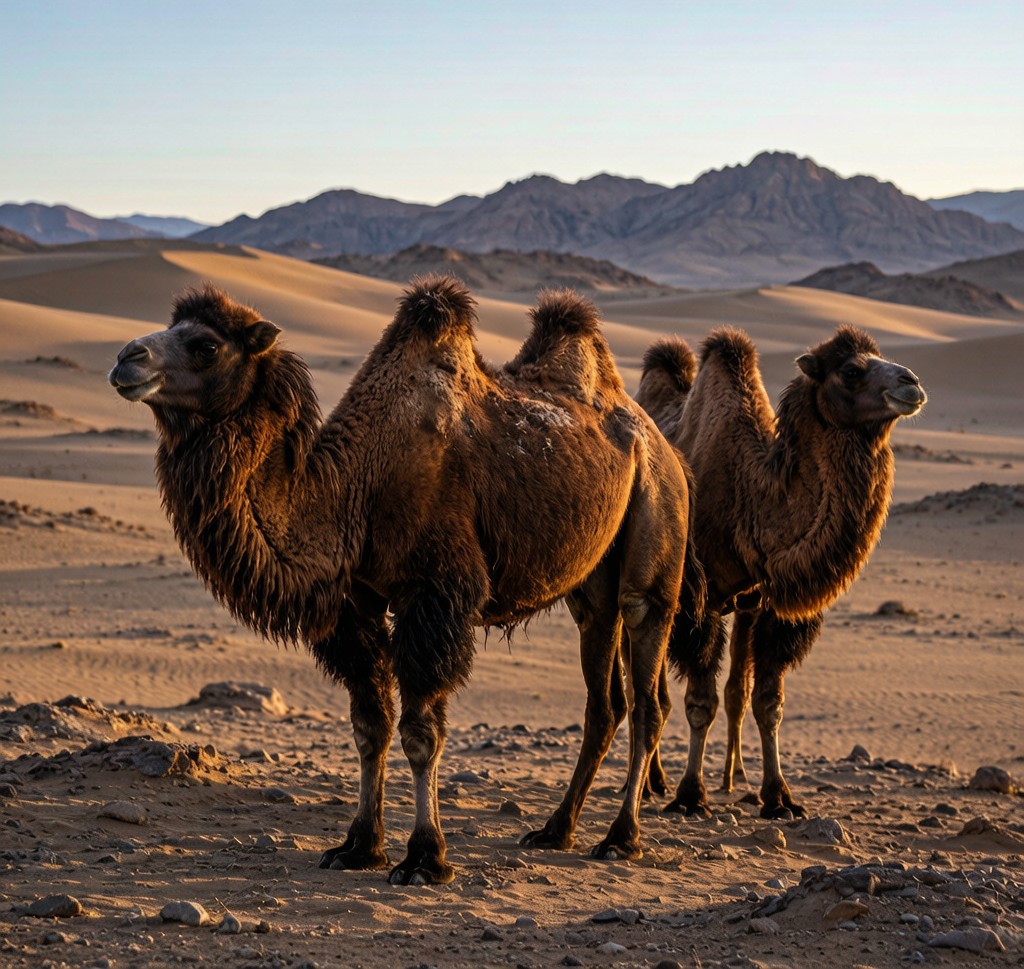
Two Bactrian Camels (Camelus bactrianus) in the Gobi Desert, showing their distinctive two humps and shaggy winter coat
Overview
The Bactrian Camel (Camelus bactrianus) is a large, distinctive even-toed ungulate native to the steppes and deserts of Central Asia, where it has been domesticated for over 4,500 years as a beast of burden and a source of milk, wool, and meat. Distinguished from the dromedary camel by its two humps rather than one, the Bactrian camel is a master of extreme environments, thriving in the cold, high-altitude deserts of the Mongolian and Gobi Plateaus where temperatures range from +40 degrees Celsius in summer to minus 40 degrees Celsius in winter.
Adult Bactrian camels stand approximately 160 to 180 centimeters tall at the shoulder and 210 to 240 centimeters at the top of the hump. Males are significantly larger than females, weighing 450 to 1,000 kilograms compared to 300 to 540 kilograms for females. Their most distinctive features are the two humps – which consist of fat deposits, not water as commonly believed – and their long, shaggy brown double-layered coat, which is shed in large clumps each spring. They have two toes connected by a leathery pad, adapted for walking on sand and snow.
Habitat and the Gobi Desert
The wild Bactrian camel – a distinct subspecies (C. b. ferus) from the domesticated form – is found in the remote desert and semi-desert regions of northwest China (Xinjiang) and southwestern Mongolia, particularly in the transcontinental Gobi Desert’s annulled. The Gobi is a cold, high-altitude desert with extreme temperature swings, sparse vegetation, and very limited water sources. Wild Bactrian camels have evolved remarkable adaptations to survive here, including the ability to drink saline and even bitter alkaline water that would kill most other mammals.
Domesticated Bactrian camels are found across a vast swath of Central Asia, from Turkey through Iran, Afghanistan, Pakistan, the Central Asian republics, and across the Mongolian Plateau to northern China. They have been integral to the great overland trade routes of history – the Silk Road – which connected China to the Mediterranean world. The caravans of the Silk Road were famously powered by thousands of Bactrian camels, which could carry loads of 150 to 300 kilograms per animal and travel 30 to 40 kilometers per day through some of the world’s most inhospitable terrain.
Adaptations to Extreme Environments
The Bactrian camel’s adaptations to desert life are extraordinary and encompass virtually every aspect of its physiology. Its thick, shaggy double coat provides insulation against both cold nights and hot days – the outer layer of coarse guard hairs reaches 30 centimeters in length and can be shed collectively in large sheets during spring. The camel can also tolerate body water losses of up to 25% of its body weight without ill effects (humans die at 12-15% water loss), and can drink up to 135 liters of water in 10 minutes after a period of dehydration.
The characteristic humps are fat reserves that can be metabolized when food is scarce, providing approximately 36 hours of energy during starvation. The camel’s nostrils can be closed completely against sandstorms, and its bushy eyebrows and double row of eyelashes provide effective eye protection. The wide, leathery footpads are heat-resistant and allow the camel to walk across both hot sand and cold, stony ground. Most remarkably, Bactrian camels can survive drinking brackish water from desert salt marshes – an adaptation that no other large mammal shares, which allows them to access water sources unavailable to their competitors.
Social Structure and Conservation
Wild Bactrian camels live in small, fluid herds of 6 to 30 individuals, led by a dominant male. The herd composition changes frequently as individuals move between groups. During the breeding season, dominant males compete for access to females through displays and physical contests that involve neck-wrestling, pushing, and biting. After a gestation of approximately 13 months, females give birth to a single calf, which can walk within hours of birth and is capable of running within days.
The wild Bactrian camel (C. b. ferus) is classified as Critically Endangered on the IUCN Red List, with fewer than 1,000 individuals remaining in the wild. The greatest threats to wild populations include hybridization with domesticated camels, hunting for meat and hides, habitat loss due to mining and infrastructure development, and competition for water sources with nomadic livestock herders. Conservation efforts in Mongolia and China include the establishment of the Great Gobi National Park, anti-poaching patrols, and research into the unique genetic adaptations of wild populations. The domesticated Bactrian camel, by contrast, remains abundant with over 2 million individuals across Central Asia.
[…] from its wild ancestor Camelus ferus, which is now critically endangered. Unlike the two-humped Bactrian Camel, which inhabits the cold steppes of Central Asia, the dromedary is exclusively adapted to hot, arid […]
[…] could not cross dry deserts. The two-humped Bactrian camel was slower. It could carry around 200 kg and go days without drinking. It became the standard […]