 By st20113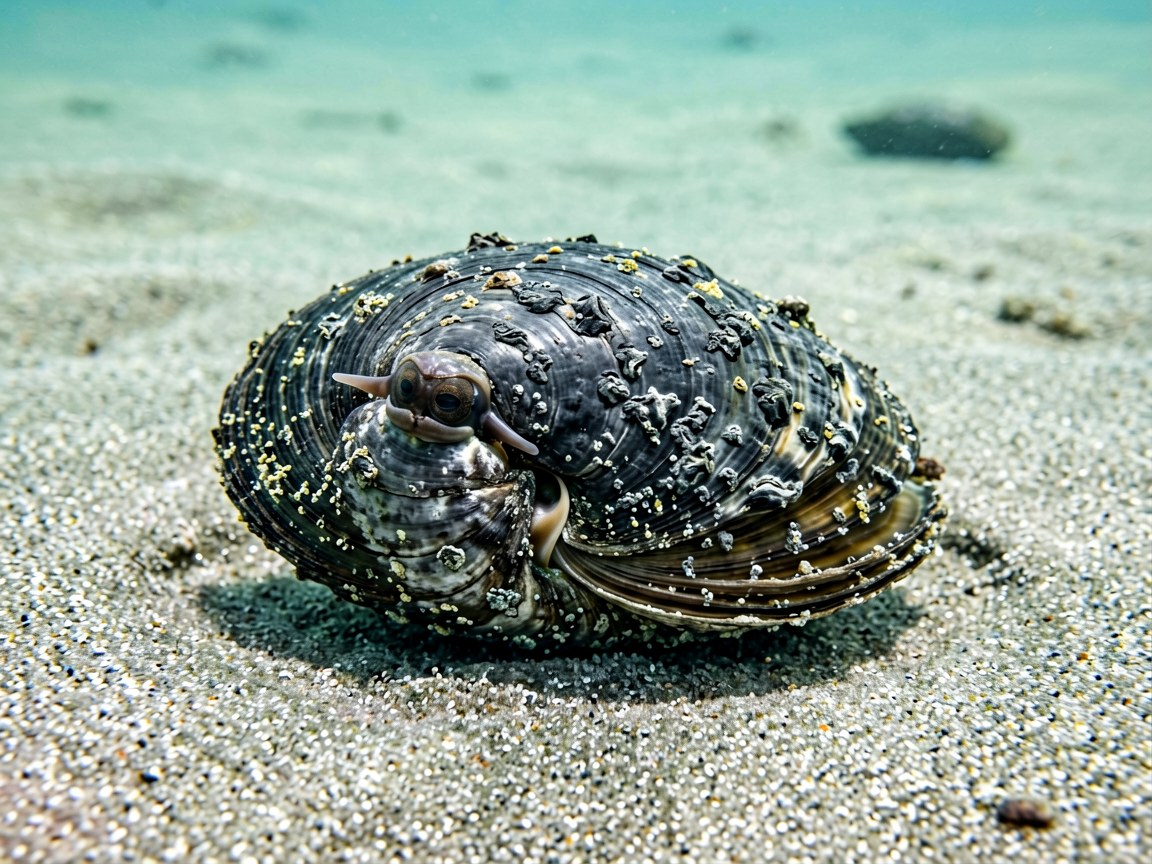
Arctica islandica | Ocean Quahog
Introduction
The ocean quahog (Arctica islandica) is a thick-shelled clam of cold northern seas and the longest-lived individual animal known to science: one specimen collected off Iceland was found to be more than five hundred years old. Buried in sand and mud from shallow water down to several hundred metres, it lives slowly and quietly, closing its shell for long stretches and adding a growth line to its shell every single year.
Taxonomy
Arctica islandica is a bivalve mollusc in the family Arcticidae, and the only living species in its genus. It belongs to the same class of bivalves as the common mussel, Mytilus edulis, sharing the two-valved shell, the muscular foot, and the filter-feeding habit, but where the mussel lives fast and attached by threads on the open shore, the ocean quahog lives slowly and buried, and can outlive it by centuries.
Physical Characteristics
The shell is robust, oval, and inflated, typically seven to twelve centimetres across, with a thick, dull, grey-black to brown outer skin called the periostracum that often flakes on older shells. The inside is smooth, glossy white, sometimes with a faint purple tinge near the hinge. The two valves are equal and close tightly. Growth lines ring the outside of the shell, one laid down each year, and these annual bands are what make the animal so valuable to science.
Habitat
Ocean quahogs live buried in soft sand, mud, or gravel, from the low shore down to depths of several hundred metres, mostly in cold temperate and boreal waters. They occur on both sides of the North Atlantic, around Iceland, Scandinavia, the British Isles, and down the North American coast. They favour stable, cold, well-oxygenated sediment and are absent from warm or disturbed ground, where their slow metabolism cannot cope.
Diet
They are suspension feeders. Two short siphons reach up to the surface of the sediment, drawing water in through one and expelling it through the other; the gills trap plankton, bacteria, and organic particles in mucus and carry them to the mouth. Feeding stops for long periods—the animal can close up and sit sealed for days or even weeks—which is one of the reasons it lives so long: a low, interrupted metabolism produces far less cellular damage.
Reproduction
The sexes are separate. Spawning takes place in summer, with eggs and sperm released into the water where fertilisation occurs. The resulting larvae drift in the plankton for several weeks before settling onto suitable sediment and burrowing in for life. Growth is extremely slow, and individuals may take decades to reach full size; the combination of slow growth, great age, and late maturity makes populations very slow to recover from disturbance.
Conservation
The species itself is not globally threatened, but it is vulnerable to heavy exploitation. Because it is so slow-growing and long-lived, dredging can remove animals that took a century or more to reach size, and recovery from even modest fishing pressure may take longer than a human lifetime. Fisheries for ocean quahog in the north-west Atlantic are managed with careful limits for this reason. Its annual shell bands also serve as a natural archive of past ocean conditions.
Fun Facts
- One specimen was aged at over five hundred years, making it the oldest individual animal ever recorded.
- Its shell carries one visible growth ring per year, like a tree—and scientists read them the same way.
- It can close its shell and go without feeding for weeks at a time.
- Its slowed metabolism is thought to be central to its extraordinary lifespan.
- Shell rings are used to reconstruct past sea temperatures, sometimes century by century.