 By st20113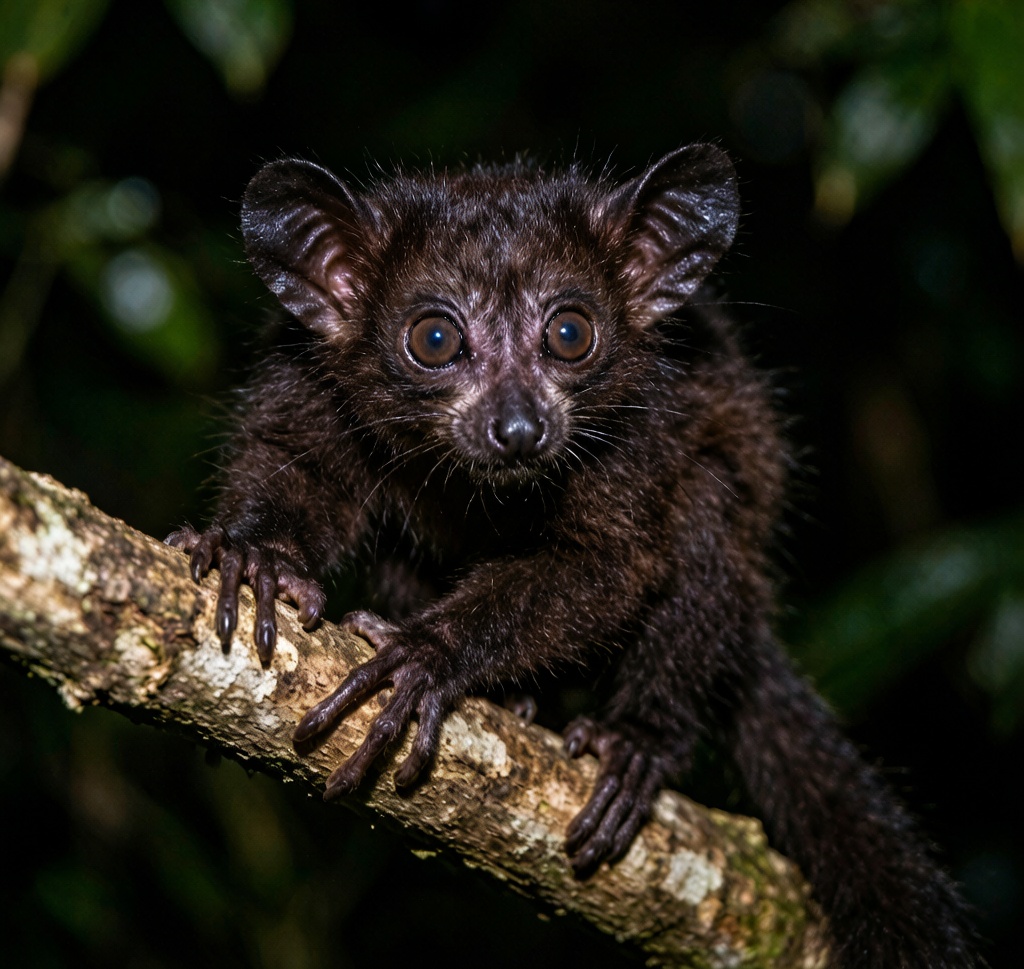
The aye-aye (Daubentonia madagascariensis) is arguably the most bizarre primate on Earth — a nocturnal lemur from Madagascar so unusual in its appearance and behavior that it was initially classified as a rodent rather than a primate. With its enormous bat-like ears, perpetually startled expression, elongated middle finger, and uniform black fur, the aye-aye looks like no other creature on the planet. This remarkable animal holds the unique distinction of being the world’s largest nocturnal primate, and it has evolved a foraging strategy — called percussive foraging — that is unlike any other primate: it taps on dead wood with its elongated middle finger, listening for the hollow sounds of wood-boring insect tunnels beneath the surface, then gnaws through the wood with its ever-growing incisors and extracts prey with its specialized finger. This combination of features has made the aye-aye a flagship species for conservation in Madagascar’s rapidly disappearing forests.
## Physical Characteristics
The aye-aye is a medium-sized lemur, with a body length of 36 to 44 centimeters and a bushy tail that can reach 60 centimeters in length, giving it an overall length comparable to a domestic cat. Its body is covered in long, coarse, dark brown to black fur, with lighter, often greyish, fur on the face, neck, and belly. The face is dominated by a pair of enormous, bat-like ears — up to 10 centimeters in diameter — which are highly mobile and extraordinarily sensitive, enabling the animal to detect the faint sounds of insect larvae moving within wood. The eyes are large, round, and forward-facing, with vertical slit pupils characteristic of nocturnal animals, giving them a perpetually startled expression. The hands possess a unique structure: four fingers of normal proportions, plus a dramatically elongated middle finger — up to three times the length of the others — which is thin, wire-like, and equipped with a ball-and-socket joint, allowing it to rotate 360 degrees. The incisors are large, ever-growing, and continuously erupting, resembling those of rodents, adapted for gnawing through hard wood.
## Habitat and Distribution
The aye-aye is found only in Madagascar, where it inhabits evergreen and deciduous rainforests, as well as some degraded forest habitats, across the eastern and northwestern regions of the island. Its distribution is patchy and largely restricted to areas with sufficient old-growth forest containing large trees suitable for feeding and nesting. Aye-ayes are canopy dwellers, spending most of their time in the upper levels of the forest, rarely descending to the ground. They construct large, spherical nests from woven leaves and twigs, typically positioned high in the canopy, where they spend the daylight hours resting alone. Despite its once broad range across Madagascar, the aye-aye has disappeared from much of its historical habitat, with populations now highly fragmented.
## Behavior and Diet
The aye-aye is exclusively nocturnal and predominantly solitary, with males and females coming together only for mating. Its most remarkable behavior is percussive foraging: the animal moves through the canopy at night, methodically tapping on branches and dead wood with its elongated middle finger at a rate of up to eight taps per second. Using its extraordinarily sensitive hearing — enhanced by the large, mobile ears — it listens for the subtle acoustic differences between solid wood and the hollow tunnels created by wood-boring insect larvae. Upon detecting prey, the aye-aye uses its rodent-like incisors to gnaw through the wood, creating a small hole, then inserts its thin middle finger to extract the larvae. This unique foraging strategy is analogous to woodpecker feeding. The aye-aye also consumes seeds, nectar, and fruit, making it a key ecosystem engineer. Males maintain large, overlapping home ranges and communicate through vocalizations including a distinctive, descending “hai-hai” alarm call, as well as scent marking.
## Reproduction
The aye-aye has one of the slowest reproductive rates of any primate, with females giving birth to a single infant every two to three years — the longest interbirth interval of any primate. Mating typically occurs between October and February, after which a single offspring is born following a gestation of approximately 160 to 170 days. The newborn aye-aye is highly altricial — tiny, blind, and entirely dependent — and is initially carried in the mother’s mouth or clinging to her fur. The mother constructs a dedicated nest for her infant, leaving it hidden while she forages. Infants are weaned at approximately seven months but may remain with the mother for up to two years before becoming independent. Sexual maturity is reached at approximately three to four years of age. Given this extremely slow reproductive rate, aye-aye populations are highly vulnerable to any increase in adult mortality.
## Conservation
The aye-aye is classified as Endangered on the IUCN Red List. Its population has declined by 50 percent over the past 36 years, driven primarily by habitat loss due to slash-and-burn agriculture, logging, and mining across Madagascar. In some regions, local people consider the aye-aye an omen of bad luck and actively kill it on sight — a cultural prejudice known as “fady” — which compounds the threat from habitat loss. Conservation efforts include the protection of remaining forest habitats in national parks and reserves, community education programs to change perceptions of the species, and captive breeding programs in zoos worldwide. Reintroduction efforts have also been undertaken, with captive-bred aye-ayes released into protected areas of eastern Madagascar.