 By st20113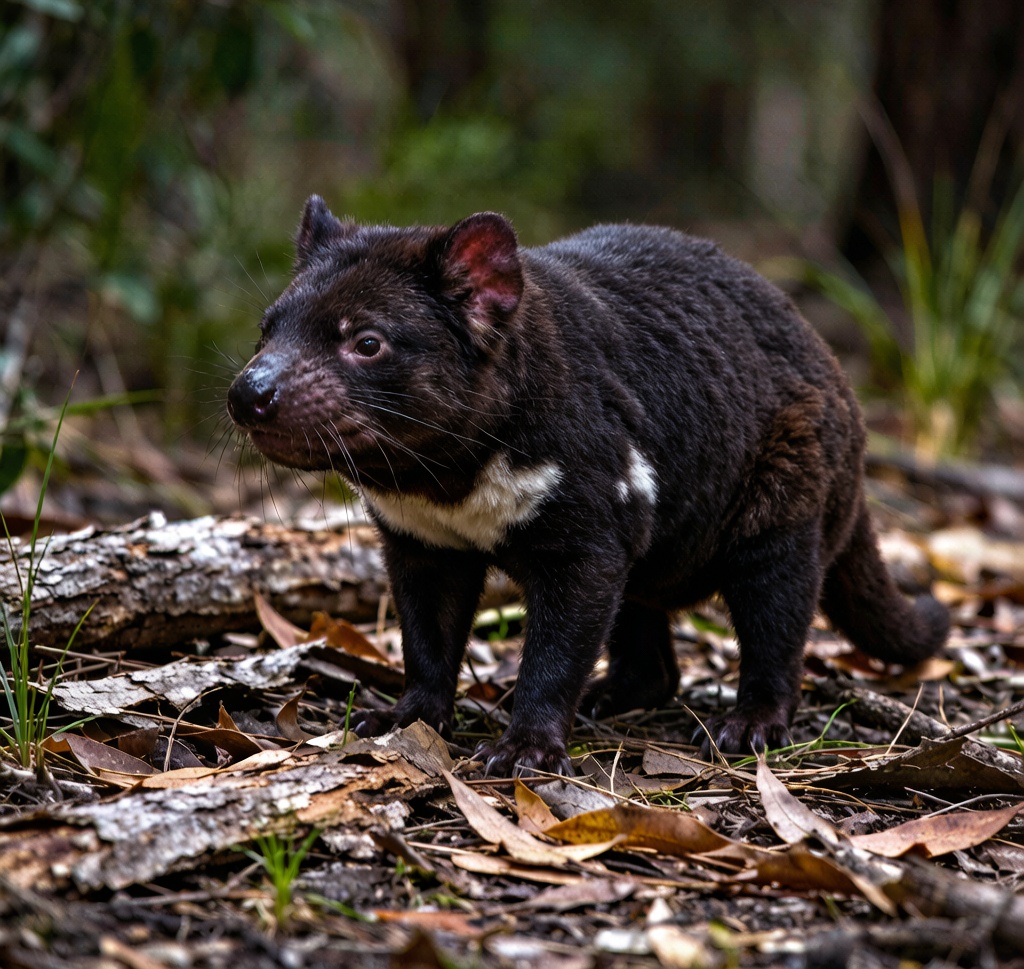
The Tasmanian devil (Sarcophilus harrisii) is the world’s largest living carnivorous marsupial — a stocky, muscular creature whose fearsome reputation for bone-crushing bite force and blood-curdling screeches belies its relatively modest body size. Endemic to the island state of Tasmania, Australia, the Tasmanian devil occupies a critical ecological niche as both a powerful scavenger and an effective mid-sized predator, consuming entire prey animals — bones, fur, and all — in a matter of minutes. Once widespread across mainland Australia, the devil became extinct on the continent approximately 3,000 years ago, likely due to competition with the dingo. Today, it survives only in Tasmania, where it faces a devastating pandemic of Devil Facial Tumour Disease (DFTD) — a contagious cancer that has reduced populations by up to 80 percent in some areas, making it one of the most urgent conservation crises in the Australian fauna.
## Physical Characteristics
The Tasmanian devil is a compact, powerfully built marsupial, measuring 50 to 80 centimeters in body length, with an additional 23 to 30 centimeters of tail. Males are significantly larger than females, weighing 8 to 14 kilograms compared to 5 to 9 kilograms for females. Its fur is coarse, almost woolly, and predominantly jet black, with irregular white markings on the chest, shoulders, and rump — unique to each individual, much like a human fingerprint. The head is large and disproportionately broad, with a blunt snout, small eyes, and rounded ears with pinkish-gray inner surfaces. The jaws are exceptionally powerful for its size, capable of generating a bite force of up to 2,000 Newtons — among the strongest of any mammal relative to body size — allowing it to crush the bones and skulls of prey. The legs are short but muscular, ending in five-toed feet with sharp claws used for digging and grasping.
## Habitat and Distribution
The Tasmanian devil is found throughout Tasmania, from coastal heaths and scrublands to wet sclerophyll forests and even some suburban areas. It is most abundant in the north and east of the island, though populations exist across all regions. Devils are primarily nocturnal, sheltering during the day in dense vegetation, hollow logs, burrows (often stolen from wombats), or rock crevices. They are highly adaptable and can survive in modified habitats provided adequate food, shelter, and nesting sites are available. However, populations have been severely fragmented and reduced by DFTD, with some local extinctions documented in the eastern and southeastern regions of Tasmania.
## Behavior and Diet
Tasmanian devils are opportunistic omnivores with a strong preference for carrion, which constitutes the majority of their diet. They are capable of consuming up to 40 percent of their body weight in a single meal, devouring prey — and carrion — including wallabies, possums, wombats, birds, reptiles, amphibians, insects, and even sheep and livestock carcasses with remarkable efficiency, leaving nothing but hair and bones. Their powerful jaws and digestive system can process virtually the entire carcass. Devils are largely solitary, coming together primarily at carcasses, where social hierarchies based on size and age determine feeding order. They communicate through a remarkable range of vocalizations — from blood-curdling screeches and growls to coughs and sneezes — which inspired their name and are used to signal aggression, submission, and alarm. Despite their fearsome reputation, devils are not dangerous to humans and are shy and retiring by nature.
## Reproduction
Tasmanian devils breed once per year, with mating occurring in March to April. After a gestation of approximately 21 days, the female gives birth to up to 50 tiny, embryonic young — the largest litter relative to body size of any marsupial. Each joey, smaller than a grain of rice, must independently locate and latch onto one of the mother’s four teats inside her backward-facing pouch. After approximately 15 weeks, the young — now approximately the size of a small mouse — emerge from the pouch and are left in a den while the mother forages. They are fully weaned at approximately five months of age and become independent by late summer, before the next breeding season. Sexual maturity is reached at approximately two years of age. Wild devils typically live five to seven years.
## Conservation
The Tasmanian devil is classified as Endangered on the IUCN Red List. A population decline of over 80 percent has been recorded in some areas since the emergence of Devil Facial Tumour Disease (DFTD) in 1996 — a unique, transmissible cancer spread through biting that causes tumors to erupt around the face and mouth, eventually preventing feeding and leading to death. DFTD has been called the most threatening disease to any wildlife species in the world. Conservation efforts include the establishment of insurance populations in sanctuaries free of DFTD, ongoing research into vaccines and genetic management, and the identification of devil populations with natural immunity that may hold the key to the species’ long-term survival.
[…] abundant, though it also inhabited coastal heath and rocky mountainous terrain. Like the related Tasmanian devil, it used rocky dens and caves for shelter during daylight hours, emerging at dusk and dawn to hunt. […]