 By st20113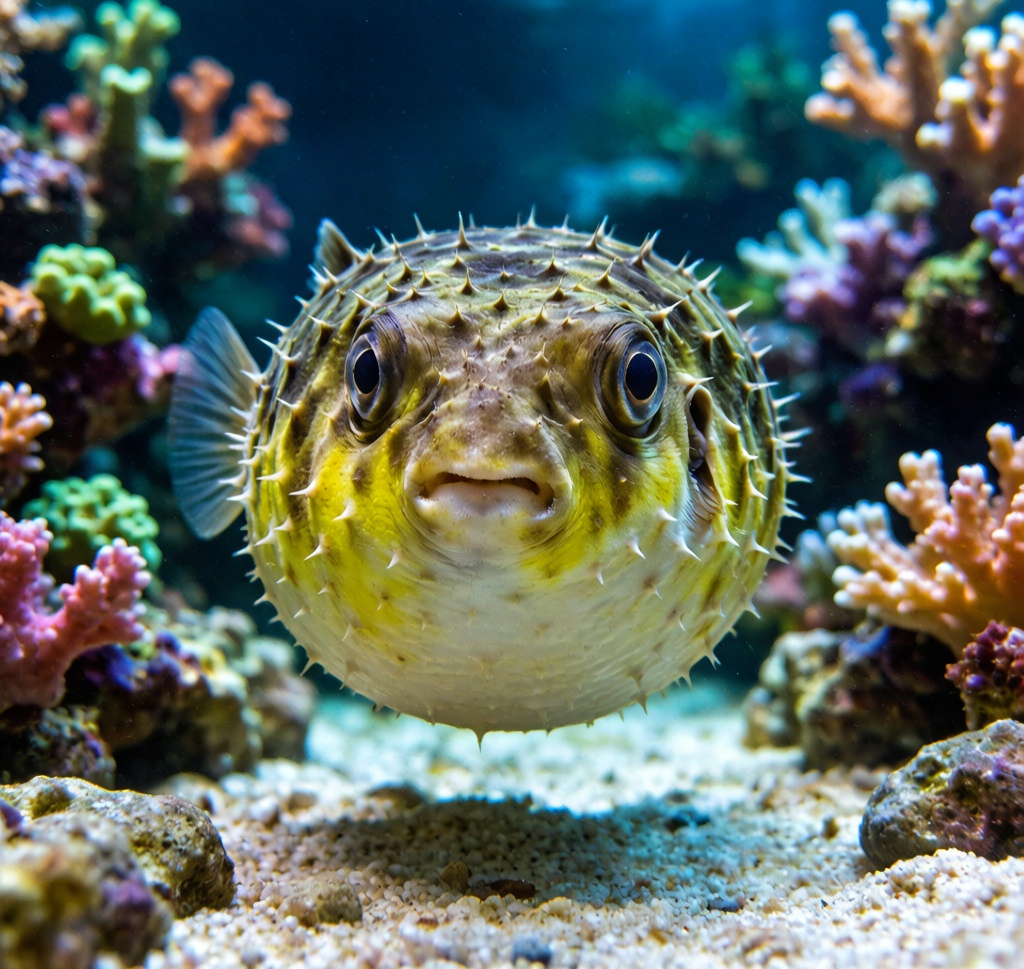
The pufferfish, also known as blowfish, belong to the family Tetraodontidae — a remarkable group of approximately 200 species of ray-finned fish found in tropical and subtropical waters worldwide. What makes pufferfish extraordinary is their unique defense mechanism: the ability to inflate their highly elastic stomachs by ingesting water (or air) until their bodies become nearly spherical, transforming them into a form that is difficult for predators to swallow. This defense is complemented by the presence of spines that become erect when inflated. Perhaps most famously, many pufferfish species contain tetrodotoxin — one of the most potent natural poisons known to science — concentrated in their skin, liver, ovaries, and certain muscles, making them a delicacy in Japanese cuisine when prepared by specially trained chefs who meticulously remove all toxic tissues.
## Physical Characteristics
Pufferfish display an extraordinary range of body shapes, though most species share a roughly globular form when inflated. Their bodies are covered in relatively thick, rough skin rather than scales, and many species are adorned with spines — variable in length and density depending on the species — that serve as an additional deterrent when the fish is inflated. Coloration varies widely: many tropical species exhibit bright, vivid warning colors including yellows, greens, blues, and blacks arranged in striking patterns, while temperate species tend toward more cryptic olive, grey, and brown tones. The eyes are typically large and expressive, and the mouth is surrounded by four fused tooth plates that form a beak-like structure, used for crushing the hard shells of their preferred prey. Most pufferfish are relatively small, measuring 30 to 50 centimeters, though some species such as the oceanic Mola sunfish — a distant relative — can reach weights of over 2,300 kilograms.
## Habitat and Distribution
Members of the family Tetraodontidae occupy diverse marine, brackish, and freshwater environments across the globe. The majority of species are marine, inhabiting coral reefs, rocky reefs, seagrass beds, and sandy bottoms in tropical and subtropical waters. Several species, particularly in the genus Tetraodon and Pao, are fully freshwater inhabitants found in rivers and lakes across South America, Africa, and Asia. Brackish-water species migrate between marine and freshwater environments at different life stages.
## Behavior and Diet
Pufferfish are generally slow-moving and rely heavily on their defensive inflation rather than speed to avoid predators. They are carnivorous, feeding primarily on slow-moving or sessile prey. Algae, sponges, mollusks, crustaceans, and echinoderms form the bulk of their diet, and their powerful beak-like teeth are specially adapted for crushing hard-shelled invertebrates. The species-specific tetrodotoxin in certain species is produced by bacteria within the fish’s tissues and is believed to serve as a chemical defense against parasites and pathogens, though its ultimate origin and precise function remain subjects of scientific study.
## Reproduction
Most pufferfish species are pelagic spawners, with males and females releasing eggs and sperm into open water simultaneously. In some reef-dwelling species, males establish territories and court females with elaborate displays before the female releases her eggs, which the male then fertilizes and guards until hatching. Larval pufferfish drift as plankton before settling to the bottom and developing their characteristic shapes. Several species, including the dwarf pufferfish (Carinotetraodon travancoricus), have been successfully bred in captivity for the aquarium trade.
## Cultural Significance
In Japan, pufferfish is known as fugu and represents one of the most sought-after — and dangerous — culinary experiences in the world. The strict licensing requirements for fugu chefs, who must undergo years of training to learn the precise art of removing all toxic parts, reflect the seriousness with which this delicacy is treated. The demand for fugu has driven both targeted fisheries and aquaculture operations across Japan and other East Asian nations.