 By st20113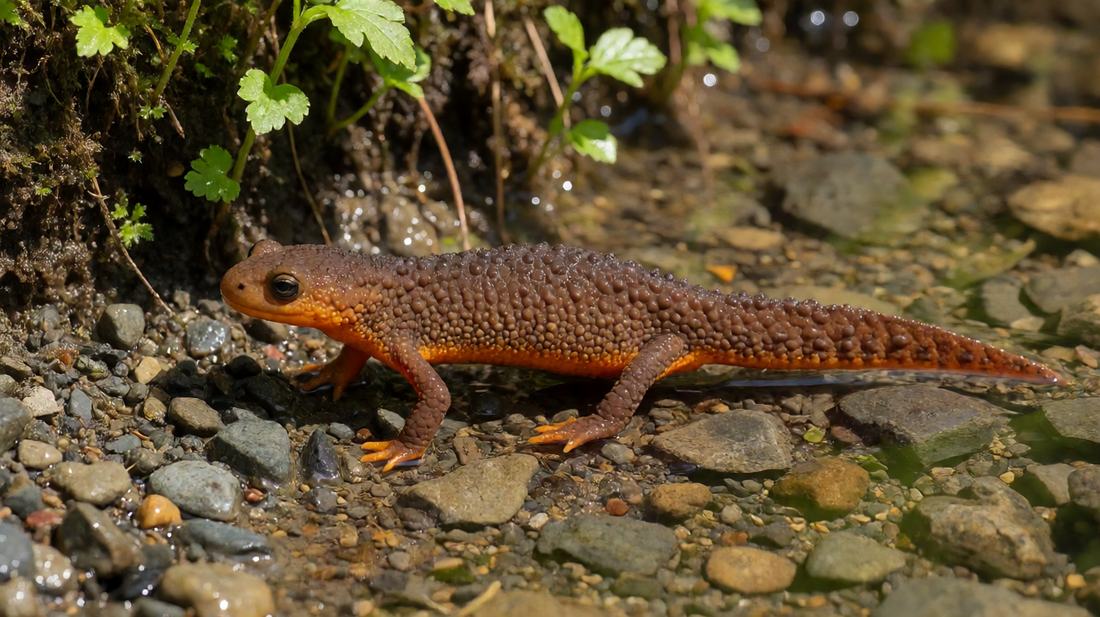
Taricha granulosa | Rough-skinned Newt
Species Profile · Salamandridae
Rough-skinned Newt
A stocky brown newt with a flame-orange belly, walking the wet forest floor of the Pacific coast and carrying enough toxin to kill a person.
Least Concern
Total length
Eggs
Hatching
Metamorphosis
Range
Rating
The Rough-skinned Newt
A newt that carries a pufferfish poison
A stocky newt walks the floor of western North American forest. Its back is dull brown. Its belly glows orange. That bright underside is a warning.
It is not decoration. Skin glands hold tetrodotoxin, the poison found in pufferfish. Few animals can eat this newt and live, of course. Garter snakes manage it, at a cost.
Outside breeding season the animal lives on land. Rain brings it out. Dry months send it under logs. Because the toxin is so strong, one small newt holds enough poison to kill a full-grown adult person.
Family tree
Salamandridae, the true salamanders
The species sits in the family Salamandridae, the true salamanders. Baird and Girard named it in 1852. Three other newts share the genus Taricha.
All live on the Pacific coast. All carry the same skin toxin. The axolotl sits in a different family altogether.
It never leaves the water. Both animals can regrow a lost limb, in fact. That trick evolved long before the two families split apart, so neither group had to invent it twice.
Brown above, orange below
How to tell one
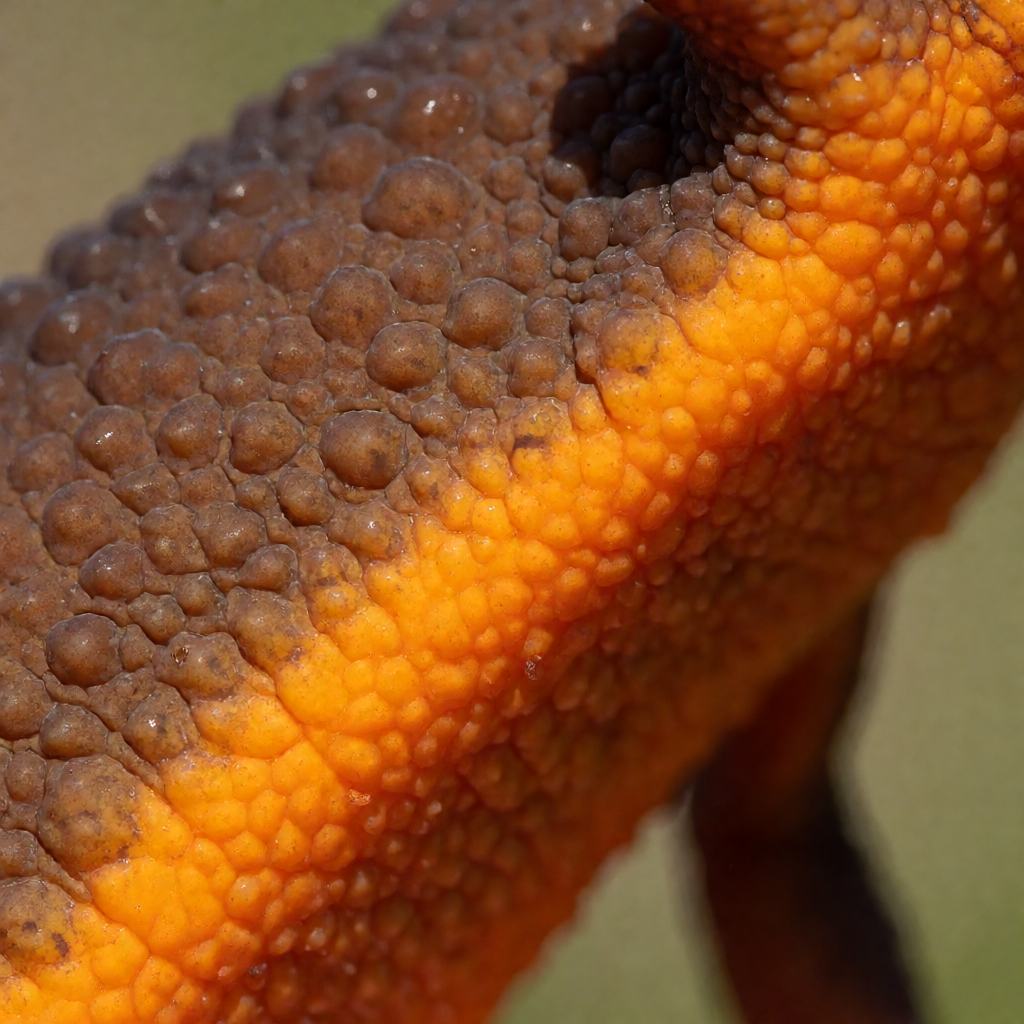
Adults reach 12 to 22 cm in total length. The tail is about half of that. Skin is grainy and dry to the touch, in fact.
It feels nothing like a frog. Upper parts are brown, olive or grey-brown. The underside shows bright orange or yellow.
Eyes are golden, with a round pupil. A broad head and short legs give a slow walk. When threatened, the animal arches its tail and shows the bright belly instead, which is the one part of the body a bird would rather not eat.
1
2
3
Damp forest and still water
Where it lives
Damp conifer forest is the usual home. Oak woodland works too. Damp grassland does as well. Still water is needed for breeding.
Ponds, ditches and slow streams all serve. Its range runs from southern Alaska to central California. Inland populations reach Idaho and Montana. Rotting logs make good shelters.
So do old rodent burrows. Because dry air kills the skin, the animal never strays far from cover of one kind or another.
Worms, slugs and insects
What it eats
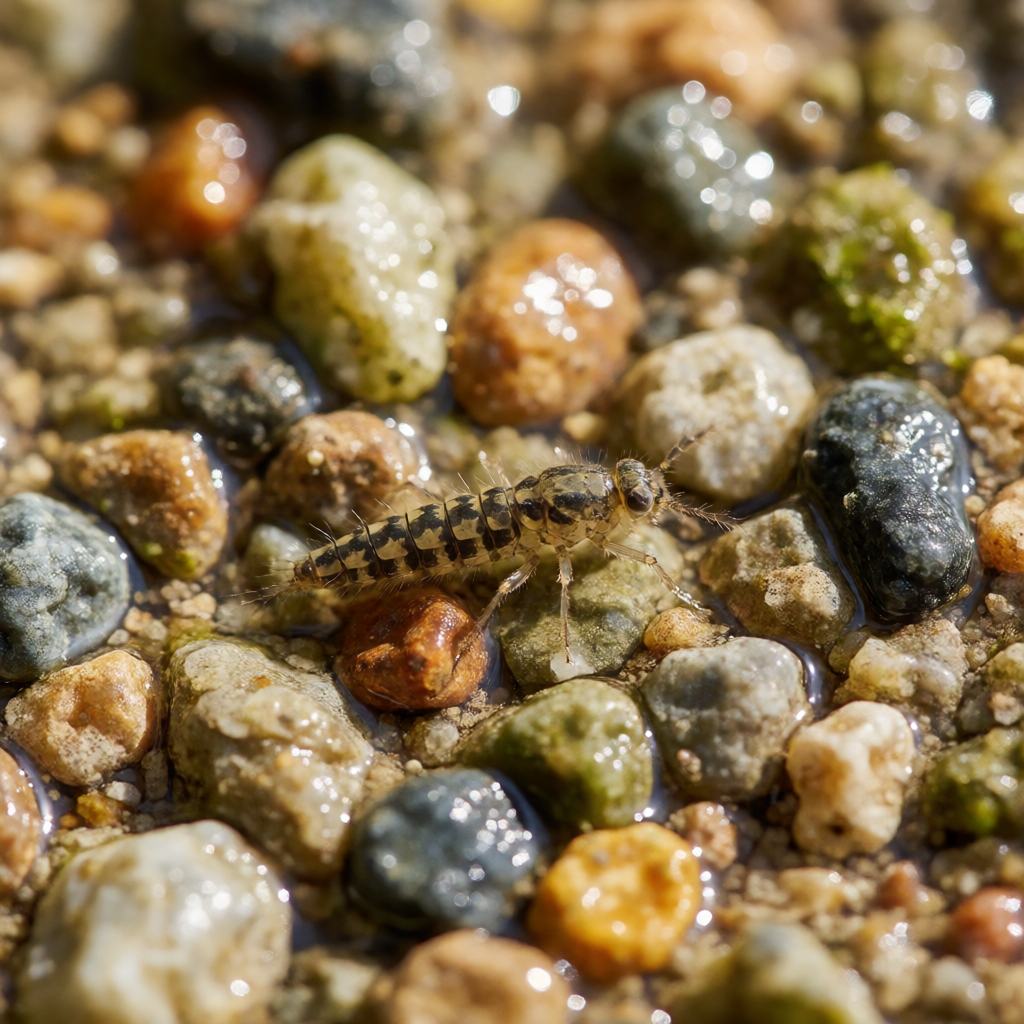
Earthworms and slugs are taken often. Beetles, ants and flies are eaten too. Snails and spiders fill out the list.
Aquatic newts hunt tadpoles and fish eggs. Insect larvae are taken as well. Even so, cannibalism happens when prey is scarce.
Food is swallowed whole. Nothing is chewed first. Since the newt moves slowly, it simply takes whatever prey comes within easy reach of that wide mouth.
Eggs glued to plants
The breeding cycle
Breeding runs from winter into spring. Males gather in ponds first. Each one grips a female in amplexus. Females lay eggs one at a time.
Some lay them in short strings. Eggs are glued to plants or stones. Larvae hatch after 3 to 5 weeks, in fact. They breathe through feathery gills.
Metamorphosis comes at 4 to 5 months. After that the young leave the pond, while some adults stay in the water and others walk back into the damp forest.
Least Concern
Conservation
The IUCN rates the species as Least Concern. The range is wide. Numbers are large.
Local losses follow pond drainage, however. Roads kill many animals on wet spring nights. In addition, stocked fish eat the eggs and larvae.
Unlike the common frog, which breeds in almost any water, this newt needs still, fish-free pools. That narrow need makes every lost pond hard to replace, since a new site must hold water all summer and stay free of fish.
Side by side
How It Compares
| Trait | Rough-skinned Newt | Common Frog |
|---|---|---|
| Skin | grainy and dry, with tetrodotoxin | smooth and moist |
| Underside | bright orange, a warning | pale and plain |
| Breeding water | still, fish-free pools | almost any pond |
| Eggs | laid one at a time, glued to plants | laid in large masses |
| Regeneration | can regrow a limb or tail | cannot as an adult |
| IUCN status | Least Concern | Least Concern |
Common misreadings
What People Get Wrong
- Newts are harmless. The skin toxin here can kill an adult.
- The orange belly is decoration. It is a warning shown to predators.
- All salamanders stay in water. This one lives on land for most of the year.
Going further
Sources and Further Reading
- Wikipedia, Rough-skinned newt
- IUCN Red List, Taricha granulosa. The IUCN Red List of Threatened Species.
- Animal Diversity Web, University of Michigan. Taricha granulosa.
- Brodie, E. D. 1968. Investigations on the skin toxin of the adult rough-skinned newt. Copeia.
Quick hits
Five things to remember
- Tetrodotoxin in the skin is the poison found in pufferfish.
- A threatened newt arches its tail and shows the orange belly.
- One known case records a person dying after swallowing a newt.
- Common garter snakes have evolved resistance to the toxin.
- Adults can regrow a lost limb or tail.