 By st20113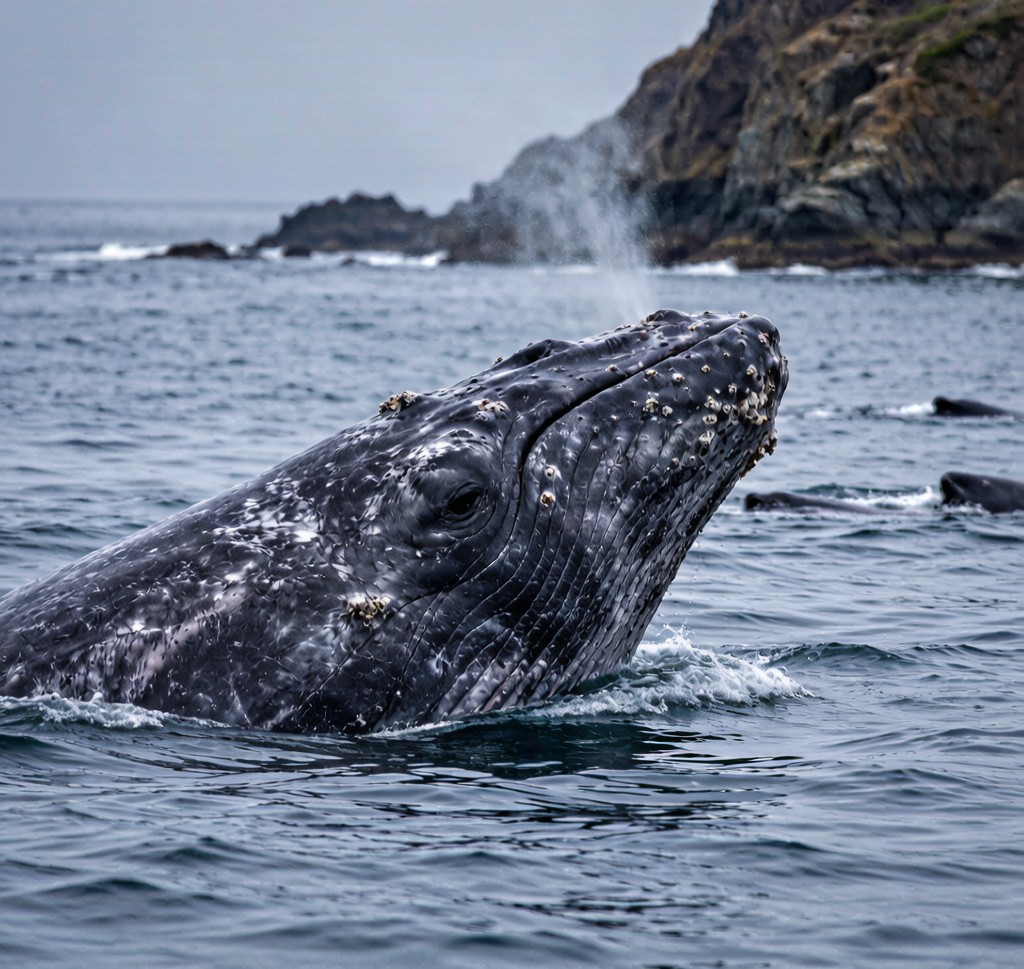
A Grey Whale (Eschrichtius robustus) surfacing in the cold Pacific Ocean off the coast of Baja California, showing its mottled grey skin with barnacles
Overview
The Grey Whale (Eschrichtius robustus) is one of the most iconic and best-studied whales in the world, famous for its extraordinary annual migration – the longest of any mammal on Earth – between its cold-water feeding grounds in the Bering, Chukchi, and Beaufort Seas north of Alaska and its warm-water breeding lagoons in the shallow bays of Baja California and the Gulf of California in Mexico. Growing to approximately 13 to 15 meters in length and weighing 15 to 40 tonnes, the Grey Whale is a baleen whale that feeds not by swallowing vast volumes of seawater as most baleen whales do, but by bottom-feeding: the whale rolls onto its side, dives to the seafloor, and scoops up mouthfuls of sediment from which it filters out tiny benthic organisms including amphipods, tube worms, and other invertebrates.
The Grey Whale’s distinctive grey and white mottled body – encrusted with patches of barnacles and whale lice – is one of the most recognizable sights in the marine world, and the species has been the subject of intensive conservation efforts since it was nearly driven to extinction by commercial whaling in the 19th and early 20th centuries. One population – the western North Pacific Grey Whale, which migrates between Russian Far East feeding grounds and Chinese and Japanese breeding grounds – is one of the most critically endangered whale populations in the world, with fewer than 200 individuals remaining. The eastern North Pacific population, which migrates along the North American coast, has recovered dramatically from near-extinction and was removed from the U.S. Endangered Species List in 1994.
Habitat and Migration
The Grey Whale’s annual migration is one of the most spectacular wildlife spectacles on Earth. Each year, eastern North Pacific Grey Whales make a round trip of approximately 16,000 to 22,000 kilometers between their Arctic feeding grounds and their Mexican breeding grounds – a journey that represents the longest annual migration of any mammal. The migration begins in October to November, when Grey Whales depart the Arctic feeding grounds and begin their southward journey along the North American coast. By December to January, they arrive at the warm, shallow lagoons of Baja California’s Pacific coast – particularly Laguna San Ignacio, Laguna Ojo de Liebre, and others – where females give birth to their calves and mating occurs.
The Grey Whale’s migration route follows the contours of the North American coastline, bringing whales close enough to shore for spectacular land-based viewing at several locations along the route. Gray Whale individuals can be individually identified by the unique patterns of white scars, barnacle patches, and pigmentation on their bodies, allowing researchers to track individual whales across years and even decades. The species’ eastern North Pacific population – which numbers approximately 20,000 to 25,000 individuals – has recovered to near pre-whaling numbers following intense international conservation efforts. The critically endangered western North Pacific population – estimated at fewer than 200 individuals – migrates along the Asian coast from its feeding grounds in the Okhotsk Sea to breeding grounds in the South China Sea, a route that is far less studied.
Feeding and Ecology
The Grey Whale’s feeding strategy is unique among baleen whales and represents a remarkable adaptation to benthic feeding. Unlike rorqual whales that lunge through dense schools of krill or fish, the Grey Whale feeds primarily on small benthic invertebrates – particularly amphipod crustaceans – that live in and on the muddy seafloor sediments of Arctic shallow continental shelf waters. To feed, the whale descends to the seafloor, rolls on its side, and sucks a mouthful of surface sediment into its mouth, where the sediment and associated organisms are strained through the baleen plates that hang from its upper jaw. The sediment is expelled through the sides of the mouth, leaving the food items caught on the baleen, which the whale then licks off with its tongue.
The Grey Whale’s feeding activities have significant impacts on the Arctic seafloor ecosystem. By disturbing sediments and consuming large quantities of benthic organisms, Grey Whales aerate and churn the seafloor, creating habitat for other species and recycling nutrients. The Whale’s body is also encrusted with enormous patches of barnacles and whale lice – commensal organisms that attach themselves to the whale’s skin and feed on its skin cells and external parasites. A large Grey Whale may carry up to 400 kilograms of barnacles and 400 liters of whale lice – an enormous commensal community that is shed along with the whale’s skin when it migrates to warm waters and molts.
Conservation
The Grey Whale’s recovery from near-extinction represents one of the most significant conservation success stories in marine biology. The eastern North Pacific population – which once numbered approximately 15,000 to 24,000 individuals before commercial whaling reduced it to fewer than 2,000 by the early 20th century – has recovered to an estimated 20,000 to 25,000 individuals, making it one of the most abundant large whales in the North Pacific. The population was removed from the U.S. Endangered Species List in 1994 and the IUCN’s global listing was downgraded from Endangered to Least Concern in 2017. This remarkable recovery was achieved through international protection from commercial whaling, which was banned globally in 1966 after decades of unregulated exploitation.
The western North Pacific population, however, remains in critical danger. With fewer than 200 individuals remaining, it is one of the most endangered whale populations in the world. The primary threats to this population include ship strikes, entanglement in fishing gear, ocean noise that disrupts communication and navigation, and the potential for illegal whaling. Research into the western population is ongoing, using satellite tags, photo-identification, and acoustic monitoring to understand migration routes and identify key habitat areas that require protection. The Grey Whale’s role as an indicator of ocean health – given its dependence on benthic food chains that are sensitive to ocean warming and pollution – makes it an important species for monitoring the impacts of climate change on marine ecosystems.