 By st20113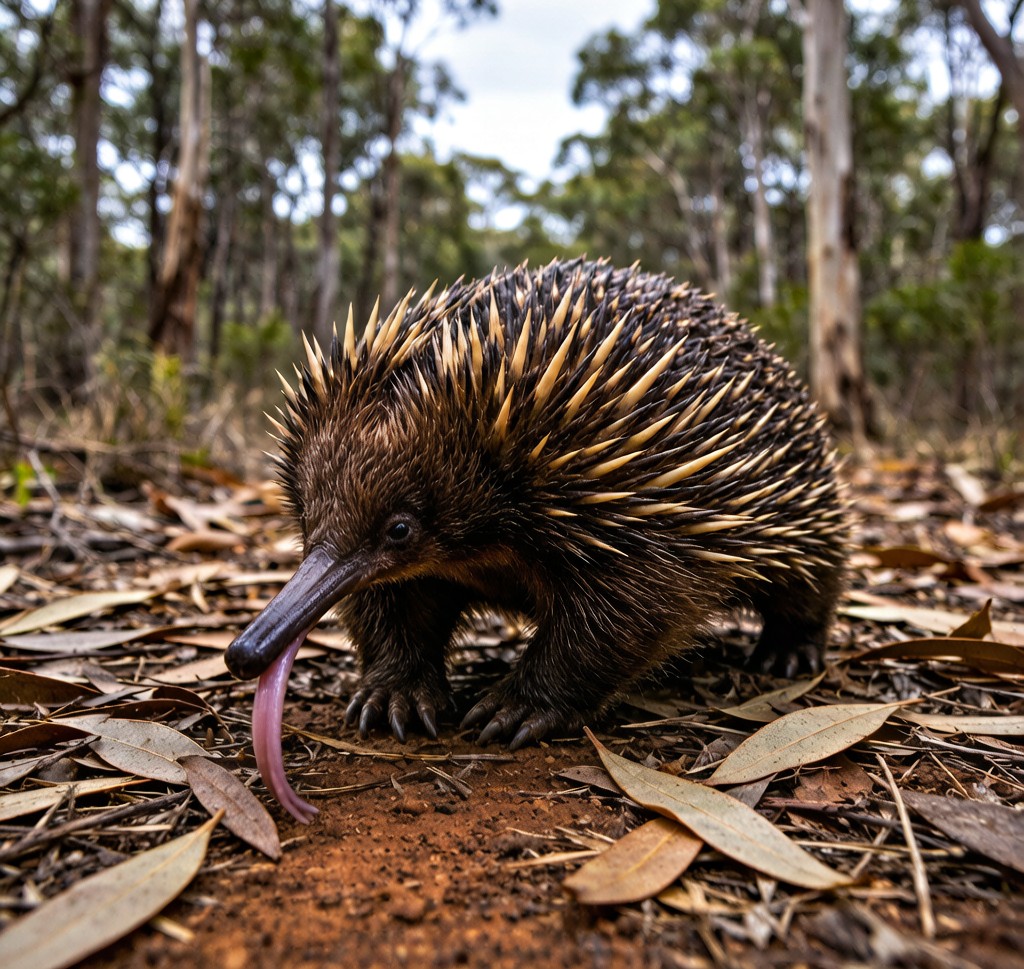
A Short-beaked Echidna (Tachyglossus aculeatus) walking through Australian bushland with its spines and long sticky tongue visible
Overview
The Short-beaked Echidna (Tachyglossus aculeatus) is one of only five surviving species of monotreme – the ancient order of egg-laying mammals that split from the lineage leading to all other living mammals approximately 187 million years ago. Found throughout Australia and parts of New Guinea, the Echidna is one of the most distinctive mammals on Earth: a small, stocky animal covered in coarse hair and a dense armor of cream to brown spines, with a distinctive long, slender, sticky tongue that it uses to capture its primary prey – ants and termites. Along with the Platypus, the Echidna represents one of the most ancient mammalian lineages, providing a unique window into mammalian evolution tens of millions of years before the extinction of the dinosaurs.
The Echidna is approximately 30 to 45 centimeters in body length and weighs 2 to 7 kilograms, with females slightly larger than males on average. Its most remarkable feature is its tongue – which can extend up to 18 centimeters beyond the tip of the snout and is coated in sticky saliva that allows it to capture up to 2,000 ants or termites in a single feeding session. The Echidna has no teeth; instead, it uses the keratinized pads at the back of its mouth and a specialized tongue anatomy to break down insect exoskeletons. When threatened, the Echidna rolls into a defensive ball, presenting only its spines to predators – a strategy so effective that adult Echidnas have virtually no natural predators.
Habitat and Distribution
The Short-beaked Echidna occurs throughout the Australian continent – from the tropical rainforests of Far North Queensland to the temperate forests of Tasmania and the arid interior of the continent – as well as in southern New Guinea. This extraordinary geographic range makes the Echidna one of the most widespread native mammals in Australia, occupying an enormous variety of habitats including tropical and temperate rainforest, eucalypt forest, alpine heathland, arid scrubland, and even semi-urban areas. The species’ remarkable adaptability to different environments is one of the key factors in its continued survival across the continent.
Within these varied habitats, the Echidna is found wherever its primary prey – ants and termites – are abundant. The species is particularly associated with areas that offer a combination of adequate food resources and suitable shelter sites, including hollow logs, rock crevices, burrows dug by other animals, and dense vegetation. Echidnas do not dig their own burrows but use existing structures for shelter, and they are highly dependent on access to moist soil for thermoregulation during hot weather. In arid and semi-arid areas, Echidnas use aestivation – a state of dormancy similar to hibernation – to survive periods of extreme heat and food scarcity, retreating to cool burrows for periods of weeks or months at a time.
Biology and Reproduction
The Echidna’s reproductive biology is one of the most remarkable of any mammal. Like the Platypus, the Echidna lays eggs – but unlike the Platypus, which lays its eggs in a burrow, the Echidna female develops a temporary pouch-like fold of skin on her abdomen during the breeding season. She lays a single leathery egg directly into this pouch, where it hatches after approximately 10 days into a jelly-bean-sized, undeveloped infant called a puggle. The puggle remains in the pouch, nursing on milk secreted from specialized mammary glands, for approximately 7 to 10 weeks before being left in a burrow while the mother forages. The mother returns to nurse the puggle at intervals for several more months before the juvenile is fully weaned.
The Echidna’s low reproductive rate – a single egg per year, or sometimes only one egg every two to three years – makes populations highly sensitive to additional sources of mortality. Males have a remarkable multi-headed mating plug at the tip of the penis – a unique anatomical feature that is thought to facilitate prolonged sperm transfer and increase reproductive success. The Echidna also has the lowest body temperature of any mammal – approximately 30 to 33 degrees Celsius – which may be an adaptation to its low-metabolism lifestyle and energy-conserving foraging strategy. Echidnas are largely solitary, coming together only briefly during the brief breeding season, and individuals maintain non-overlapping home ranges that may extend over several square kilometers.
Conservation
The Short-beaked Echidna is listed as Least Concern on the IUCN Red List, reflecting its large population and broad distribution across Australia and New Guinea. However, the species faces a number of significant localized threats, including habitat loss from agriculture and urbanization, road mortality (Echidnas are slow-moving and frequently killed on Australian roads), introduced predators including foxes and feral cats, and disease. The Echidna’s low reproductive rate means that populations in heavily impacted areas can take many years to recover from local extinctions.
Perhaps the most significant emerging threat to Echidna populations is the spread of sarcoptic mange – a skin disease caused by the mite Sarcoptes scabiei – which has caused significant Echidna mortality in parts of eastern Australia since the 1990s. The disease, which is thought to have spread from introduced foxes, causes severe skin lesions, secondary infections, and death. Research into Echidna populations using radio telemetry and field surveys is providing new insights into the species’ ranging behavior, habitat requirements, and disease dynamics, and conservation efforts focus on reducing introduced predator numbers, protecting key habitat areas, and monitoring disease spread through targeted surveillance programs.
[…] in small family groups, chasing prey until exhaustion rather than relying on a sprint. Unlike the echidna and koala, which shared its range but were not primary prey, the thylacine was an active pursuit […]