 By st20113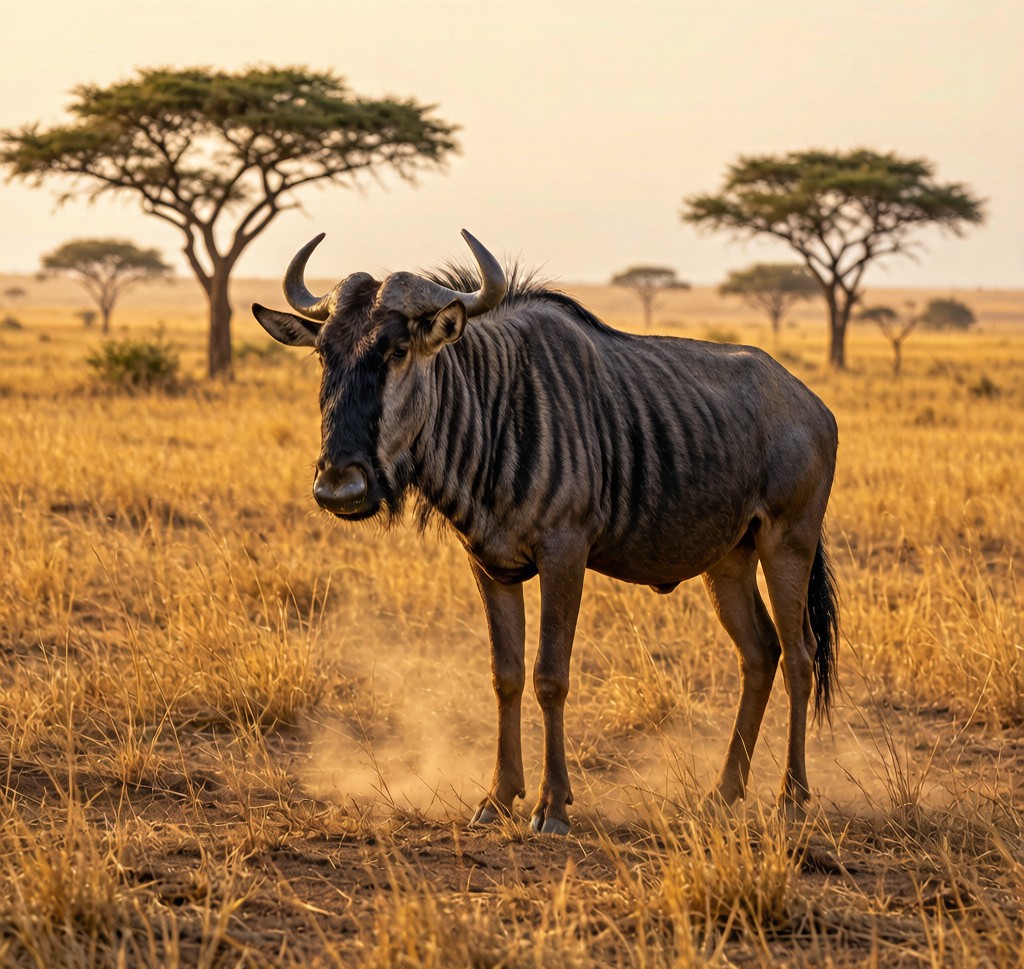
A Blue Wildebeest (Connochaetes taurinus) standing in the golden African savanna with acacia trees in the background
Overview
The Blue Wildebeest (Connochaetes taurinus), also known as the common wildebeest or brindled gnu, is one of the most abundant and iconic large mammals in Africa. Famous for its role in the Great Wildebeest Migration – the largest mammal migration on Earth, involving over 1.5 million individuals – the blue wildebeest is a large, powerful antelope characterized by its muscular front shoulders, long, beard-like mane, and distinctive curved horns that sweep downward, outward, and upward. Despite their somewhat awkward appearance, wildebeests are remarkably athletic animals capable of running at speeds of up to 80 kilometers per hour and sustaining these speeds over long distances during their annual migrations.
Adult blue wildebeests weigh 140 to 290 kilograms for males and 110 to 180 kilograms for females, with males being significantly larger and darker than females. Their coat is typically a bluish-grey to brownish-grey, with darker vertical stripes on the flanks that give them a brindled appearance – the feature that gives the species its alternative common name. Their head is large and ox-like, with a broad, bulbous muzzle and curved horns that meet at the base in a boss. Blue wildebeests are critical to the ecology of the Serengeti-Mara ecosystem, and their grazing patterns and migratory behavior shape the structure of the grassland itself.
Great Migration
The Great Migration of the blue wildebeest is one of the most spectacular natural events on Earth. Each year, approximately 1.5 million wildebeest, accompanied by 300,000 Thomson’s gazelles and 200,000 zebras, follow the rains and fresh grass across the vast Serengeti-Mara ecosystem of Tanzania and Kenya. The migration is a circular journey of approximately 800 to 1,000 kilometers, driven by the animals’ need to track seasonal rainfall patterns and the resulting flush of nutritious new grass growth.
The wildebeest follow a predictable route: they calve in the shortgrass plains of the southern Serengeti from January to March, when approximately 400,000 to 500,000 calves are born within a 2 to 3 week period – the most synchronized birth of any large mammal in Africa. The concentrated births are an antipredator strategy: so many calves are born simultaneously that predators cannot possibly eat them all, giving most calves a chance to survive. The calves are able to run within minutes of birth and keep pace with the herd as it begins its northward migration toward the Mara River crossing in July to September – one of the most dramatic wildlife events, where tens of thousands of wildebeests surge across the crocodile-infested waters of the Mara River.
Ecology and Predators
The blue wildebeest plays a fundamental role as an ecological engineer in the Serengeti. As the dominant grazer of the ecosystem, their grazing maintains the open grassland structure that benefits dozens of other species, including Thomson’s gazelles, zebras, and the predators that depend on them. Their migration pattern prevents any single area of grassland from being overgrazed and allows vegetation to recover in areas where the herd has moved on.
As a prey species, the blue wildebeest supports one of the richest predator communities in Africa. Lions are the primary predators of adult wildebeest, with individual lions preferentially hunting wildebeest over other available prey. Cheetahs take primarily wildebeest calves, and spotted hyenas are highly effective wildebeest hunters, capable of running down even adult wildebeest through sustained pursuit. Perhaps most dramatically, the annual wildebeest migration provides a critical seasonal food source for Nile crocodiles in the Mara River, which gorge themselves on migrating wildebeests during the river crossings. The migration thus drives predator populations and ecosystem dynamics across a vast area of East Africa.
Conservation
Despite its great abundance – there are approximately 1.5 to 2 million blue wildebeests in East Africa – the species faces significant threats and its populations are declining in some parts of its range. The major threat is habitat loss and fragmentation: the conversion of rangeland to agriculture, the establishment of fences that block migration routes, and the expansion of human settlements all reduce the area available to wildebeest and prevent them from completing their historic migration patterns.
The blue wildebeest is listed as Least Concern globally on the IUCN Red List, reflecting its large numbers in East Africa. However, populations in South Africa have declined dramatically from historic levels, and the western white-bearded wildebeest subspecies (C. t. cooksoni) in Zambia’s Liuwa Plain is listed as Vulnerable. The species is also vulnerable to climate change, as shifts in rainfall patterns could disrupt the timing and predictability of the migration, and droughts – which already cause significant mortality during dry years – are expected to become more severe and more frequent. Conservation efforts focus on protecting migration corridors, reducing fence barriers, managing water resources, and maintaining the open rangeland conditions that wildebeest require to thrive.