 By st20113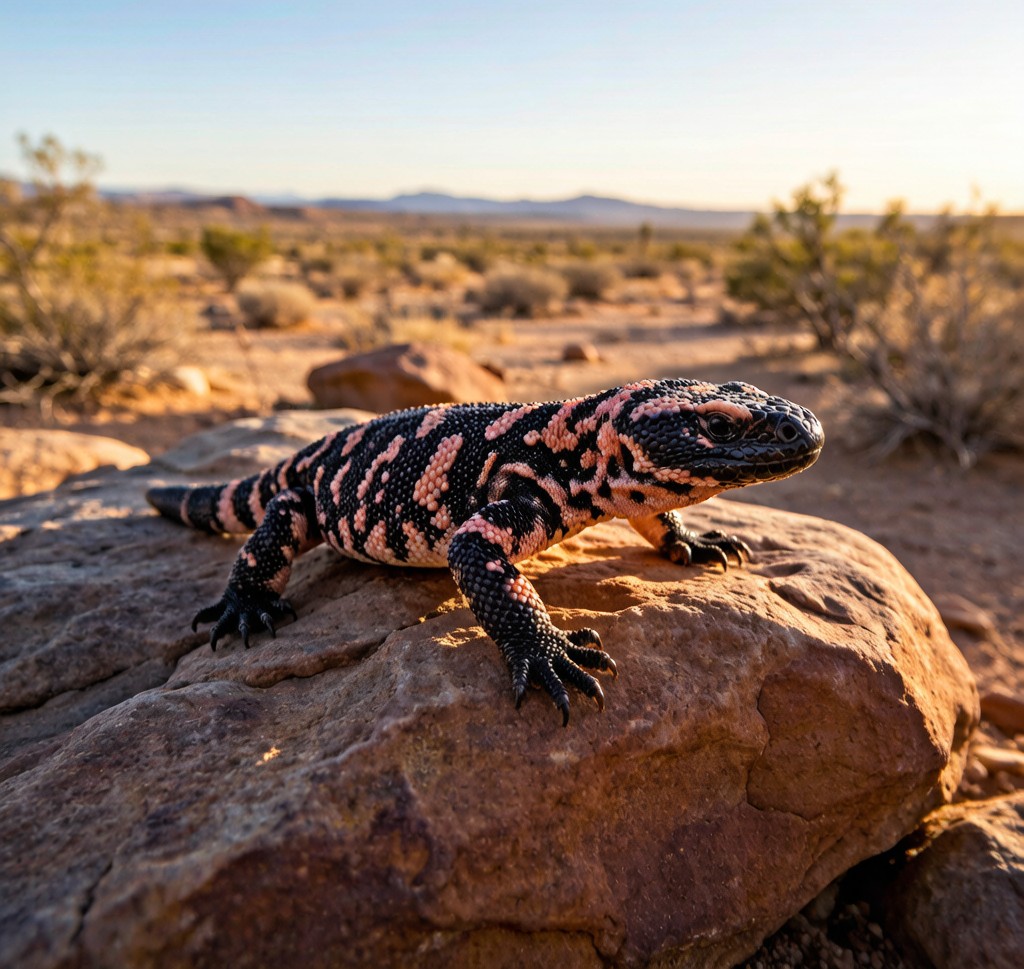
A Gila Monster (Heloderma suspectum) on sun-warmed rocks in the Sonoran Desert, displaying its distinctive black and pink-orange bead-like skin
Overview
The Gila Monster (Heloderma suspectum) is one of only two species of venomous lizards in the world and the most venomous lizard native to the United States. Found in the arid and semi-arid regions of the southwestern United States and northern Mexico, the Gila Monster is a large, heavy-bodied lizard with one of the most striking appearances in the reptile kingdom: a black body covered in bead-like scales of vivid pink, orange, and yellow that create intricate reticulated patterns across its back and sides. Reaching lengths of 30 to 60 centimeters and weighing up to 2.3 kilograms, the Gila Monster is the largest native lizard in the United States.
Despite its fearsome reputation, the Gila Monster is a sluggish, docile creature that poses virtually no danger to humans if left alone. Its venom – delivered through grooves in its lower jaw teeth rather than injection via fangs as in snakes – is used exclusively for defense and is rarely fatal to healthy adult humans, though it causes excruciating pain, swelling, and systemic symptoms. The species’ name comes from the Gila River basin of Arizona, where the species was first scientifically described. Gilas are long-lived for their size, with individuals surviving 20 to 30 years in the wild and over 35 years in captivity.
Habitat and Distribution
Gila Monsters inhabit the desert and semi-desert regions of the southwestern United States and northwestern Mexico, ranging from southern Nevada and southwestern Utah through Arizona, southeastern California, the Colorado Desert, and south through Sonora and Sinaloa in Mexico. Within this range, they occupy a diversity of arid habitats including the Mohave and Sonoran Deserts, thornscrub valleys, oak woodland margins, and rocky slopes with sufficient crevice cover for shelter.
The Gila Monster’s habitat requirements are dictated primarily by its need for thermoregulation and shelter. As an ectotherm that relies on external heat sources, the Gila Monster must balance exposure to the sun with the risk of overheating, and it achieves this by using underground burrows, rock crevices, packrat nests, and abandoned animal burrows as thermal refuges during the hottest parts of the day and throughout the night. During the winter months (November to February), Gilas enter a state of brumation – the reptilian equivalent of hibernation – remaining underground for up to 90 percent of the season and emerging only on warm, sunny days. They are most active during the spring months of March and April, when breeding occurs and they emerge to feed intensively.
Diet and Venom
The Gila Monster is a specialized predator whose diet is unusual among large lizards. Unlike most large lizards that are opportunistic carnivores, Gilas feed almost exclusively on the eggs of birds and reptiles – particularly quail, roadrunners, and desert tortoises – and on newborn mammals such as packrat pups. This dietary specialization is reflected in the species’ extremely slow metabolism: a Gila Monster may consume a meal equivalent to 35 to 50 percent of its body weight and then not feed again for several weeks or even months. After a large meal, the lizard may remain inactive for days while digesting.
The Gila Monster’s venom is produced by modified salivary glands in its lower jaw and delivered through grooved teeth when the lizard chews on prey or a perceived threat. The venom contains multiple bioactive compounds, including gilatoxin (a potent neurotoxin that disrupts nerve function) and helodermin (which causes hypotension and intestinal distress). While a bite from a Gila Monster is extremely painful and can cause local swelling, weakness, and nausea, fatalities in humans are extremely rare and mostly limited to children, elderly individuals, or those with compromised immune systems. The venom has proven scientifically valuable: exendin-4, a compound isolated from Gila Monster saliva, has been developed into the drug exenatide, used to treat type 2 diabetes.
Conservation
The Gila Monster is listed as Near Threatened on the IUCN Red List, with populations declining in parts of its range. Despite legal protection in all U.S. states where it occurs (it is illegal to harm, capture, or kill Gila Monsters in Arizona, California, Nevada, New Mexico, and Utah), the species faces significant threats including habitat loss and fragmentation from urban and agricultural development, direct mortality from vehicles on roads, illegal collection for the pet trade (particularly juveniles and eggs), and predation by introduced species including domestic dogs and cats.
The greatest long-term challenge for Gila Monster conservation is the species’ extremely slow reproductive rate. Females lay only 3 to 13 eggs every one to two years, and eggs are extremely vulnerable to predation and environmental conditions. Hatchlings are small and highly vulnerable to predation, and survival to adulthood is low. These factors mean that populations that experience increased adult mortality from roadkill or illegal collection can take many years to recover. Conservation strategies include road crossing infrastructure (wildlife underpasses at known Gila Monster crossing points), public education campaigns to reduce illegal collection, and protection of key habitat areas through conservation easements and management agreements with private landowners.