 By st20113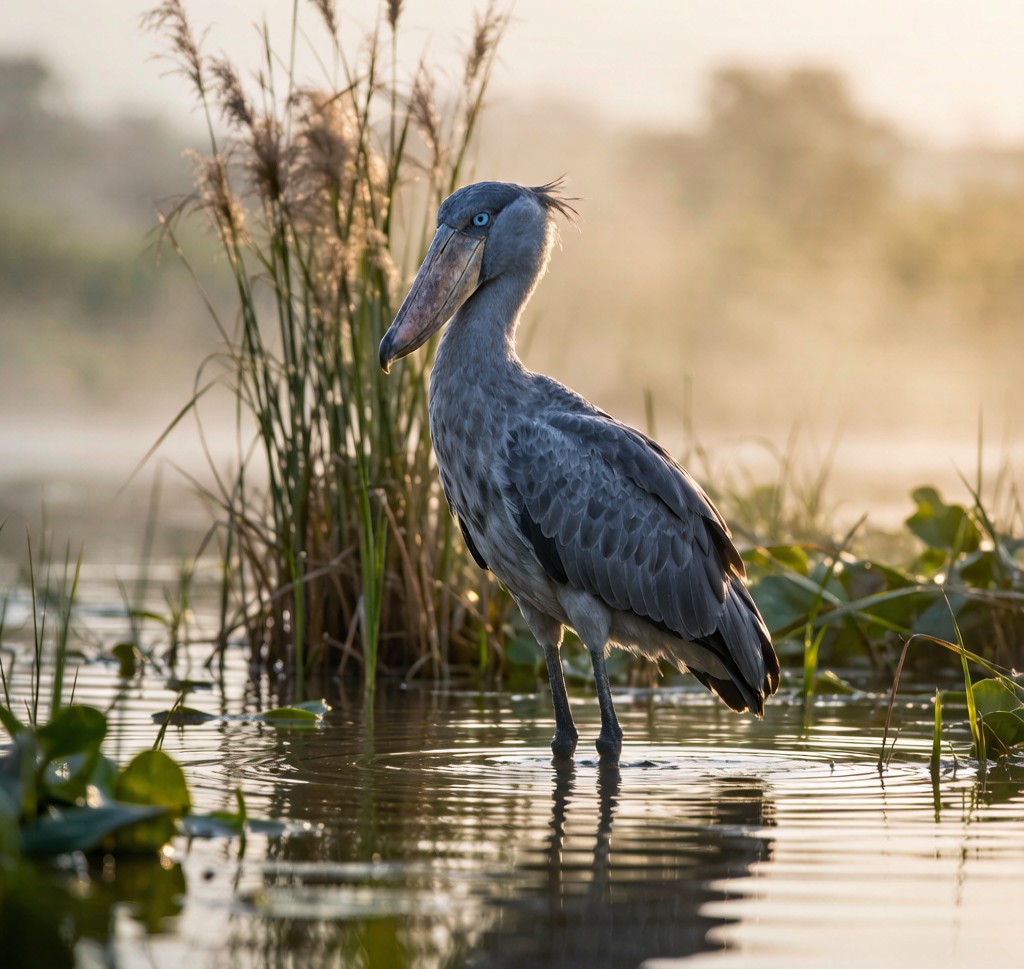
A Shoebill (Balaeniceps rex) standing in shallow swamp water in Central African wetland, showing its enormous shoe-shaped bill
Overview
The Shoebill (Balaeniceps rex) is one of the most bizarre and visually striking birds on Earth. Found in the vast tropical freshwater swamps of Central and East Africa, the Shoebill is named for its extraordinary shoe-shaped bill – an enormous, grotesque structure that is unlike the bill of any other living bird species. With a height of 110 to 150 centimeters and a wingspan reaching 230 to 260 centimeters, the Shoebill is one of the tallest and most impressive birds in Africa, and its prehistoric appearance evokes the giant birds of the dinosaur era.
The Shoebill’s bill is its most remarkable feature, measuring approximately 20 to 24 centimeters in length and 10 to 12 centimeters in width at the base. Its shape – broad, deep, and rounded at the tip like an old wooden shoe – is uniquely suited to its hunting strategy: the bill can be brought up sharply under the water’s surface with explosive speed to create a suction force that sucks prey into the mouth. The bill is also equipped with sharp hook-like mandibles capable of decapitating large fish and killing Nile monitor lizards. Shoebills are estimated to number approximately 3,300 to 5,300 individuals in the wild.
Habitat and Distribution
The Shoebill has one of the most restricted ranges of any large African bird, occurring primarily in the enormous swamp systems of tropical Central and East Africa. The species’ core range includes South Sudan (particularly the Sudd swamp system, which is one of the largest freshwater wetlands in the world), the Bangweulu Swamps of Zambia, the沼泽 of northeastern DR Congo, Uganda’s marshes around Lake Albert, and isolated populations in Tanzania’s Malagarasi wetlands and Rwanda’s Rutsindu swamp. A small, possibly disjunct population is also reported from western Ethiopia.
The Shoebill’s habitat is extremely specific: it requires extensive, undisturbed freshwater marshes with floating vegetation, particularly areas of papyrus (Cyperus papyrus) and ambatch swamp, with water depths of 10 to 50 centimeters, good visibility, and abundant prey. The species is highly sensitive to human disturbance and is rarely found near settlements or in areas with regular boat traffic. It is a solitary nester, with breeding pairs maintaining territories of 3 to 7 square kilometers. The combination of highly specific habitat requirements and a naturally small global population makes the Shoebill particularly vulnerable to habitat destruction.
Diet and Feeding Behavior
The Shoebill is an ambush predator that hunts primarily from a standing position, standing motionless for hours in shallow water waiting for prey to approach within striking range. This patient, statue-like hunting behavior – described by observers as one of the most mesmerizing sights in the natural world – is accompanied by a remarkable feeding technique. When prey is detected, the Shoebill lunges downward with extraordinary speed, using its bill like a submerged shotgun: the bill is brought up sharply, creating a powerful suction that draws the prey into the mouth along with large quantities of water. The water drains through the sides of the bill while the prey is retained.
The Shoebill’s diet consists primarily of lungfish (which make up approximately 60 to 70 percent of its diet in some areas), catfish, and other large fish. It also takes Nile monitor lizards, snakes, baby crocodiles, turtles, frogs, and occasionally small waterbirds. Its powerful bill and neck musculature allow it to tackle prey up to 50 centimeters in length. Remarkably, Shoebills have been documented swallowing lungfish whole despite the fish’s spines – a testament to the extraordinary flexibility of the Shoebill’s gape and digestive system.
Breeding and Conservation
Shoebills are believed to be monogamous, though little is known about their breeding biology in the wild due to the extreme remoteness of their habitat. They build large, flat platform nests of aquatic vegetation on the ground or on floating vegetation, typically laying 1 to 3 eggs (most commonly 2). Both parents share incubation duties over approximately 30 days, and both feed the chicks by regurgitation. Like many large wetland birds, Shoebills are sensitive to human disturbance during breeding, and pairs that are frequently flushed from their nest typically abandon it.
The Shoebill is listed as Vulnerable on the IUCN Red List, with population trends described as decreasing. Major threats include habitat destruction through drainage of wetlands for agriculture, oil exploration activities in South Sudan and DR Congo, poaching for the illegal bird trade (Shoebills command extremely high prices as exotic pets, though they almost never survive captivity), and subsistence hunting. The birds’ large body size makes them easy targets, and their slow reproductive rate (typically raising only one chick every two years) means populations recover extremely slowly from any additional mortality. Conservation efforts focus on protecting key swamp habitats, reducing disturbance at known nesting sites, and improving understanding of the species’ distribution and population through dedicated surveys.