 By st20113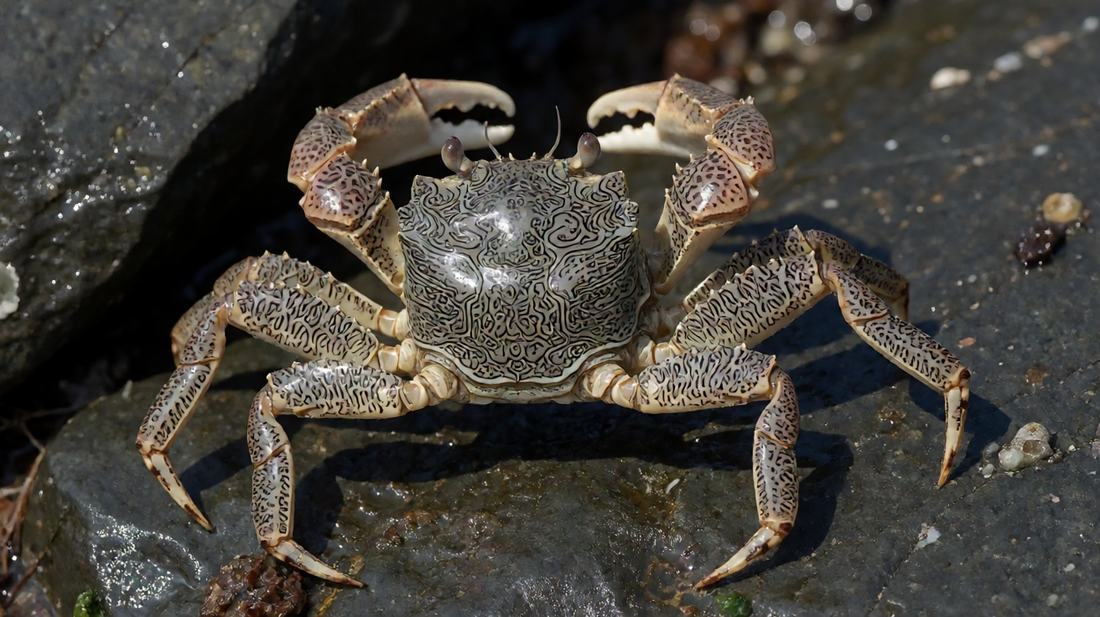
Pachygrapsus marmoratus | Marbled Crab
Species Profile · Grapsidae
Marbled Crab
A square shelled crab of rocky shores whose fine marbled pattern hides it on wet stone, and which can stay out of water for hours at a time.
A fast marbled crab that lives on rock above the tide line
Shell
Claws
Legs
Out of water
Brood
Life
The marbled crab
A fast runner of rocky shores
The Marbled Crab is a fast runner of rocky shores. It is 1 of the commonest crabs of the Mediterranean. It lives in cracks above the waterline.
It can stay out of water for hours. It runs sideways over the rock at speed. It climbs a vertical wall with ease.
It eats green algae and dead animals. It is quick to hide from a visitor.
Family tree
Decapoda, Grapsidae
The Marbled Crab sits in the phylum Arthropoda. Its class is the Malacostraca. Its order is the Decapoda. Its family is the Grapsidae, the shore crabs.
Our crab shares the family group with the Green Shore Crab. That crab has a smooth green shell. It lives on sand and mud below the tide line. Our crab has a marbled shell.
It lives high on bare rock. The 2 species both walk sideways. Both also moult their shell to grow.
4 cm and a marbled shell
How to tell one
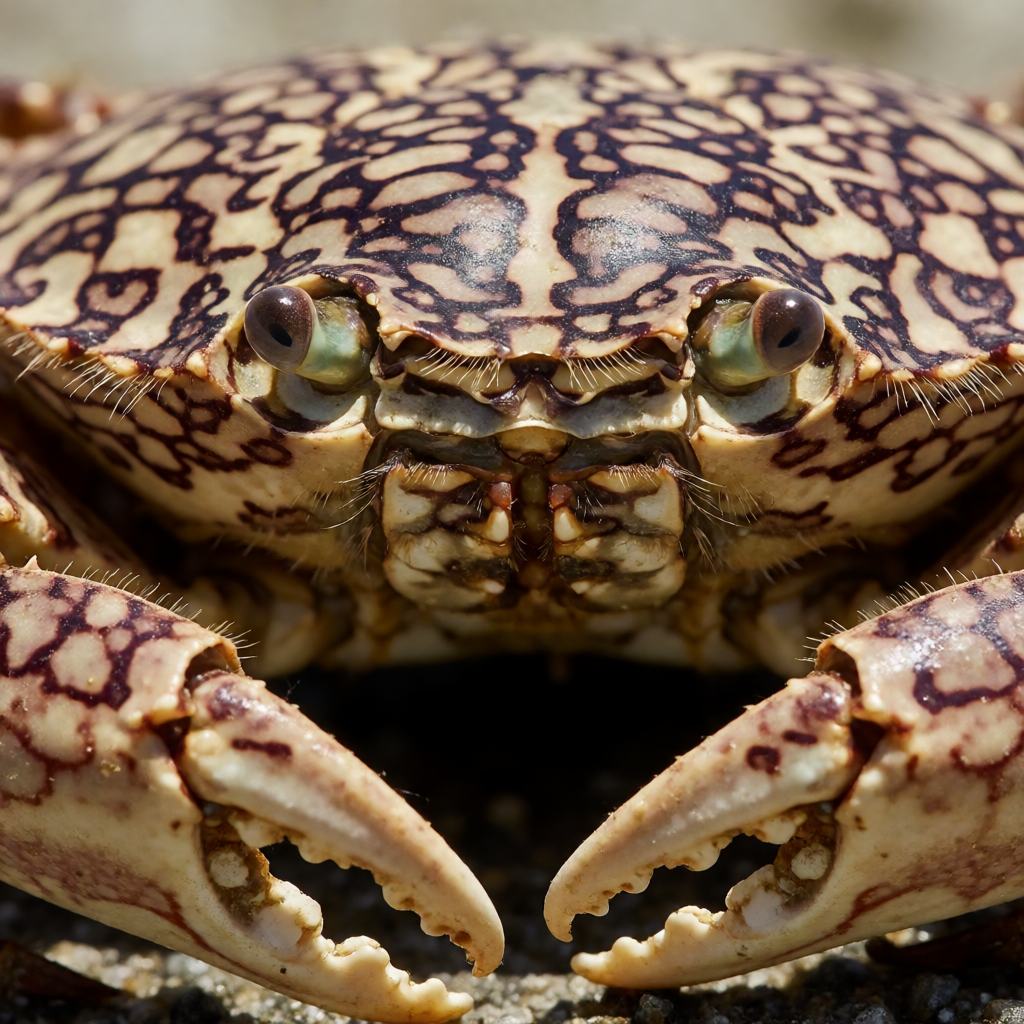
The shell may reach about 4 cm across. The shell is squarish and rather flat. The surface carries a maze of fine dark lines. That pattern gives the crab its name.
The colour ranges from olive to almost black. The animal has 2 broad claws. Each claw carries a row of small teeth. The legs are flattened and stout.
The last pair of legs sits high on the body. Fine hairs fringe each leg. Those hairs help the crab grip wet stone. The eyes sit on short stalks at the front.
1
2
3
Rock above the tide and sea walls
Where it lives
The species lives on rocky shores and harbour walls. It favours the upper zone above the tide. It hides in a crack or under a stone. It also lives in a hole in a sea wall.
It needs water close by for its gills. It can breathe air when the gills stay wet. It dislikes long dry spells in hot sun. The animal is most active at low tide.
It moves fast over the bare rock. A rough shore with many cracks suits it best.
Algae, barnacles and carrion
What it eats
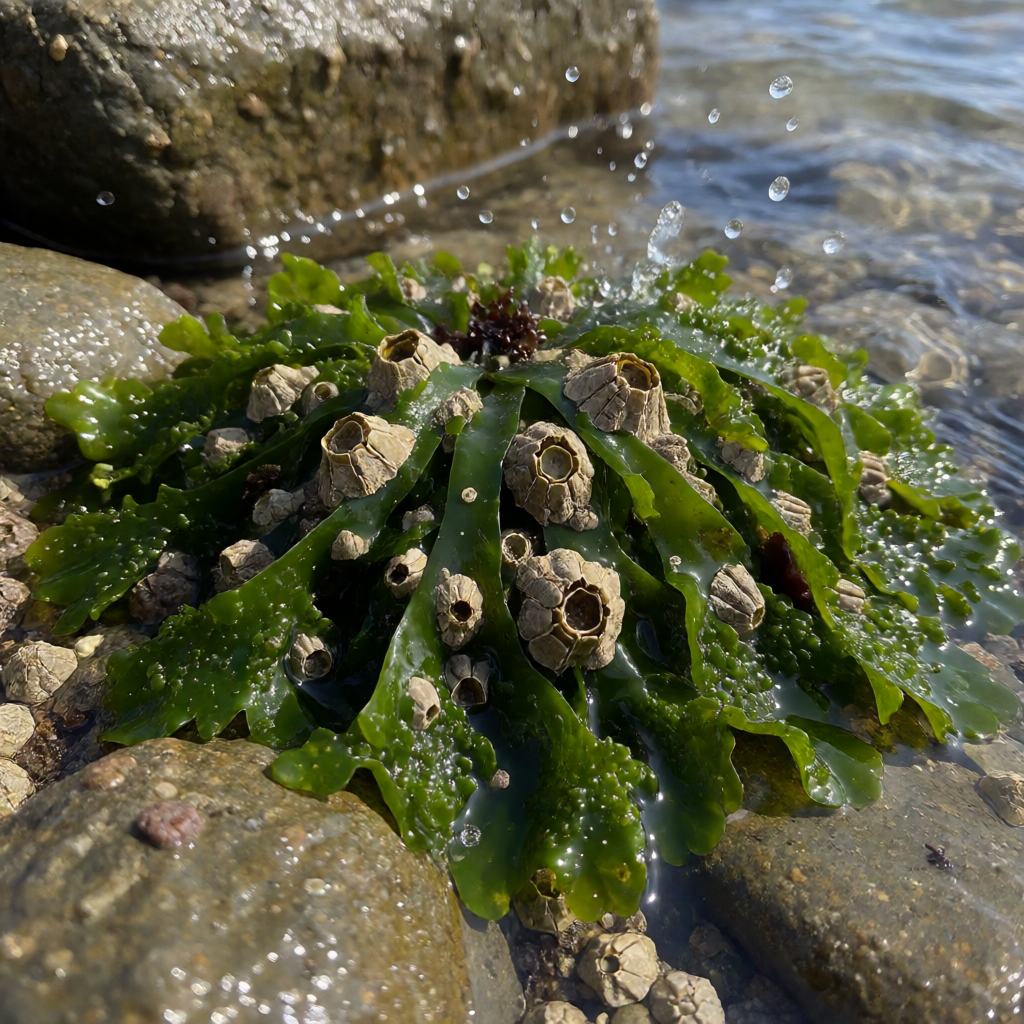
The Marbled Crab is an eater of many things. It grazes on green algae. It also takes dead fish and dead crabs. It eats barnacles and small limpets.
The animal uses its claws to tear food. It also scrapes algae from the rock. It feeds mostly at low tide. It may travel some distance to find food.
It hides at once if a shadow falls. It can live for weeks on very little food.
Eggs carried for a month
The breeding cycle
The male and the female mate in summer. The male waves his claws to attract a mate. The female then carries a mass of eggs. The eggs stick under her body.
She holds them for about 1 month. She then releases the young into the sea. The young is a tiny drifting larva. It drifts with the current for some weeks.
It then settles on a rocky shore. It grows fast in warm water. The animal may live for about 3 years.
Shores cleaned and walls repaired
Conservation
The Marbled Crab is not listed as endangered. It is very common on its shores. It has no legal protection. It suffers when a shore is cleaned of stones.
Building work on a sea wall also harms it. Poison against barnacles kills it too. The animal needs cracks and rough rock. A smooth wall offers it no shelter.
Its numbers are healthy at present. A shore left in its natural state helps it most.
Quick hits
Five things to remember
- Its shell is covered in fine marbled lines.
- It can run faster than a person walks.
- It can live out of water for many hours.
- It sheds a leg to escape the grip of a predator.
- The female carries her eggs under her body.