 By st20113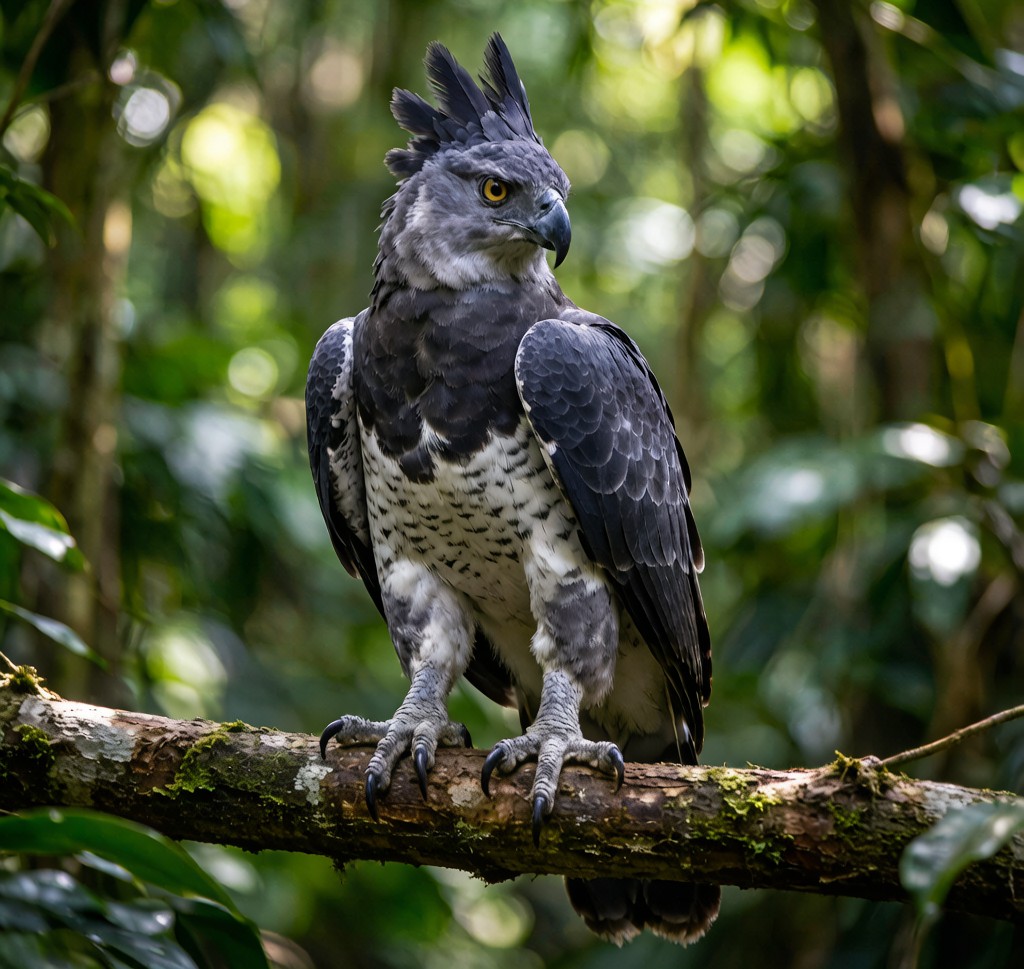
A Harpy Eagle (Harpia harpyja) perched on a branch in the Amazon rainforest, displaying its powerful talons and distinctive double crest
Overview
The Harpy Eagle (Harpia harpyja) is one of the largest, most powerful, and most distinctive eagles in the world. Inhabiting the canopy of lowland tropical rainforests from Mexico through Central America to Argentina, the Harpy Eagle is an apex avian predator capable of taking prey as large as monkeys, sloths, and deer. Its enormous size, deep gray plumage, dramatic black breast band, and distinctive double-crested head make it one of the most recognizable and sought-after raptors among birdwatchers and wildlife photographers.
Adult Harpy Eagles measure 86 to 107 centimeters in length and weigh 4 to 9 kilograms, with females being significantly larger than males. Their wingspan ranges from 176 to 201 centimeters. The species exhibits striking sexual dimorphism – females can be up to twice the size of males. Their powerful legs and feet, armed with claws measuring up to 9 centimeters long, are among the largest of any living eagle species, capable of exerting crushing grip forces.
Habitat and Distribution
Harpy Eagles inhabit the Amazon rainforest ecosystem and other tropical forests of Central and South America, from southern Mexico through Guatemala, Belize, Honduras, Nicaragua, Costa Rica, Panama, Colombia, Venezuela, the Guianas, Ecuador, Peru, Bolivia, Brazil, Paraguay, and northern Argentina. Their range is limited to large, contiguous tracts of undisturbed primary rainforest with tall canopy trees that provide nesting sites.
The species prefers the interior of humid lowland forests, typically below 900 meters elevation, though they have been recorded up to 2,000 meters. They are highly sensitive to forest fragmentation and logging, as they require large hunting territories – typically 100 to 150 square kilometers per pair – and tall trees for their enormous stick nests, which can measure up to 1.5 meters across and weigh over 100 kilograms.
Diet and Hunting Behavior
The Harpy Eagle is an ambush predator that hunts primarily in the forest canopy and mid-story, using stealth and explosive speed to capture prey. Its diet is remarkably diverse for a raptor, including arboreal mammals such as sloths and monkeys (including howler, capuchin, and spider monkeys), opossums, porcupines, coatis, and even young deer and peccaries. Birds such as toucans and macaws are also occasionally taken.
The eagle typically hunts from a perch, scanning the canopy for movement, then launching a rapid pursuit through the branches. Its short, broad wings are highly maneuverable in confined forest spaces – an adaptation that gives it an advantage over more agile monkey species. Once captured, prey is taken to a feeding perch or the nest. Studies of nest provisioning show that a single Harpy Eagle chick can consume up to 13 kilograms of food per week during peak growth periods.
Breeding and Life Cycle
Harpy Eagles are monogamous and appear to mate for life, with pairs remaining in their territory year-round. They build the largest nest of any raptor in the Americas – a massive platform of sticks constructed high in a kapok or emergently tall tree, typically 27 to 43 meters above ground. A pair may use and enlarge the same nest over multiple breeding seasons, with some nests documented at over 4 meters in height after years of reuse.
The female lays 1 to 2 white eggs (usually 2) and incubates them for approximately 53 days while the male provides food. If two eggs are laid, the second chick typically dies within days of hatching due to sibling competition – the first-hatched chick is aggressively dominant. The surviving chick fledges at approximately 95 to 110 days but continues to depend on its parents for food for 6 to 10 months after fledging. Young Harpy Eagles do not reach breeding age until 4 to 5 years old, and pairs breed only every 2 to 3 years, making population recovery extremely slow after disturbance.
Conservation Status
The Harpy Eagle is listed as Vulnerable on the IUCN Red List. Populations have declined dramatically across much of their range due to widespread deforestation for agriculture, cattle ranching, and logging. Even in Brazil’s Amazon, where vast tracts of forest remain, Harpy Eagle populations are highly sensitive to selective logging and forest fragmentation, which disrupts their prey base and nesting requirements.
Illegal hunting also poses a direct threat – eagles are sometimes shot by poultry farmers who view them as a threat to their livestock, or by poachers who target them for the illegal wildlife trade. Conservation measures include protecting large areas of primary forest, anti-hunting campaigns in rural communities, and captive breeding and reintroduction programs in countries such as Panama and Venezuela, where the species has been locally extirpated.