 By Iris
Dysdera crocata | Woodlouse Spider
Species Profile · Dysderidae
Woodlouse Spider
The two-tone hunter of the compost heap — a spider with six eyes and fangs longer than its head, built to pierce the armour of a woodlouse.
Common in gardens
Range
Length
Eyes
Fangs
Eggs
The two-tone hunter
Six eyes and a pair of tongs
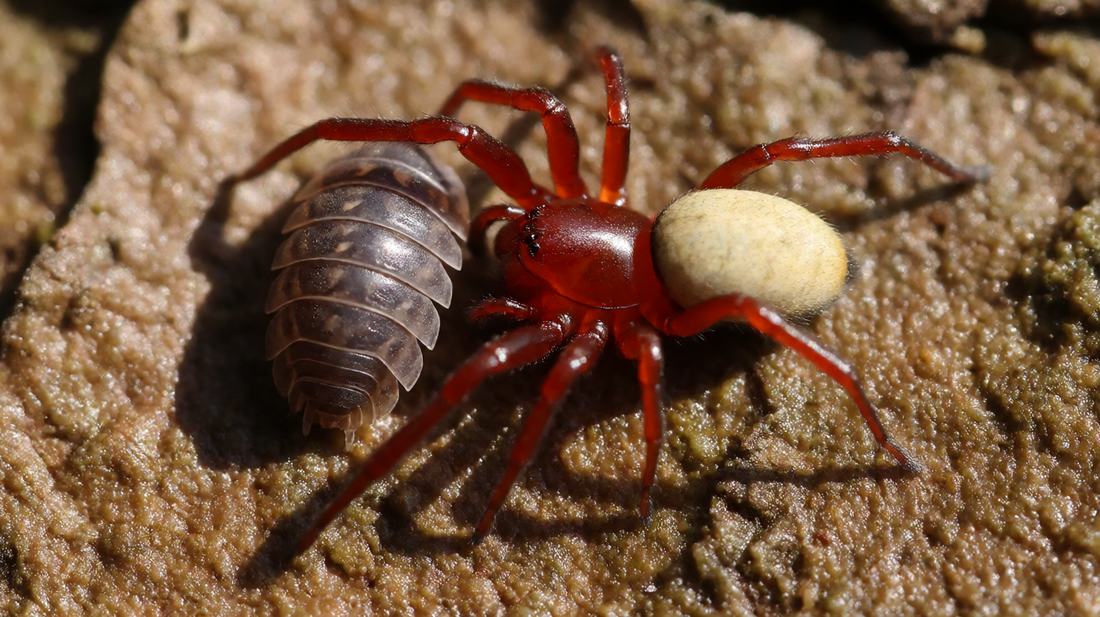
The Woodlouse Spider is one of the most striking spiders in Europe. It is also one of the few that most gardeners have seen. It is painted in 2 colours that do not look as if they belong together. The front half of the body and all the legs are a deep shiny red-orange. The oval abdomen is a pale cream or buff colour. It is covered in fine hairs.
The female is 11 to 15 mm long, and the male is a little smaller. So this is a heavy-bodied spider by European standards. Its most remarkable feature is the pair of fangs at the front of the head. They are longer than the fangs of any other common European spider. They point straight forward like a pair of curved pincers. The reason for their size is the food the spider eats.
Almost the whole diet is made up of woodlice. Woodlice are armoured animals related to crabs and shrimps. The great fangs are what it takes to reach through the plates and kill one. The species lives in gardens, compost heaps and cellars. It also hides under stones and flower pots. It came originally from the Mediterranean area.
Family tree
Dysderidae, the woodlouse hunters
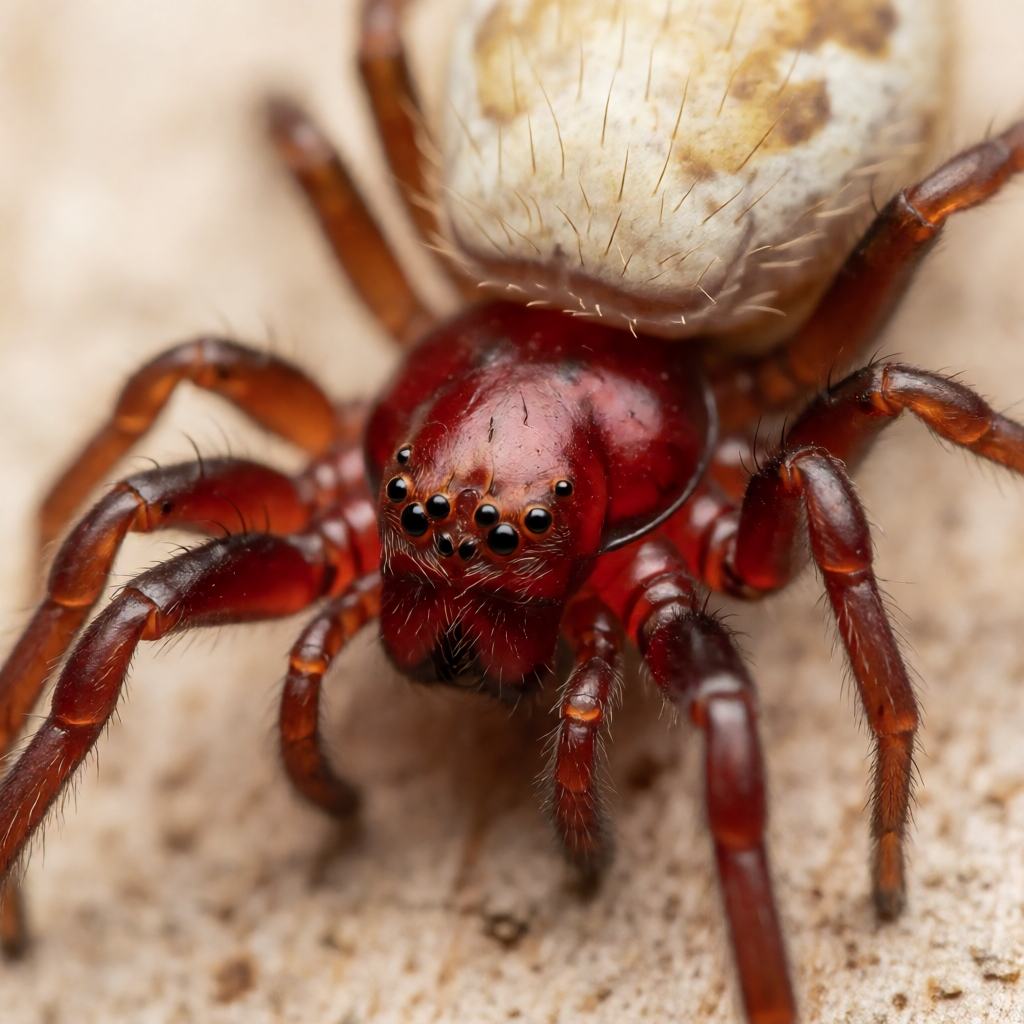
The Woodlouse Spider sits in the family Dysderidae, the woodlouse hunters. Its genus is Dysdera. It was named by C. L. Koch in 1838. The family holds a few hundred species. It is set apart from other spiders by 2 features. The first is the number of eyes. Almost every spider has 8 eyes, but the members of this family have only 6. In the Woodlouse Spider the 6 eyes sit in a tight oval group at the front of the head.
The second feature is the shape of the fangs. They are long. They join the head in a way that lets them swing forward. They act like tongs. The family sits in the great order Araneae, the spiders. Every member of that order has a body in 2 parts. It also has 4 pairs of legs and a pair of fangs that inject venom. The family is unusual in one respect. Its members have given up building a web to catch prey, and they hunt on foot instead. The genus Dysdera holds a number of very similar red-legged species.
The Woodlouse Spider is the one that has been carried around the world. It travels with soil, plants and garden pots. The genus name is Greek and refers to the difficult taxonomy of the group. The species name comes from the word for saffron, and it describes the deep orange-red of the legs. The Woodlouse Spider shares its order with the Garden Cross Spider. That spider builds a large orb web in every autumn garden. The 2 could hardly be more different. One sits in the middle of a web and waits. The other hunts on the ground at night, and it eats only armoured prey.
Red front, cream back
How to tell one
The female is 11 to 15 mm long, and the male is slightly smaller and slimmer. The body is in 2 parts. The front part carries the legs, the eyes and the fangs. It is coloured a deep shiny red-orange that looks almost like polished copper. The rear part is a rounded oval abdomen. It is a pale cream or buff colour, and it is covered in fine short hairs. The change from red to cream happens abruptly at the waist.
This 2-tone pattern is the easiest way to know the species. The 6 eyes sit in a tight oval cluster at the very front of the head, and they are small. The fangs are the outstanding feature. Each one is a long, curved blade with a dark tip. Together they are longer than the head itself. They are held forward rather than folded down, and that gives the spider a front-heavy look. The legs are fairly thick and carry a few strong spines.
The feet have 3 claws. The spider has no web. It makes only a flat silken cell, a small sheet of silk in a crack or under a stone. It sits there through the day. The body is covered in fine hairs that sense vibration. The spider uses these to find prey in the dark.
1
2
3
Compost, pots and cellars
Where it lives
The Woodlouse Spider needs damp ground with plenty of cover. It also needs plenty of woodlice, and gardens provide both. It lives under stones, planks, flower pots and compost heaps. It also hides in log piles and garden rubbish. It is often found in the soil beneath a pot that has stood for a while. It also lives in greenhouses, sheds, cellars and outbuildings, and it can be found in walls and rockeries.
In the countryside it lives in woods and hedgerows, and it hides under bark and on waste ground. It always chooses damp places with rotting plant material. The species is found right across Europe and around the Mediterranean. It has been carried by trade to North and South America. It also travels to southern Africa, Australia and New Zealand. In Britain it is common in gardens almost everywhere, particularly in the south.
It is often brought indoors in a plant pot, or found in a cellar. It is active at night and hunts on foot over the ground. During the day it stays in its silk cell. A person who lifts a stone or a pot will often find the spider sitting in a neat white pocket of silk. The empty husks of woodlice usually lie around it.
Woodlice, almost only
What it eats
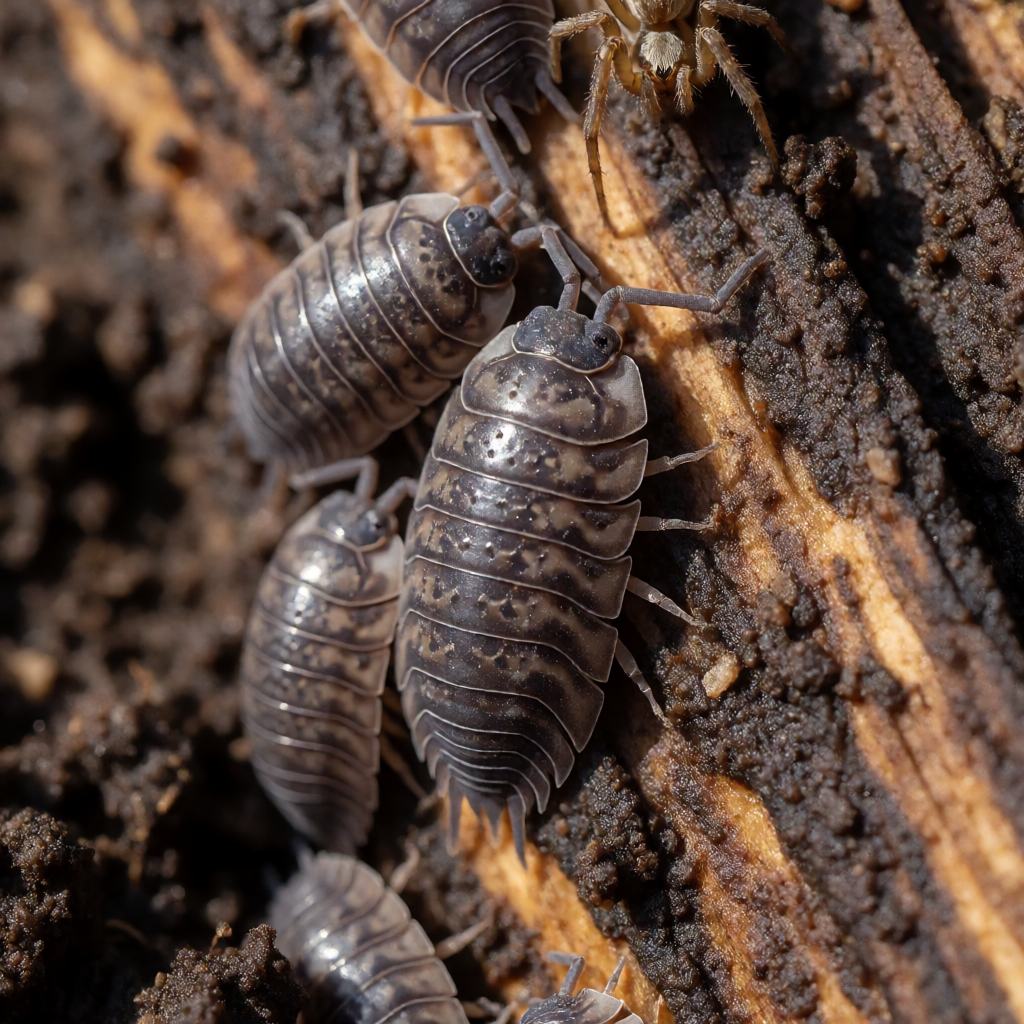
The Woodlouse Spider eats woodlice, and almost nothing else. Woodlice are not insects at all. They are land-living crustaceans, and their bodies are protected by a set of hard overlapping plates. Most predators find them difficult to deal with. That is why so many of them survive in gardens. The Woodlouse Spider has solved the problem with its fangs.
It hunts at night. It walks over damp ground and feels for prey with the hairs on its legs. When it finds a woodlouse it takes hold with its front legs. It turns the animal over, or forces its fangs between 2 plates. Then it drives the long fangs into the softer parts of the body. It injects venom, which paralyses the woodlouse, and eats it at its leisure.
The spider will also take other kinds of woodlouse. It will even take the ones that roll up into a ball, and it will sometimes eat other small animals. A single spider will kill a surprising number of woodlice in one night. The pile of dry grey husks in its silk cell is a clear sign that it has fed well. The spider can live for several weeks without food, and it will do so in cold weather.
A guarded egg sac
The breeding cycle
The Woodlouse Spider breeds in the spring and early summer. It is unusual among European spiders for the care the female gives her young. The male approaches the female with care. She is a large and powerful hunter, and she will treat him as food if he moves at the wrong moment. He drums on the ground with his front legs and his small feelers. The drumming signals what he is.
If the female accepts him, mating takes place after a period of courtship. The male holds her fangs with his own during the process. The female then spins an egg sac of white silk and stays with it. This is one of the few spider species in Europe in which the mother guards her eggs. She will defend the sac by turning to face anything that disturbs it. A single female can lay up to 70 eggs.
The young hatch after a few weeks and stay close to their mother for a short time. That is also rare among spiders. They then scatter to live on their own. The young are paler than the adults at first, and they gain the red colour as they moult. Females are long-lived for their size and may survive for 2 or 3 years.
Common, and helped by gardens
Conservation
The Woodlouse Spider has not been assessed on the global Red List. There is no suggestion that the species is at risk. It is common over its native range. It has also expanded its range greatly by travelling with people, so it is now found in gardens on several continents. Like all spiders in northern Europe, it has no legal protection, and none is needed. The species can only be harmed by the loss of damp, sheltered ground.
It needs rotting plant material. Gardens, compost heaps and log piles are exactly what it needs. The modern interest in compost has probably helped it. Untidy corners of the garden help it too. There are no management plans for the Woodlouse Spider anywhere. The one thing a person should know about it is the bite.
The species can bite if it is picked up or squeezed. The bite is painful, rather like a bee sting. It may leave a small red mark for a day or 2. There are no serious medical cases, and the spider is not aggressive. It should be left alone rather than handled, and it does far more good in a garden than harm.
Quick hits
Five things to remember
- It has only 6 eyes instead of the usual 8. They sit in a tight little oval group at the front of the head.
- Its fangs are longer than its head and point forward like pincers. It needs them to pierce the armour of a woodlouse.
- Woodlice are not insects but land-living crustaceans. This spider lives on small armoured relatives of the crab.
- The mother guards her egg sac and stays near her young for a while, which is rare among European spiders.
- The bite is painful, like a bee sting. There are no serious medical cases, though, and the spider is not aggressive.