 By Iris
Calopteryx splendens | Banded Demoiselle
Species Profile · Calopterygidae
Banded Demoiselle
The jewel of the slow river — a metallic damselfly whose males carry a broad dark band across the middle of every wing.
Declining where rivers are damaged
Range
Length
Mark
Water
Young
The jewel of the river bank
Bands of dark on shining wings
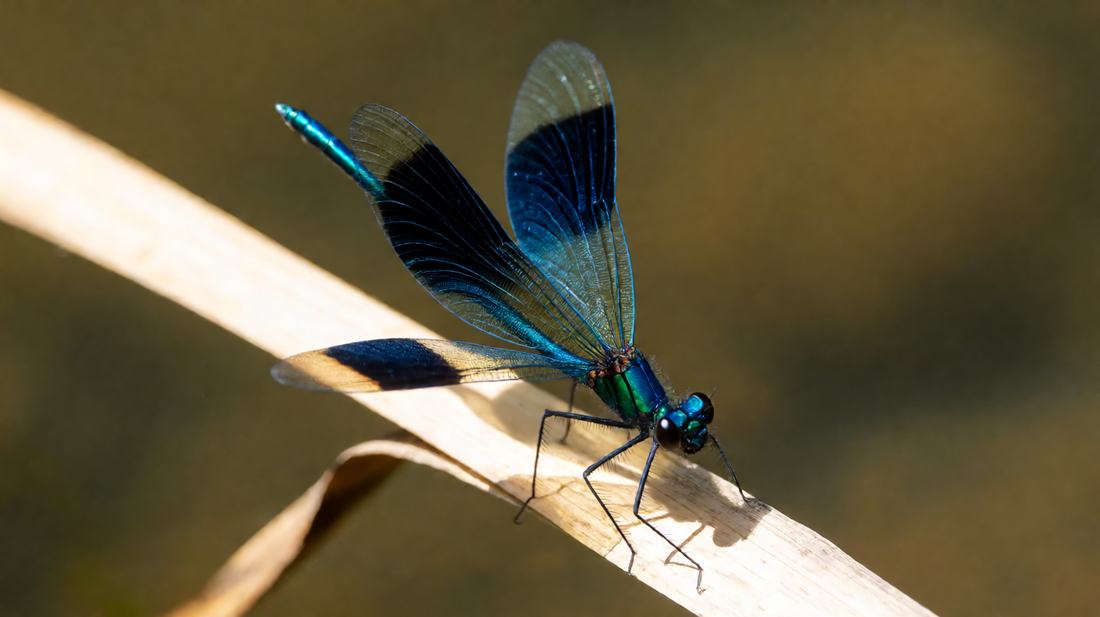
The Banded Demoiselle is one of the most beautiful insects of the European river bank. It is also the easiest damselfly in the region to recognise. The male is a slim insect about 45 to 48 mm long. His body is a shimmering metallic blue-green. Across the middle of each wing he carries a broad band of deep blue-black. The band is not a marking on the surface.
It is a patch of dark pigment inside the wing, and it gives the insect its name. The rest of the wing is clear glass with a faint sheen. When the male flutters along the water, the dark bands seem to flicker on and off. The female is a different colour. Her body is a metallic green with a bronze tint. Her wings are clear with a faint green wash, and she has a small white spot near the tip.
Both sexes have large, well-separated eyes and a slender body. Those features mark them out as damselflies. The species lives on slow rivers, canals and streams. It is found across most of Europe and on into Asia. It is one of the classic animals of a clean, slow waterway. It is a strong flier for a damselfly, and a stretch of river in July can hold dozens of them.
Family tree
Calopterygidae, the jewelwings
The Banded Demoiselle sits in the family Calopterygidae, the broad-winged damselflies. Its genus is Calopteryx. It was named by Harris in 1780. The family holds about 150 species. It is set apart from other damselflies by 3 features. The wings are broader than those of most damselflies, and they are held apart when the insect rests. The body is metallic and brightly coloured. The males of most species have dark patches or bands on the wings. This family is often called the jewelwings, because of the shine of the body.
In Europe the family is small. Only a handful of species live here, and 2 of them are widespread. One is the Banded Demoiselle. The other is the Beautiful Demoiselle. Its males have wings that are dark all over rather than banded. The 2 often live on the same river, and they can be told apart at a glance. The family sits in the order Odonata. That order holds the dragonflies and the damselflies. Every member of it spends its early life as a hunter in fresh water.
As an adult, every one of them catches its prey in flight. The genus name comes from the Greek for beautiful wing. The species name is Latin for shining. The Banded Demoiselle shares its genus with the Beautiful Demoiselle. That is the dark-winged species of the same rivers. Both need clean, slow water with plenty of plants. Both have declined where that habitat has been damaged.
Banded wings, metallic body
How to tell one
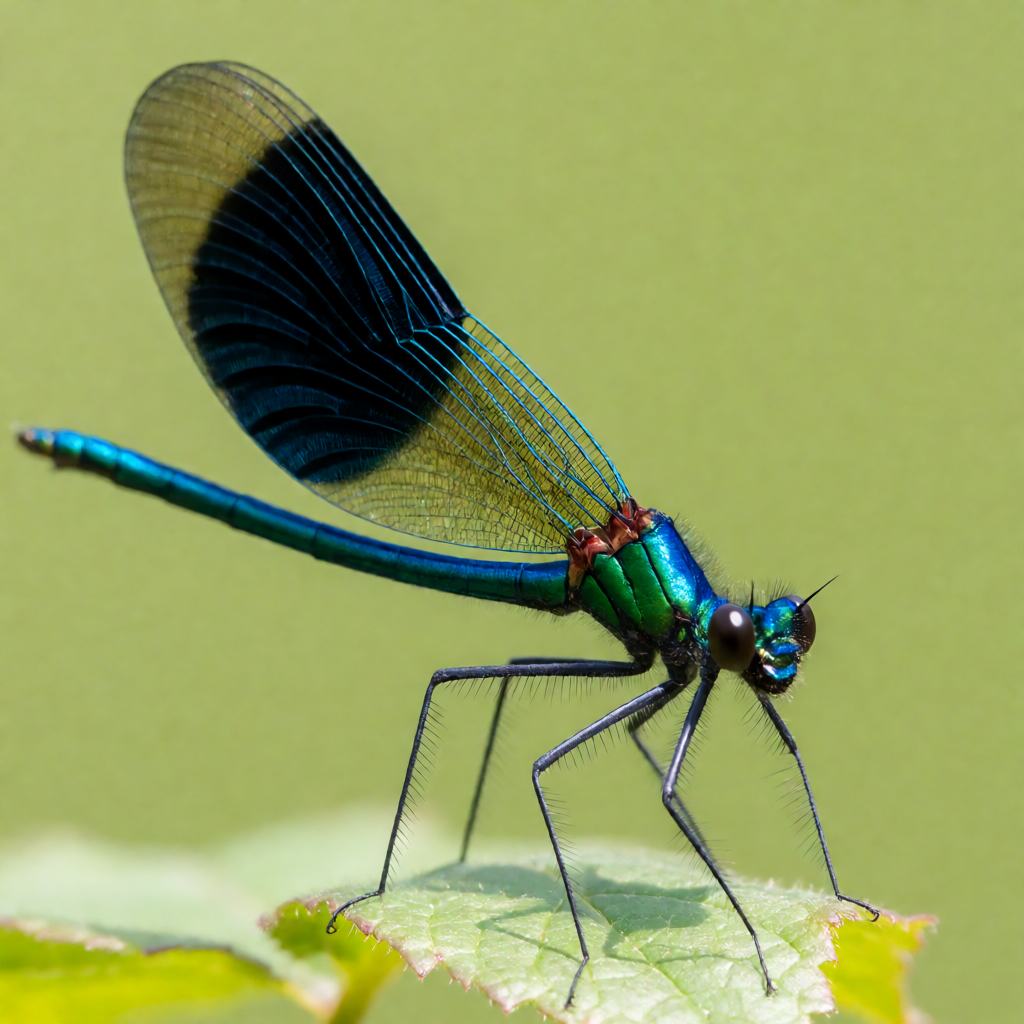
The adult is 45 to 48 mm long, and its wingspan is about 70 mm. The body is long and very slender, and it is built from 3 parts. The head carries 2 large eyes that sit far apart on the sides. This wide spacing is one way to tell a damselfly from a dragonfly. The middle part of the body carries the wings and the legs. The long rear part is made of 10 segments. The male has a metallic blue-green body.
His sheen changes with the light, and his underside is often a paler blue. Across each of his 4 wings runs a broad band of dark blue-black pigment. The outer part of the wing is clear. The female is a metallic green, sometimes shading to bronze. Her wings are clear with a greenish tint, and she has a small pale spot near the tip. The legs are long and thin and carry fine spines. They grip stems and hold prey.
The young are called nymphs, and they look nothing like the adult. They are dull brown or green, and they live in the water. Three leaf-like flaps at the end of the body work as gills. The nymph also has a special lower lip that folds out like a mask. It is shot forward to seize prey. A full-grown nymph is about 30 mm long.
1
2
3
Slow lowland rivers and canals
Where it lives
The Banded Demoiselle lives on slow-flowing water. It is found on rivers, canals, streams and larger ditches. The current is gentle, the bottom is muddy, and the banks carry plenty of tall plants. It needs plants in the water as well as on the bank. The female lays her eggs inside the stems of plants that stand in or over the water. The species is common on lowland rivers across England and Wales, and it is spreading north in Britain.
On the continent it is found from France and the Low Countries across central and eastern Europe. It reaches western Asia to the east. It avoids fast mountain streams and deep cold lakes. It also avoids water that is heavily polluted. The adults fly from May to August. They spend much of their time resting on the leaves of waterside plants.
Reeds, bur-reed, water lilies and the leaves of alder and willow all give good perches. On dull or windy days they shelter in the vegetation. The males hold small territories on floating leaves or patches of weed. They chase away other males and even large insects that come too close. The species is usually found below about 500 metres, and it is absent from the highest ground.
A hunter in air and water
What it eats
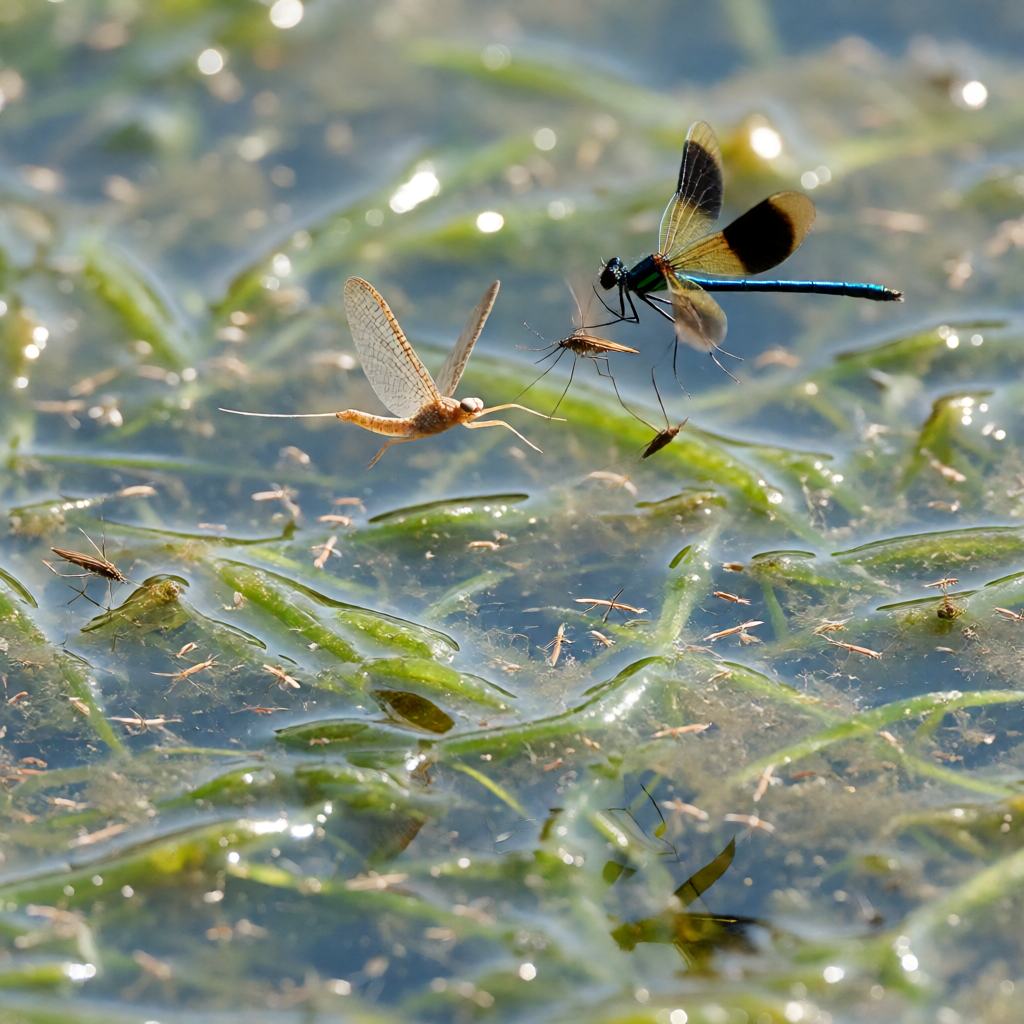
The Banded Demoiselle is a hunter in both of its lives. In both stages it feeds on other animals. The adult catches small insects in the air. It flies out from its resting place and snatches a midge or a small fly. It also takes a mayfly or a caddisfly with its spiny legs. Then it returns to a leaf to eat. The legs of a damselfly form a basket, so the insect can hold several small prey at once.
The eyes are large and give it excellent sight. It can pick out a moving insect against moving water. The adult hunts most actively in the warm part of the day. It may take several hundred small insects in a week. The nymph is a hunter of the water. It feeds on water fleas, small worms, insect larvae and the young of other water animals. It waits among the plants and shoots out its folding lower lip.
The strike takes a fraction of a second. The prey is pulled back to the mouth before it can escape. The nymph cannot chase a fast animal, so it depends on ambush. It also depends on the cover of plants. So a shortage of water plants means a shortage of food.
Eggs cut into plant stems
The breeding cycle
The Banded Demoiselle has 1 generation a year. Its life cycle takes longer than the flight season suggests. The adults come out in May and fly through to August. The male holds a small territory on a floating leaf or a patch of weed. He displays by fluttering his dark-banded wings. When a female comes near, he flies out and takes hold of her behind the head. The pair mate on a nearby plant.
The female then lays her eggs. She settles on a plant that stands in the water or leans over it. She uses a sharp blade at the end of her body to cut a slit in the stem. The slit is below the water line. She lays her eggs inside the stem, and she may stay under the surface for many minutes. The male keeps hold of her and stays with her through the process. The eggs stay in the plant stems through the winter and hatch in the spring.
The nymph lives in the water and grows slowly. In colder places it takes up to 2 years. When it is fully grown it climbs a plant stem out of the water. The adult then comes out of the nymph skin. The new adult rests while its wings harden, and then it flies.
Still common, but rivers are damaged
Conservation
The Banded Demoiselle has not been assessed as threatened worldwide. It is still common on suitable rivers over much of Europe. Local declines have been recorded in many countries though, and the causes are well understood. The species needs slow, clean water with plenty of plants. All 3 of those needs have been damaged in the last century. Rivers have been straightened, dredged and walled.
So the muddy shallows and the beds of water weed have gone. Pollution from farms and from treated waste has lowered the oxygen. It has changed the plant life as well. The removal of trees and tall plants along the bank has taken away the resting places of the adults. Work in Britain has shown that the species will return to a river. It comes back once the water is clean and the plants return.
Some populations have spread up rivers that were once too dirty. Other rivers have been lost altogether. The best measures are the control of pollution and the protection of natural banks. Dredging should also be timed so that it avoids the breeding season.
Quick hits
Five things to remember
- The dark band on the male’s wings is a patch of pigment inside the wing. It flickers on and off as he flutters along the water.
- The female cuts slits in the stems of water plants and lays her eggs inside them. She may stay under the surface for many minutes.
- The nymph has 3 leaf-like gills at the end of its body. It also has a lower lip that folds out like a mask to catch prey.
- It is a damselfly, so its eyes sit far apart on the sides of its head. The eyes of a dragonfly nearly touch.
- The young live in the water for up to 2 years. Then they climb a stem to become the short-lived adult.