 By Iris
Pyrrhocoris apterus | Firebug
Species Profile · Pyrrhocoridae
Firebug
The red and black bug of the sunny town wall — a harmless crowd-forming insect that drills lime seeds with a fine beak and can barely fly.
Common, and not a pest
Range
Length
Mark
Wings
Broods
The red bug of the warm wall
Bold, common, and harmless
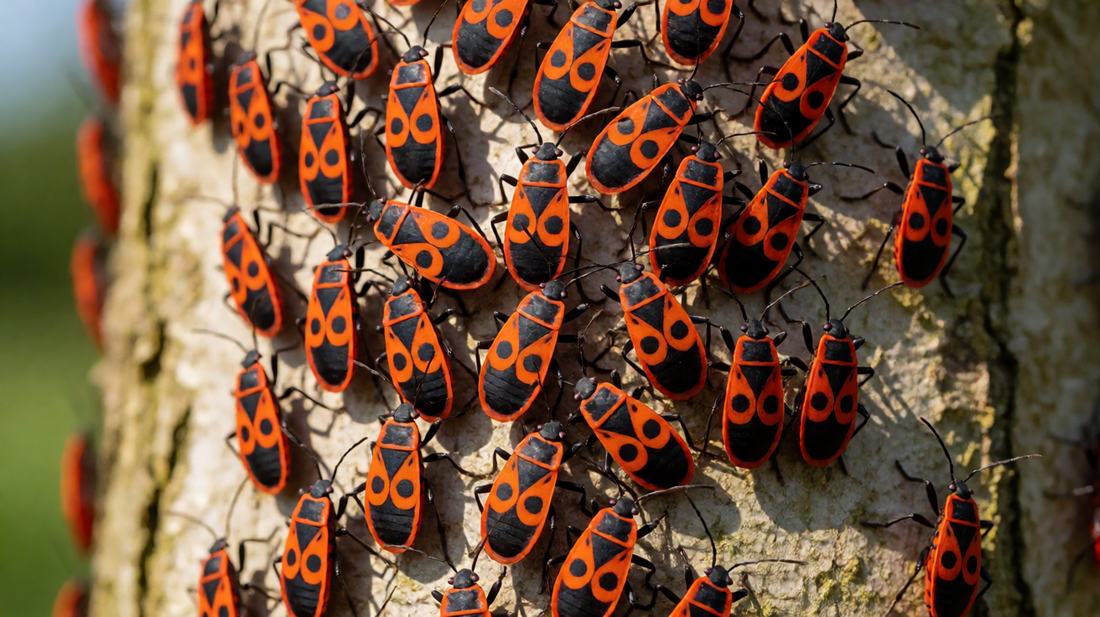
The Firebug is one of the boldest insects of the European town. Once it is seen, it is never forgotten. The adult is a small bug. It is between 10 and 12 mm long. It is painted in a bright warning red. The head, the antennae and the legs are black. Two round black spots sit on the red wing covers. A black triangle marks the middle of the back.
The pattern is so strong that the insect cannot be mistaken. The bugs gather in crowds. Dozens or even hundreds of them cluster on a warm tree trunk. They also gather on a stone wall or a fence post. There they sit in the sun. They look like a scatter of red and black beads. They are not pests. They do not bite people, and they do not damage buildings.
They do not spoil food either. They live almost entirely on the seeds of a few plants. The species is found across Europe and north Africa, and it also lives in much of Asia. It has been carried to other parts of the world. It has become more common as towns have grown. The warm walls and the lime trees of a city suit it perfectly.
Family tree
Pyrrhocoridae, the red bugs
The Firebug sits in the family Pyrrhocoridae, the red bugs. Its genus is Pyrrhocoris. Linnaeus named it in 1758. The family holds around 300 species. Most of them live in warm parts of the world. All of them feed on plants. Almost all of them are marked in red, orange or yellow, and the colour sits against black. The family sits in the great order Hemiptera, the true bugs. Every member of that order has a long pointed beak.
The beak folds under the head when it is not in use. Inside the sheath are fine needles. The bug uses them to pierce plant tissue. It can also pierce the body of an animal. Then it sucks out the liquid inside. True bugs do not chew. The Firebug pushes its beak into the hard coat of a seed. Then it drinks the contents. It has no jaws, and it cannot bite a person.
The species name means without wings. Most adults have short wings, and those wings do not reach the end of the body. The Firebug shares its order with the Pond Skater. That insect runs on the surface of still water. The 2 look nothing alike. One lives on trees and the other on water. But they sit in the same great order. Both feed through the same kind of piercing beak.
Red and black, with 2 spots
How to tell one
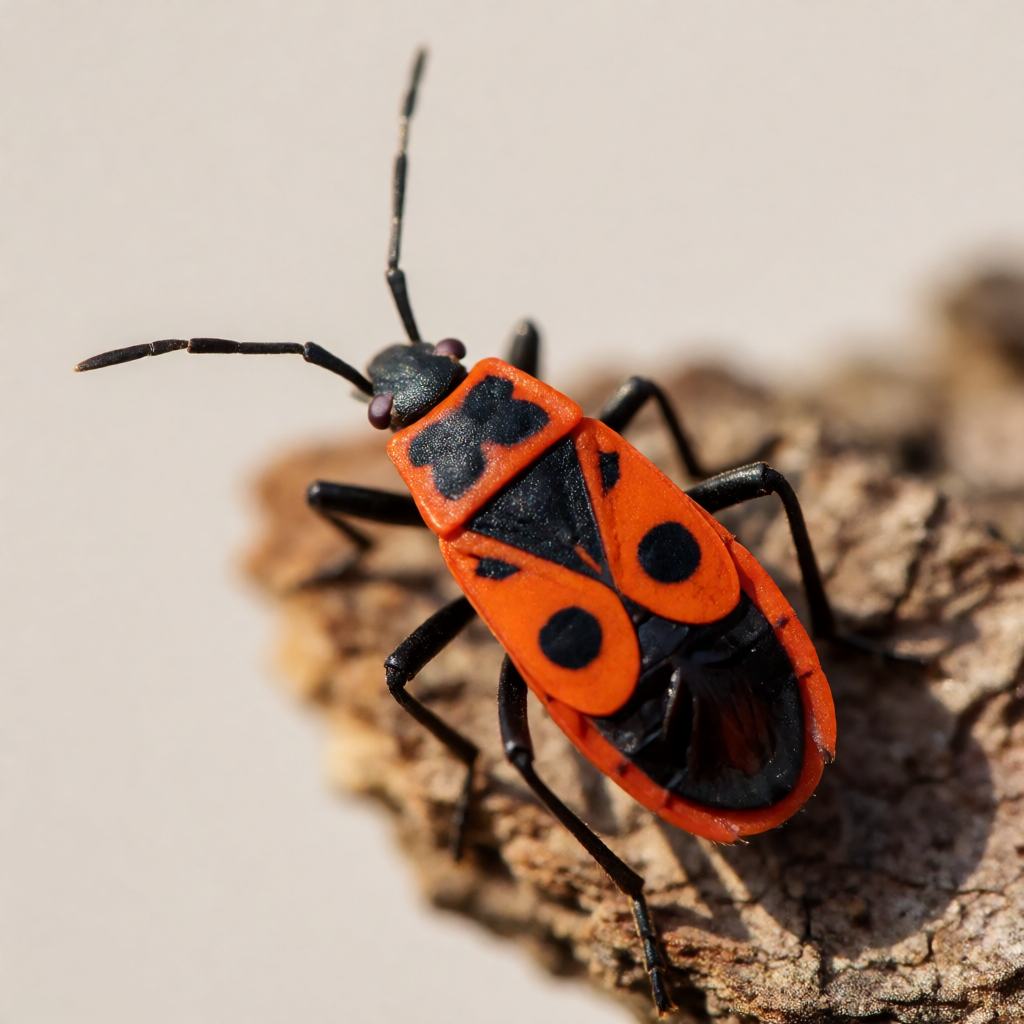
The adult is between 10 and 12 mm long, and it is rather flat. The flat shape lets it press into cracks in bark. The head is black and carries 2 black antennae. The front part of the body behind the head is red with a black edge. A small black triangle sits in the middle of the back. The wing covers are red. Each one bears a round black spot, so 2 black dots show on the red back. The legs are black. Underneath, the body is red or orange with black plates.
The whole insect is covered in tiny pits and short hairs. The red colour is a warning signal. It works. The body of the Firebug holds bitter chemicals. They taste bad. A bird that tries one will usually drop it, and it will not try another. This kind of warning pattern is found in many insects. A distasteful animal advertises itself with bright colours. The wings are the most interesting feature.
Most adults carry short wings. Those wings cover only part of the abdomen. That is why the species is called apterus. A small share of adults grows full wings. Those insects can fly, and they spread the species to new places. The young are called nymphs. They look like small adults, but they have no wings. They pass through 5 stages as they grow.
1
2
3
Lime trees, walls and kerbstones
Where it lives
The Firebug lives wherever its food plants grow. It does best in warm, open, sunny places. It needs a hard surface to sit on. Old lime trees are its favourite home. A row of mature limes along a street will hold a crowd of Firebugs. So will a row in a park. The insects sit on the bark in the sun.
They drop to the ground to feed on fallen seeds. In towns the species is common on walls, fences and kerbstones. It also gathers on gates and poles. It likes any warm surface with a little shelter. In the countryside it lives in hedgerows and on road verges. It also lives in waste ground and on the edges of woods. The Firebug is found from Portugal and Ireland across Europe, and it reaches central Asia to the east.
It also lives in north Africa. It has been carried to North America. There it has settled in towns in the eastern states and in California. It prefers low ground and mild winters. It is less common in cold mountains and in the far north. In a mild year a warm wall will hold the insects through the winter.
Lime seed, drilled and drained
What it eats
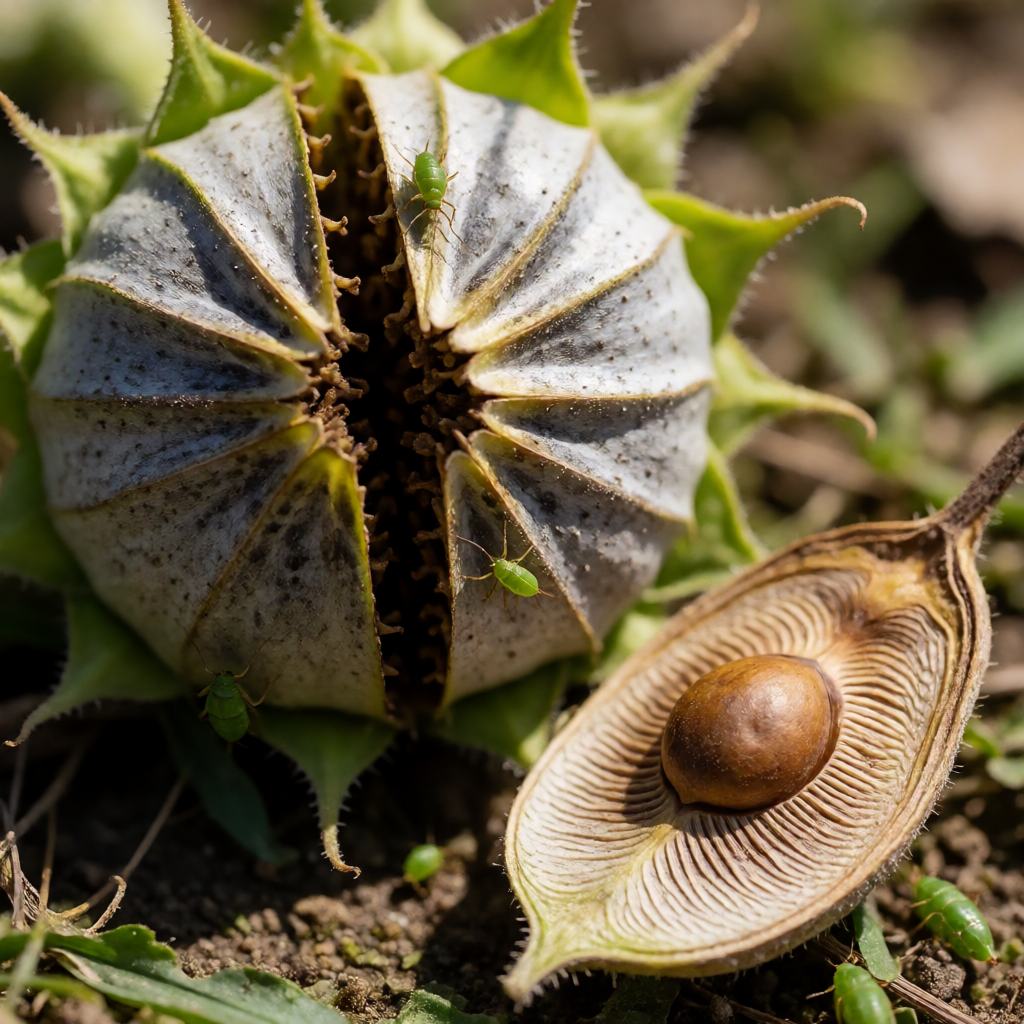
The Firebug feeds mainly on the seeds of plants in the mallow family. Of these the lime tree is the most important. The bug also takes the seeds of hibiscus, hollyhock and marsh mallow. It will feed on the fallen seeds of sunflowers as well. It also takes the seeds of the black locust tree. It does not chew the seed. It pushes its fine beak into the coat.
Then it injects a little digestive fluid. It sucks out the soft contents, and it leaves an empty shell. A large group of bugs can strip a patch of seeds in a few days. The Firebug also drinks plant sap. It will take sweet liquid from a cut stem or a damaged leaf. It cannot live on sap alone. The seeds are the real food of the species.
One reason the Firebug does so well in towns is the supply of seed. A single mature lime tree can drop many thousands of seeds. One fallen seed will feed a bug for days. The insect feeds in the warm part of the day. It rests at night. It can go without food for a long time in cold weather.
Several broods a warm year
The breeding cycle
The Firebug breeds through the warm months. It is unusual among insects for the way the adults behave in spring. On the first warm days the bugs come out of their winter hiding places. Mating pairs are then seen everywhere on the sunny side of trees. A pair will stay joined for a long time. Sometimes they stay joined for several days. The male lets the female walk and feed while he stays attached.
After mating the female lays her eggs in the soil. She also uses leaf litter or a small crack near the food plant. A single female can lay several hundred eggs in a season. She places them in small groups. The eggs hatch into nymphs. They pass through 5 stages before they become adults. Each stage ends with a moult.
In warm weather a full generation takes only about 6 weeks. So the species can raise several broods in one year. Adults spend the winter in a group. They hide under dead leaves, in the soil or in a warm crack in a wall. They come out again in the first mild days of spring. Some bugs live for a year. A few survive a second winter.
Common, and spreading with towns
Conservation
The Firebug has not been assessed on the global Red List. There is no reason to think the species is at risk. It is common over a vast area. In many towns it has become more numerous over the last century. The species has gained from the planting of lime trees. It has also gained from the warm walls of buildings. The long, mild autumns of a changing climate help it too.
It has spread to new countries. It travels by accident in soil or plants. The winged form can also fly to new ground. There are no management plans for the Firebug, and none are needed. Where the species is absent, its food plant is usually absent too. So the simplest way to help it is to plant and keep lime trees. Gardeners sometimes worry that the bugs are pests.
They are not. They do no damage to the tree. They do not bite, and they do not come into houses in any numbers. The alarm comes from the look of a crowd of red and black bugs. In fact the Firebug is one of the most harmless animals of the European town.
Quick hits
Five things to remember
- The red and black pattern is a warning. The insect holds bitter chemicals that make a bird drop it.
- Most adults have short wings and cannot fly. Yet the species has still spread to North America and beyond.
- One mature lime tree can shed many thousands of seeds. The bugs below it will feed for weeks.
- It does not bite people and does no damage to trees. A crowd of them on a garden wall is harmless.
- The Firebug helped science once. Insects raised on paper from America failed to grow up properly.