 By Iris
Aconitum napellus | Monkshood
Species Profile · Ranunculaceae
Monkshood
The tall blue hooded flower of the damp mountain meadow — one of the most poisonous plants in Europe and a garden plant of long standing.
Protected in Britain
Range
Height
Flower
Leaves
Poison
The beautiful poison of the mountain
Blue hoods, and a dark history
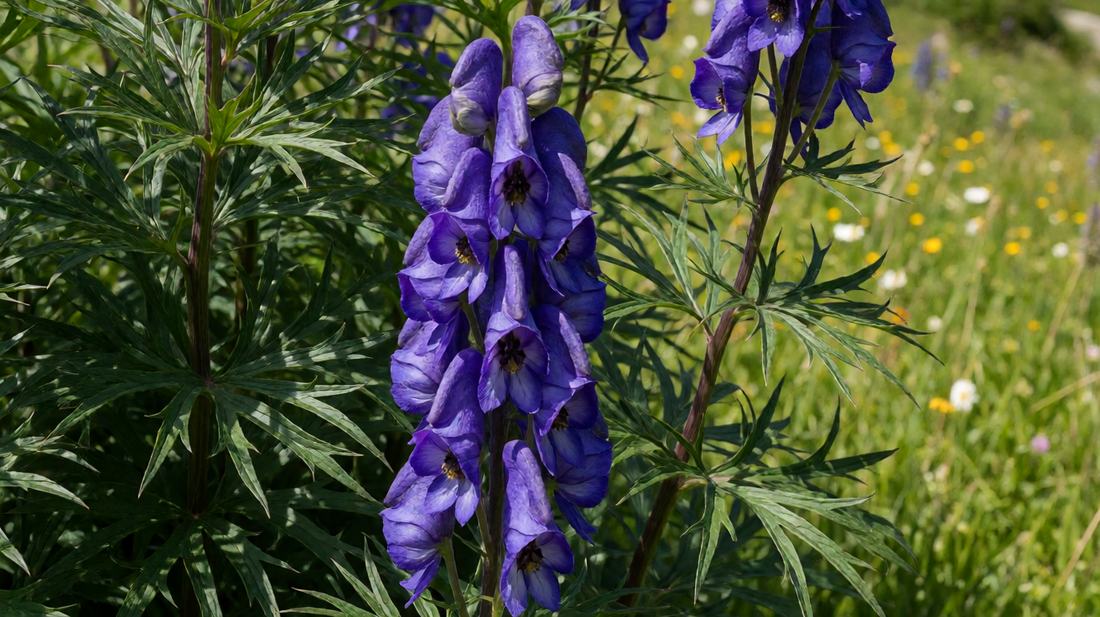
The Monkshood is one of the most beautiful plants in Europe. It is also one of the most dangerous, and it has a long, dark history. In summer it sends up a tall, stiff stem. The stem carries a dense spike of deep violet-blue flowers. Each flower is shaped like a small helmet or hood. The whole plant can stand 1.5 metres high. The leaves are just as striking.
They are dark green and glossy. They are cut so deeply into narrow lobes that they look like a hand with long fingers. The colour of the flowers is a deep blue-purple. Very few garden plants can match it. This is why the Monkshood has been grown in gardens across Europe for hundreds of years. The danger lies in the chemistry. Every part of the plant holds aconitine and a set of related poisons.
These attack the heart and the nerves. The plant is one of the most poisonous in the whole European flora. The name comes from the shape of the hooded flower. An older name, Wolfsbane, records its use as a poison for wolves and for arrows. In the wild it grows in damp mountain meadows and along stream banks.
Family tree
Ranunculaceae, the buttercup family
The Monkshood sits in the family Ranunculaceae, the buttercup family. It belongs to the genus Aconitum. Linnaeus described it in 1753. The family Ranunculaceae is an ancient group of flowering plants. It is marked by a set of simple features. The parts of the flower are arranged in a spiral rather than in rings. The stamens are numerous.
The petals are often small or absent. The genus Aconitum is a large one, with over 250 species across the northern temperate world. Most of them are mountain plants with the same hooded blue or yellow flowers. The taxonomy of the genus is difficult. The species cross with one another freely. The plants also vary a great deal with the soil and the height. Linnaeus named Aconitum napellus after the shape of the root, which is a small turnip-like tuber.
The word napellus is a small form of the Latin napus, meaning turnip. The whole plant is so poisonous that it has been used as a weapon for thousands of years. The Monkshood shares its family with the meadow buttercup. That is the small yellow flower of every damp field. The 2 look nothing alike, with their deep blue hoods and their simple yellow cups. But they sit in the same family and share the same simple flower structure.
Blue hoods, cut leaves
How to tell one
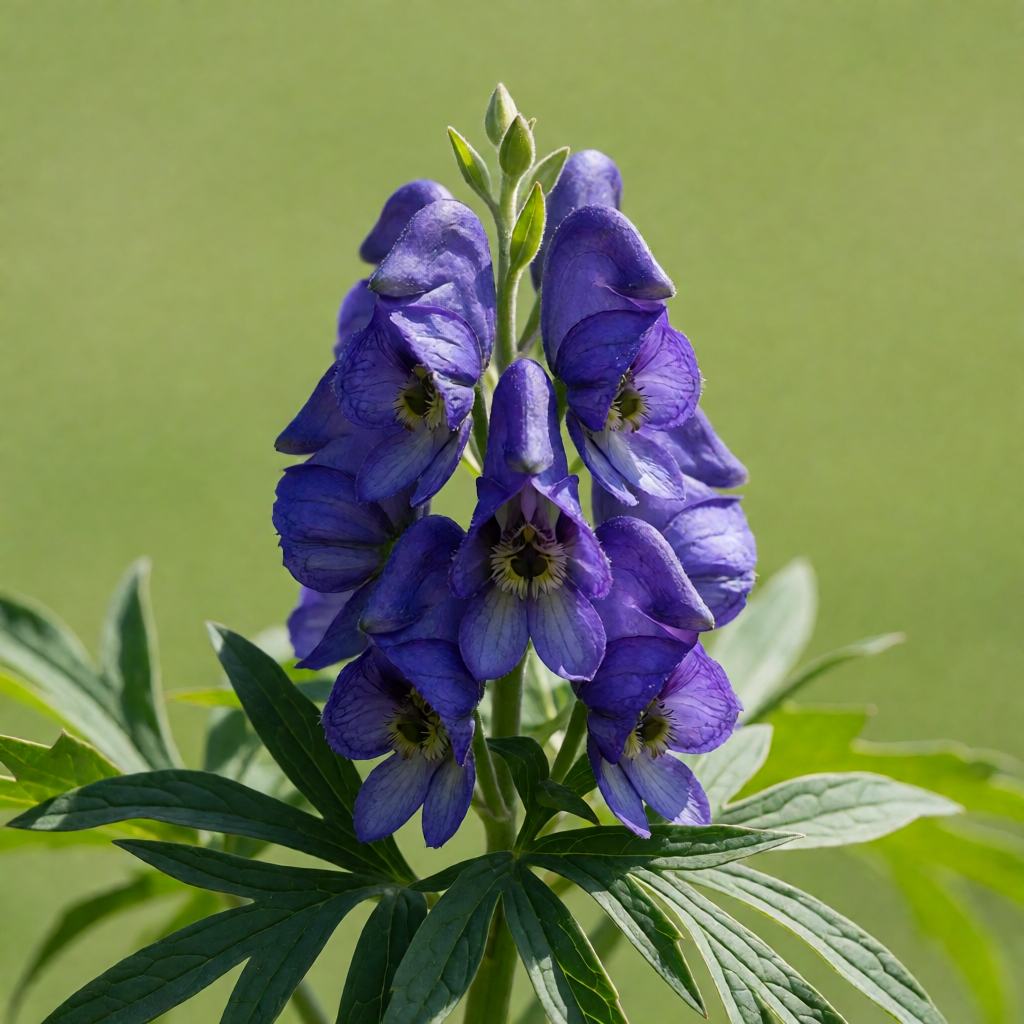
A Monkshood grows 60 to 150 cm tall. The stem is erect, unbranched and pale green. The leaves are alternate and dark green. They are glossy on the upper surface. Each leaf is divided into 5 to 7 deep lobes. Each lobe is cut again into narrow teeth. The lower leaves are large, up to 15 cm across.
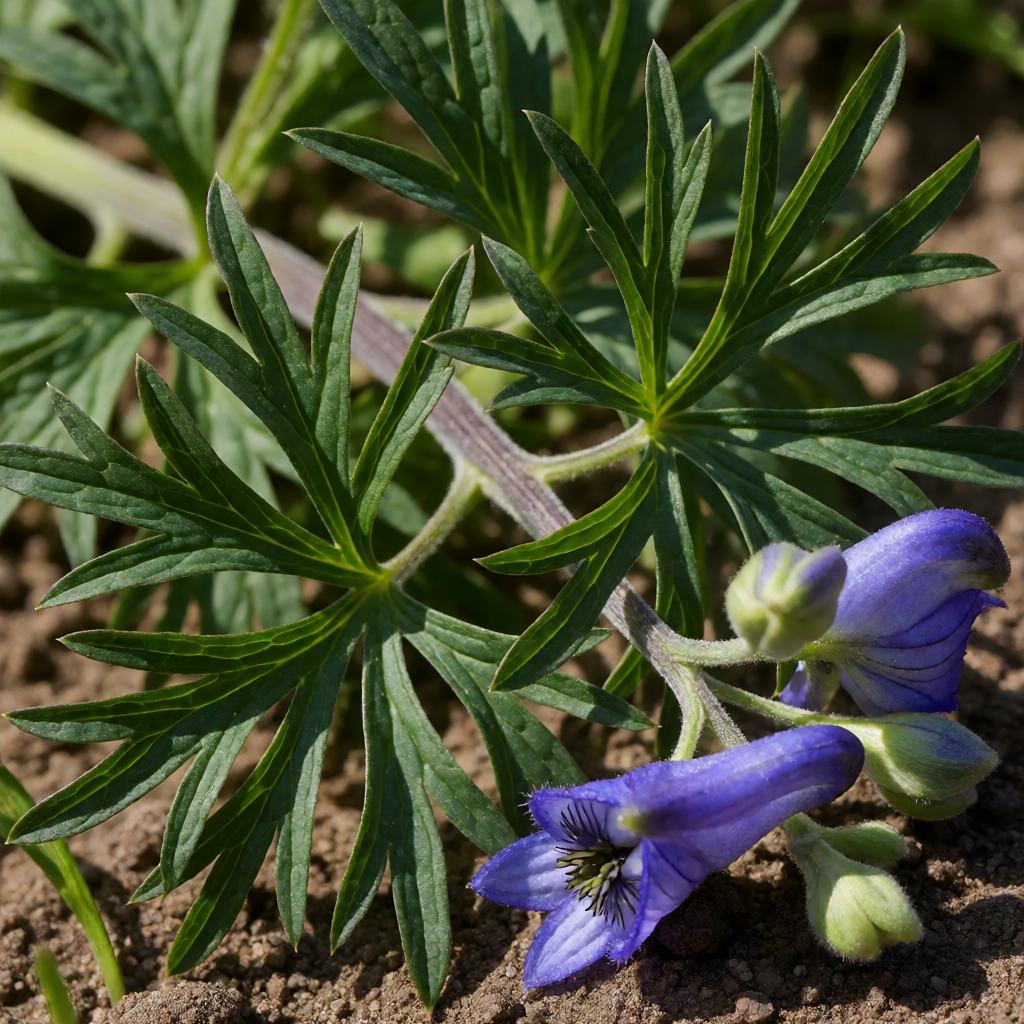
They get smaller towards the top of the stem. The flowers open from the bottom of the spike upwards. A full spike can carry 20 to 30 blooms. Each flower is 2 to 4 cm across and is built in an unusual way. The blue hood at the top is not a petal at all but a sepal. The true petals sit inside it as small, dark nectaries on long stalks. Beneath the hood sit 4 more sepals, arranged in pairs.
The plant has 3 to 5 carpels. So a single flower can produce several separate seed pods. The root is a black, turnip-shaped tuber. It is the most poisonous part of the plant by far. The whole surface of the plant is smooth and slightly shiny, with no hairs at all. This smoothness is an easy way to tell it apart from its hairy relatives.
1
2
3
Damp meadow and stream bank
Where it lives
The Monkshood grows in cool, damp, rich places. In the wild it is a plant of the mountains. It is most abundant in the Alps, the Pyrenees and the Massif Central. It also grows in the mountains of central Europe. It lives in tall herb meadows, along stream banks, in wet woodland clearings and beside mountain paths.
It reaches 2500 metres in the Alps. It is often found in the deep soil at the foot of scree slopes where water collects. The plant needs a soil that stays moist through the summer. It does badly on dry, thin or acid ground. In Britain the species is native in only a few places in the south-west of England and in Wales.
It has been recorded in many other areas only as a garden escape. It is often found near old houses and gardens. The plant has been grown for so long that it has escaped and settled along lanes and stream banks nearby. It spreads by seed and by the division of its root tubers. A single plant can form a large clump in a few years.
Its own food, and the bees
What it eats
The Monkshood makes its own food, as all green plants do. It takes water and minerals from the soil through its roots. What makes it interesting is the way it feeds its pollinators. The plant cannot offer open nectar to just any insect. The nectar sits in a small nectary hidden inside the hood. The only visitors that can reach it are the long-tongued bumblebees.
A bumblebee lands on the lower sepals. It pushes its head up into the hood. It reaches the nectar with its long tongue while its back brushes against the stamens. In this way it picks up pollen. On the next flower the pollen is moved across. The plant gets pollinated without having to reward short-tongued insects at all.
This is why the flowers are built around the size and the behaviour of 1 group of insects. The plant also grows from a tuber that stores food over the winter. So it can send up a tall stem early in the season, before most meadow plants have started. The poison in the tissues is very strong. Almost nothing eats the plant.
Hooded flowers for bumblebees
The breeding cycle
The Monkshood flowers from June to August. The flowers are visited almost entirely by bumblebees. The plant can pollinate itself, but it does best when pollen comes from another plant. The bees carry it reliably over long distances. After pollination the flower fades. The 3 to 5 separate seed pods begin to swell.
Each pod holds 10 to 20 small, dark, wrinkled seeds. When they are ripe the pod splits open along one side. The seeds fall out. The seeds are light and they can be carried a short distance by the wind or washed along a stream. Most seeds fall close to the parent plant. This is why Monkshoods tend to grow in dense clumps.
The plant also spreads by its root tubers, which divide each year. A large clump is usually a single plant that has grown outwards from one original tuber. Seeds come up in the spring. A young plant will not flower until it is 3 or 4 years old. The stem dies back to the ground each autumn. The plant spends the winter as a sleeping tuber under the soil.
Protected, and still planted
Conservation
The Monkshood is not threatened worldwide. Across the mountains of central and southern Europe it remains widespread and locally common. The species does have local problems. In the Alps and the Pyrenees the loss of traditional grazing and mowing has changed the tall herb vegetation. The plant has lost ground in some areas where the grass is now cut or grazed at the wrong time.
In Britain the native status of the species is disputed. It is accepted as native in only a small number of sites in the south-west of England and in Wales. Everywhere else it is treated as a garden escape. This matters legally. In Britain the Monkshood is one of the plants listed in the wildlife laws.
It is an offence to pick, uproot or destroy a wild plant without a licence. Poisoning remains the greatest risk to people rather than to the plant. Gardeners who handle Monkshood are told to wear gloves. People have died after eating the root by mistake for horseradish.
Quick hits
Five things to remember
- The blue hood at the top of the flower is not a petal but a sepal, and the true petals sit hidden inside it as small dark nectaries.
- Only long-tongued bumblebees can reach the nectar, so the flower is built around the size and behaviour of 1 group of insects.
- The black turnip-shaped root is the most poisonous part of the plant, and people have died after mistaking it for horseradish.
- The plant has a completely smooth, hairless surface, which sets it apart at a glance from the hairy members of the same family.
- In Britain the Monkshood is protected by law, and it is an offence to pick a wild plant without a licence.