 By st20113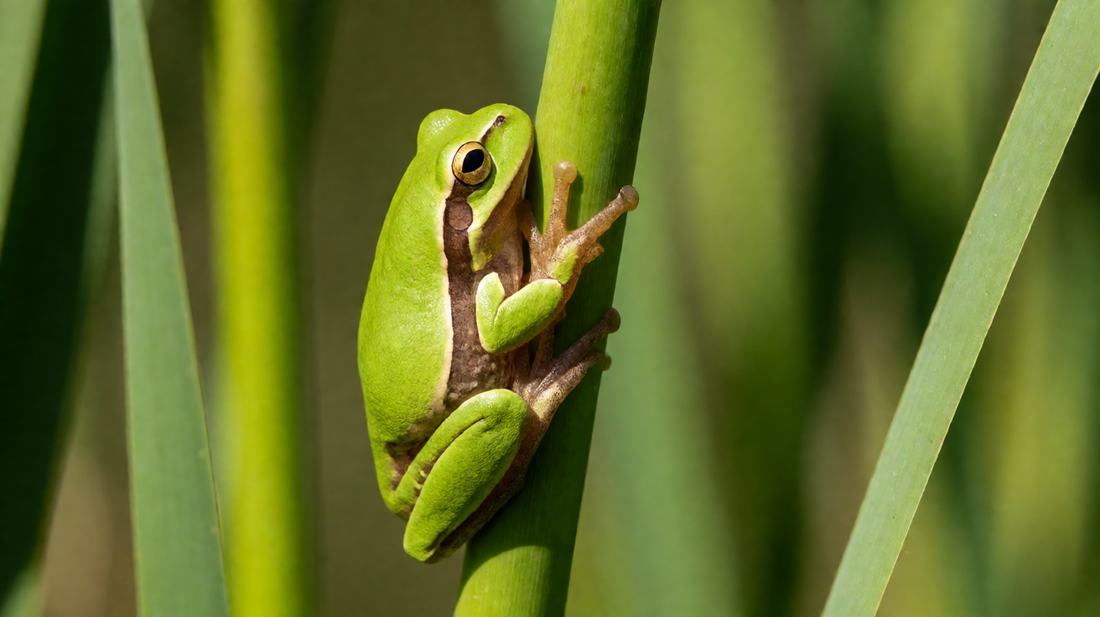
Hyla arborea | European Tree Frog
Species Profile · Hylidae
European Tree Frog
A small bright green frog with sticky toe pads and a voice that carries — the classic tree frog of Europe, at home in ponds, reedbeds and vines.
IUCN: Least Concern
Range
Body
Eggs
Tadpoles
Life
The green pond singer
Europe’s classic tree frog
The European tree frog is a small bright green frog. It climbs reeds and branches. It calls on warm spring nights. It is the only widespread tree frog in Europe. It is easy to know. It has smooth lime-green skin. A dark stripe runs from the eye along the side.
Round sticky pads sit on the ends of its toes. It is a climber, not a swimmer. It spends most of the year in plants away from water. It comes down only to breed. By day it sits still on a leaf. Its colour makes it very hard to see. At night it hunts insects among grass and shrubs.
The call is a loud fast croak repeated again and again. A group of males at a pond in May is one of the clearest sounds of European wetlands. The species lives across most of central, southern and eastern Europe and into western Asia. It is gone from most of the north-west, including Britain and Ireland. It is protected in nearly every country where it lives. Local groups have been lost through the draining of wetlands. They have also been lost through the loss of the shallow sunny pools it needs to spawn in.
Family tree
Hylidae, the tree frogs
The European tree frog is in the family Hylidae, the tree frogs. It sits in the genus Hyla. Linnaeus named the species in 1758. The genus name comes from Greek and points to its woodland home. Hylidae is a large family found on every continent but Antarctica. It is defined by the claw-shaped end bone in each toe. That bone lets the animal grip. The European tree frog is the type species of the genus.
It is the only Hyla species native to most of Europe. A few kin live in southern and eastern Europe and in Asia Minor. Groups across the range differ in call, colour and body shape. A number of subspecies have been named. Several of these are now treated as full species. Genetic work keeps reshaping the group. Animals in the southern Balkans and Turkey are split off by some experts. The fossil history of Hylidae in Europe goes back to the Oligocene.
The European tree frog sits in the order Anura, the frogs and toads. The common toad is in that order too. The toad is a heavier land animal. The two use the same ponds in spring but not in the same way. The toad walks to water and spawns in long strings of eggs. The tree frog climbs. It spawns in small clumps. It spends the rest of the year in plants, not in leaf litter.
Green skin, sticky toes
How to identify one
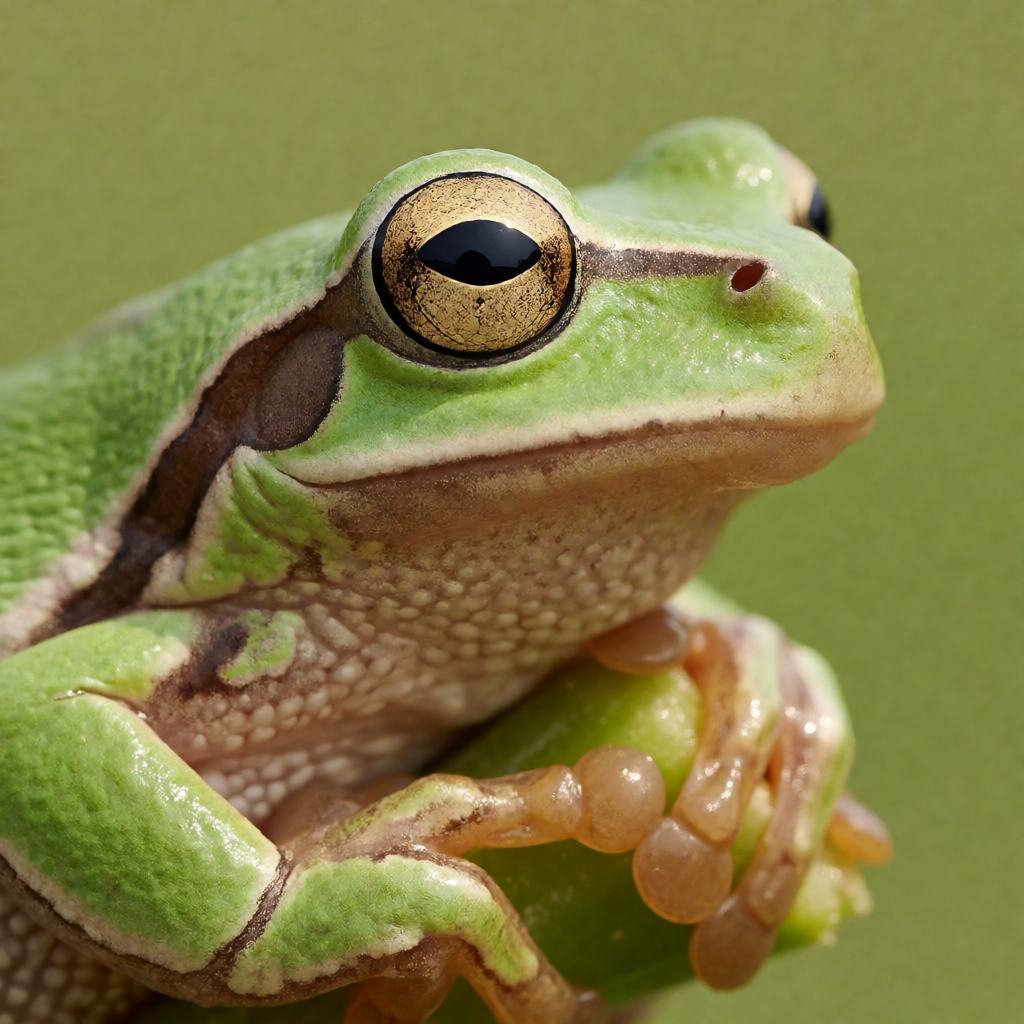
The European tree frog is small. Adults are 3 to 4.5 cm from snout to vent. Females are a little bigger than males. The biggest reach 5 cm. The body is slim and the legs are long and thin. The skin is smooth and shiny. That is quite unlike the warty skin of a toad. The usual colour is bright apple-green on the back. The belly is white or yellow.
The animal can change shade. It turns grey, olive or brown when it is cold, upset or in shade. The change takes minutes to hours. A dark stripe runs from the nose through the eye and along the side to the hip. Sometimes it breaks into spots. The eye is large and bulging. The pupil is a flat oval. The best feature is the disc at the tip of each toe and finger. These round pads are sticky.
They let the animal cling to smooth upright surfaces, even glass and reed stems. The male has a big vocal sac under the chin. It blows up like a balloon when he calls. It looks yellow or brown. Females have a smooth white chin. The tadpoles reach about 5 cm before they change. They have a tall tail fin and a round body.
1
2
3
Ponds, marshes and scrub
Where it lives
The European tree frog needs two habitats side by side. It needs a place to breed and tall plants to live in for the rest of the year. For breeding it uses shallow sunny still water with dense plants. It uses pond edges, ditches, marshes, old river bends, flooded gravel pits, rice fields and slow backwaters. The water should have no fish. Fish eat the eggs and tadpoles. Temporary pools are used where they hold water long enough.
For the rest of the year the animals live in shrubs, reedbeds, hedges, orchards, vineyards, damp wood edges and tall herbs. They are often several hundred metres from the nearest water. They climb all the time. They can be found well above the ground. Winter is spent on land. The animal sleeps in a burrow, a tree hole, a heap of stones or under leaves. It sleeps from about October to March.
The range covers most of central, southern and eastern Europe. It runs from France and the Low Countries east to the Urals and the Caucasus. It goes from the Baltic south to the Balkans, Italy and Turkey. It is gone from Ireland, from most of Scandinavia and from the driest Mediterranean lowlands. It is not native to Britain. A small group put there by people lives on in the south of England.
Insects taken by ambush
What it eats
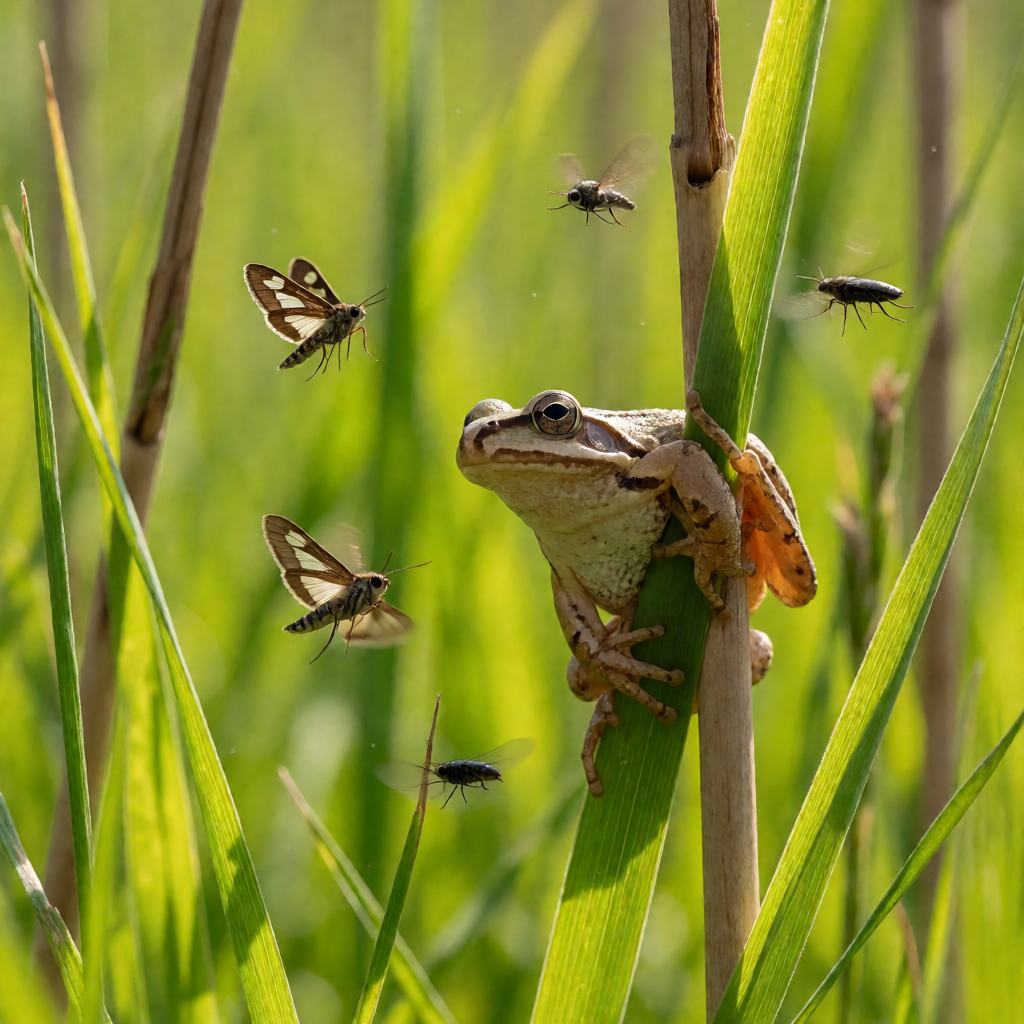
The European tree frog eats insects. It is an ambush hunter. It sits still on a stem or leaf and waits. When prey comes close it lunges. It takes the prey with a flick of its sticky tongue. Its main food is flying and climbing insects. It takes flies, mosquitoes, moths and their caterpillars, beetles, aphids, leafhoppers, bugs, ants and small grasshoppers. It takes spiders and other small animals too.
The size of prey is set by the width of its mouth. Most items are small. A big adult will take a large caterpillar or beetle. The tadpoles mostly eat plants. They graze algae and waste from sunken surfaces and from the film on the water. They will take animal matter and dead flesh too. Feeding is almost entirely at night or at dusk. By day the frog hides and does not hunt.
In warm weather an adult eats a great many small insects over a season. That makes the species useful against pest insects in gardens, vineyards and orchards. The animals stop feeding before winter sleep. They live off stored fat. New froglets eat very small insects and mites. Their survival through the first weeks is the hardest point in the life cycle.
Eggs in clumps, spring calls
The breeding cycle
Breeding runs from late March to July. It depends on latitude and weather. Most of it happens in April and May. Males gather at the water as the weather warms. They call from plants at the edge or from floating plants. The call is a harsh fast krek-krek-krek. It is repeated many times in a row. It carries for hundreds of metres. Males compete for calling spots.
They do not hold territories the way many frogs do. When a female comes near, a male grabs her behind the front legs. The pair may stay joined for hours. The female lays the eggs in several small clumps, not in one mass. Each clump holds about 30 to 80 eggs. One female lays between 200 and 2000 in all. The clumps stick to plant stems or lie loose on the bottom. The male fertilises them outside the body. The eggs hatch in 1 to 3 weeks, depending on heat.
The tadpoles live in open water. They take 2 to 3 months to change into frogs. In cold or crowded pools they grow slowly and some pass the winter as tadpoles. Most change in July and August. The froglets leave the water and climb into plants. They can breed at 2 to 3 years. Adults may live 9 to 15 years. That is long for a frog of this size.
Least Concern, locally lost
Conservation
The European tree frog is Least Concern on the global Red List. Its range is large and the species is still common in much of central and eastern Europe. The local picture is much worse in the north-west. Groups have been lost or cut back across the Netherlands, Belgium, Denmark, Germany, Switzerland, the Czech Republic and Britain. The animal is now rare or gone over wide areas where it once was common. The cause is habitat loss. It is the loss of both habitats at once.
Draining wetlands, filling ponds and turning marsh into farmland removed breeding sites. Straightening and shading ditches removed the rest. So did clearing hedges and shrubby edges. Putting fish into ponds for angling is a serious problem. Fish eat tadpoles. A single stocked pond may produce no froglets at all. Pesticides cut insect food and can harm tadpoles.
Roads kill animals moving between winter habitat and breeding ponds. Climate is a growing factor. Dry springs leave shallow pools empty before the tadpoles can change. Help means making and restoring shallow ponds with no fish. It means keeping sunny open edges and dense plants. It means keeping the shrubby links between ponds and the plants the animals live in. The species is protected by law across most of its range.
Quick hits
Five things to remember
- It can change colour from bright green to grey or brown within minutes, depending on heat, light and mood.
- The sticky discs on its toes let it cling to smooth upright surfaces, even window glass and single reed stems.
- A calling male blows up a vocal sac under his chin into a balloon, which makes the harsh call carry for hundreds of metres.
- It is one of the few European frogs that spends most of the adult year in shrubs and trees rather than in water or leaf litter.
- Females lay eggs in several small clumps rather than one mass, and the tadpoles need water with no fish to survive.