 By st20113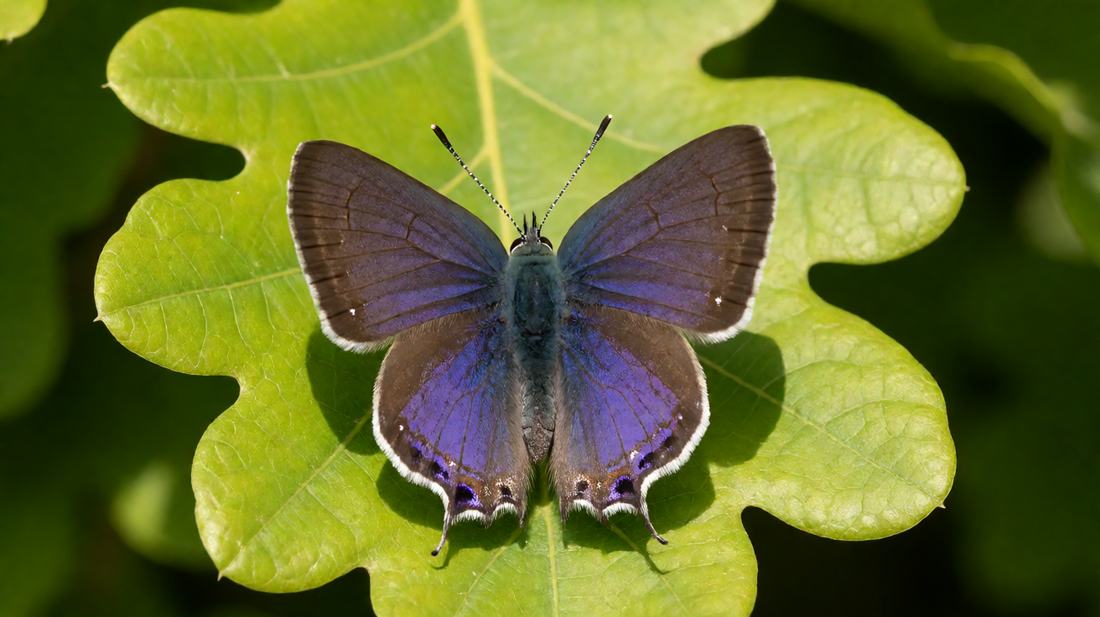
Favonius quercus | Purple Hairstreak
Species Profile · Lycaenidae
Purple Hairstreak
A butterfly almost nobody sees: it lives its whole adult life high in the oak canopy, feeding on the honeydew that aphids make.
IUCN: Not Evaluated
Range
Wingspan
Altitude
Diet
Broods
The butterfly in the treetops
Common, widespread, and almost never seen
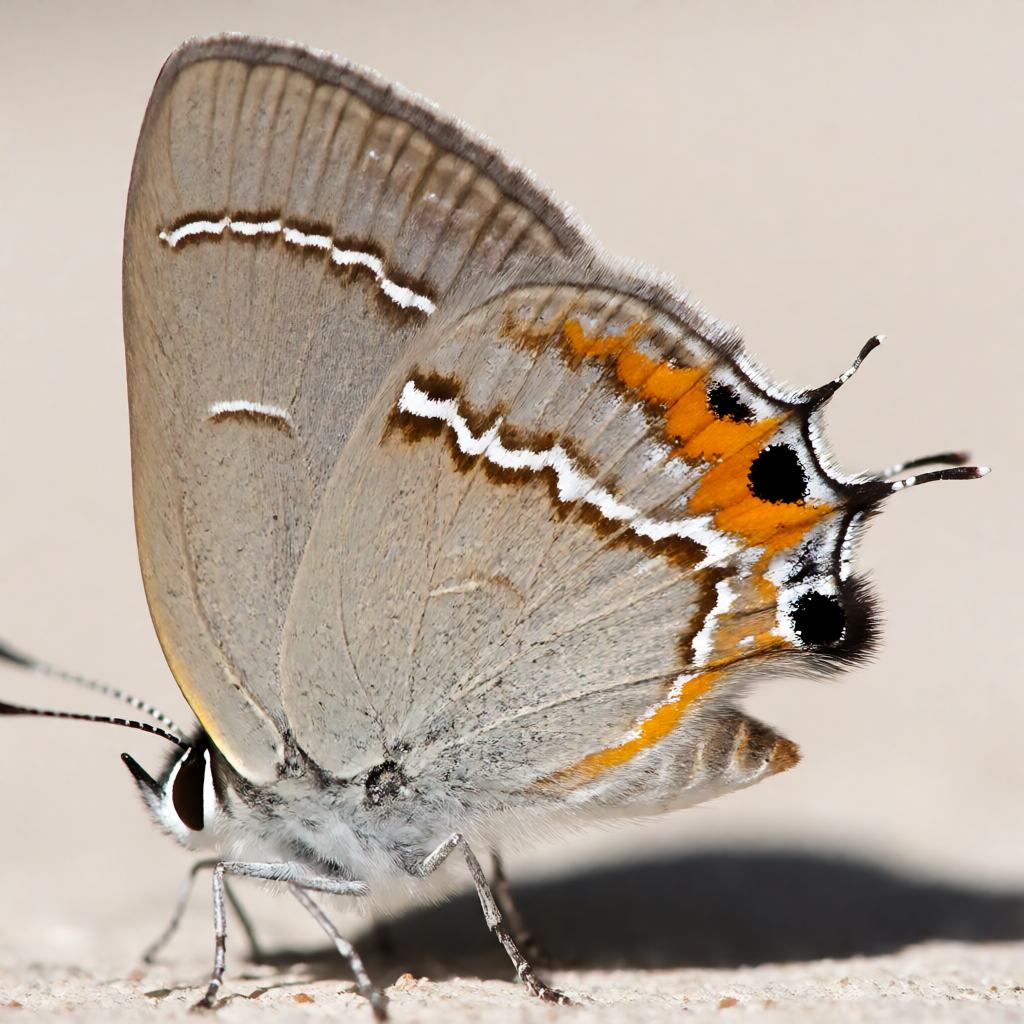
The purple hairstreak is a butterfly that almost nobody sees. It is not rare. It spends its adult life high in oak trees. It is small and hard to notice. Its upperside carries a violet sheen. The sheen comes and goes with the angle of the light. Its underside is pale grey-brown, crossed by a thin broken white line.
Adults live high in the oaks. They walk and flutter among the leaves. They feed on the sweet honeydew made by aphids. They come down to the ground only rarely. For most of the 20th century people found it mainly by accident. A storm, or a fallen oak, brought one down within reach of a naturalist. The species occurs across most of Europe.
It also lives in North Africa, Anatolia and the Caucasus. It is the only member of its genus outside eastern Asia. In Britain it is a common butterfly of oak woods. The best way to see it is not to look for it. Stand under a mature oak on a still July evening and watch the canopy with binoculars.
Family tree
Favonius, an almost entirely Asian genus
The purple hairstreak belongs to the family Lycaenidae. That family holds the blues, coppers and hairstreaks. It sits in the subfamily Theclinae, the hairstreaks. That group is named for the fine hair-like tails at the base of the hindwings. Linnaeus described it in 1758. It has been moved between genera more than most butterflies. It has been placed in Papilio, Thecla, Quercusia and Neozephyrus.
Most authorities now use the name Favonius quercus. All four combinations still appear in older literature. The genus Favonius contains about a dozen species. Nearly all of them are East Asian. The purple hairstreak is the only one that reaches Europe. The species name quercus is the Latin name of the oak. It describes the larva’s food plant.
Among European hairstreaks this one is the most strictly arboreal. That single fact explains most of its biology. It shares a family with the common blue, the small blue of grassland and brownfield sites. Both associate with ants and share a body plan. In other ways the two lead very different lives. Recent work shows that its closest relatives are Asian. It reached Europe from the east, not from the other European hairstreaks.
A violet sheen and a W-shaped line
How to identify one
This butterfly is small. Its wingspan is 30 to 40 mm. The two surfaces of its wings are very different. The same insect can look like two species. From above the wings are dark brown. The male carries a broad violet patch on the forewing. It also shows a smaller purple flush on the hindwing. The female is plainer and shows less purple, or none. The colour is structural rather than pigmented. It comes from the fine structure of the wing scales.
Those scales reflect light at certain angles and not others. So the purple appears and vanishes as the insect tilts. It also shifts as the eye moves. From below the butterfly is pale grey to silvery brown. A thin, broken white line marks the wing. It forms a series of W shapes across the hindwing. On the forewing it runs as a less regular line. A row of small orange spots runs along the outer edge of the hindwing. Near the base of the tails sits a black eyespot ringed with orange. The tails are short, thin and slightly curved.
This underside pattern is a classic hairstreak design. It works as a decoy. The tails look like antennae and the eyespot looks like an eye. So a bird that pecks at it hits the wrong end. At rest it moves its hindwings in small circles. That makes the tails look like twitching antennae. The legs, antennae and body are dark. The antennae are ringed with pale bands, as in most blues.
1
2
3
Mature oak, nothing less
Where it lives
The purple hairstreak is tied to oak. In practice that means mature oak woodland. It also uses parkland with old oaks and wooded common land. It lives in hedgerows with large oaks and in old orchards. The tree species alone is not what matters. The size and age of the trees matter more. It needs a tall, broad crown with dense leaves. That is where the aphid colonies live and where it spends its adult life. Young oaks and small isolated trees are rarely used.
The species is found across most of Europe wherever oaks grow. Its range runs from southern Scandinavia and the British Isles to the Mediterranean and North Africa. It reaches eastward through Anatolia and the Caucasus into central Asia. In Armenia it uses oak woods from about 800 to 2200 m. In the far south it becomes a mountain woodland butterfly. In Britain it is widespread in southern and central England and Wales. It reaches southern Scotland. Its spread follows the spread of mature oaks more closely than any other single factor. This habit makes the species very hard to survey.
Standard transects walked along woodland rides record almost nothing. A count made by scanning the canopy from beneath one large oak can produce dozens in a single July evening. So the purple hairstreak is probably much commoner than the maps suggest. Its apparent scarcity in many areas is an artefact of how it is looked for. Light and temperature also matter. On cool or windy days it stays deep in the crown. It becomes active mainly in warm, still evenings.
A diet of honeydew
What it eats
Its diet is unusual among European butterflies. The adult does not normally feed on flowers. It lives on honeydew, a sweet liquid that aphids make as they feed on oak sap. Oak trees support large numbers of aphids in summer. The sticky film of honeydew coats the leaves beneath a colony. That is a rich and reliable food source. It also means it need not leave the canopy. Adults walk over the top of the leaves. They lap honeydew with their short tongues. They are often seen with ants and other insects doing the same.
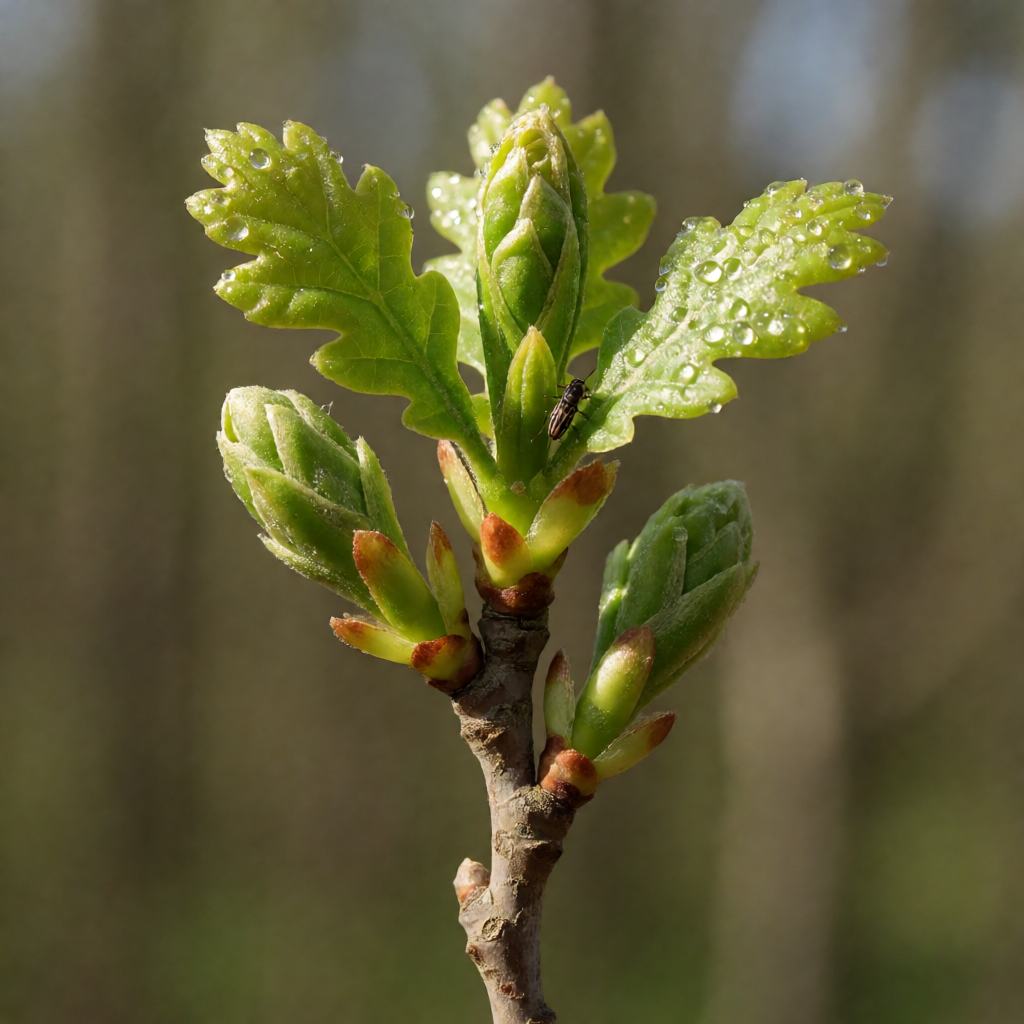
They will take nectar from flowers now and then. That happens mostly when they come down to feed in woodland clearings. They also visit sap runs on damaged trunks. This ties the insect closely to the aphids in its own canopy. A year with few aphids is a poor year for purple hairstreaks. The larva has a very different diet. Females lay their eggs singly on oak twigs and buds in late summer. The eggs stay there through the winter. They hatch in spring as the oak buds begin to open. The young larva feeds on the buds and the tender young leaves and shoots.
It eats only during the day. At night it hides in cracks in the bark. Its body is green, with a brown head and a dark stripe along the back. That blends with the bark and the buds. Like many blues, the larva is attended by ants. They collect the sweet drops it makes. The partnership seems to protect it from some enemies. The larva feeds for several weeks in late spring and early summer. It then pupates in the canopy or in a crack near the base.
Eggs that winter on the twigs
The breeding cycle
The purple hairstreak produces a single generation each year. Its whole cycle is organised around the oak’s own annual rhythm. Adults emerge in late June. They fly through July and August, and in the south into early September. Courtship takes place in the canopy, often in the early evening. Males and females find each other by sight. The pale underwing shows well against the dark bark and leaves. Mated females lay their eggs singly. Each one is pressed into a crevice in the bark or against a bud on a young shoot.
She picks twigs at a height and on a side of the tree. That gives the egg the best chance of surviving the winter. A female may lay only a modest number of eggs. The species is far less prolific than most butterflies of open habitats. The eggs overwinter in place. That stage carries the species through the 6 or 7 months when the tree has no leaves. The buds begin to break in April or May. The eggs then hatch, and the young larvae feed on the opening buds and the first soft leaves. Growth is rapid.
After several moults the larva pupates in the canopy or at the base of the tree in early summer. The pupa is attached to bark or hidden in litter. It lasts about 3 weeks. The new adults emerge in late June, at the peak of the aphid season. Honeydew is then most abundant. So the timing of the whole cycle is tuned to two separate events. One is bud burst in spring. The other is aphid activity in midsummer. Both are shifting as the climate warms.
Hard to survey, easy to lose
Conservation
The purple hairstreak has not been assessed for the global IUCN Red List. It is therefore listed as Not Evaluated. The European Red List of Butterflies, published in 2010, classes it as Least Concern. Its range is large. Its food plant is one of the commonest trees in Europe. No continent-wide decline has been shown. So the European verdict is secure. Local assessments vary, and they reflect real regional differences.
The species is near threatened in Wallonia and endangered in Israel. It is of least concern in France and Finland. Its main need is mature oak. Fewer landscapes meet that need every decade. Ancient oak woodland and old parkland have been broken up. Mature oaks are often felled for safety or timber before they become veterans. Tidying the wood also removes the dead wood and the sap runs that add to the diet. The species lives in the canopy and is rarely seen.
So declines can go unseen for years. Practical conservation is not about specialised management. It is about keeping large oaks standing. It is also about letting young oaks grow to maturity somewhere in the landscape. Woodland grazing that stops any oak from reaching the canopy is a special problem. So is the removal of hedgerow oaks and the loss of wooded commons. Those commons once supplied long-lived trees in abundance.
Quick hits
Five things to remember
- It spends almost its whole adult life in the canopy of oaks.
- Adults feed mainly on honeydew from aphids, not on nectar.
- Its purple sheen is structural colour, not pigment.
- The white W-shaped line and the hindwing tails act as a false head.
- Eggs overwinter on oak twigs and the caterpillars eat the buds in spring.