 By st20113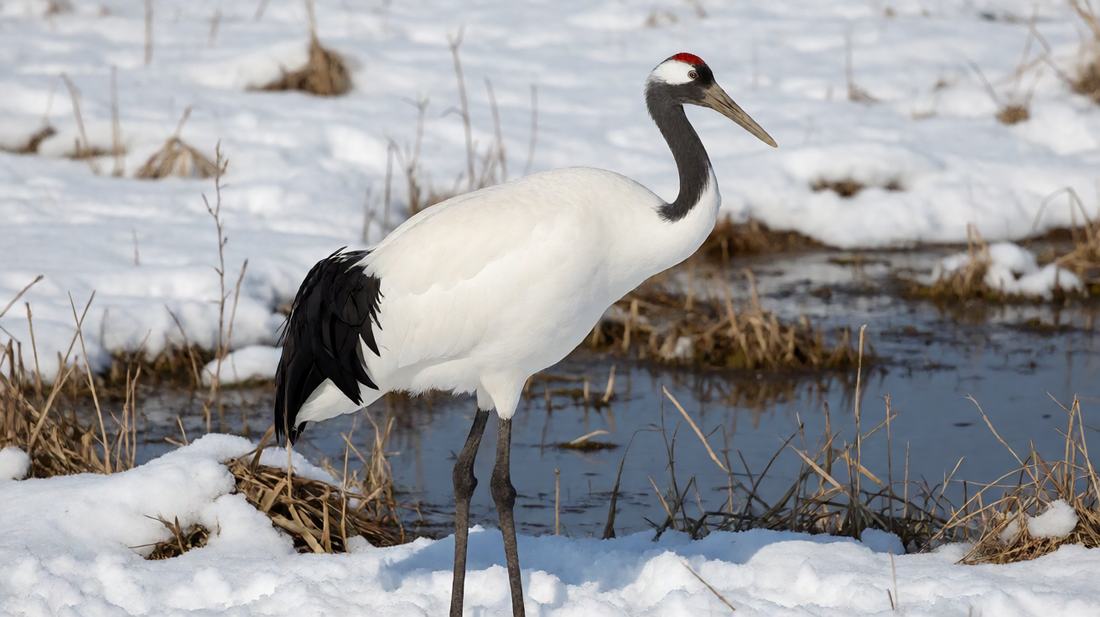
Grus japonensis | Red-crowned Crane
Species Profile · Gruidae
Red-crowned Crane
The crane of the East Asian marsh, standing a metre and a half tall, whose two populations live in two entirely different ways — one fed by people, one still slipping away.
IUCN: Vulnerable
Range
Height
Weight
Nest
Incubation
The twice-told crane
One species, two lives
The red-crowned crane is one of the largest of the flying birds of the world. It is also one of the most celebrated. It lives in the great marshes of the north-east of Asia. It stands about a metre and a half tall. So the bird can look a person of ordinary height in the eye. The plumage is a plain and a snowy white. The white is broken by the black of the neck and of the throat. It is also broken by the black of the trailing tips of the wing. A patch of bare and brilliant red skin sits on the crown. That patch has given the species its English name. It is the single most conspicuous character of the living bird.
The species survives in 2 populations. The 2 groups are separated by a great distance. They live in 2 entirely different ways. The first is the insular population of the island of Hokkaido in the north of Japan. Those birds are resident and they do not migrate at all. In winter they depend on the feeding stations and the grain fields of the people of the region. The second is the continental population of the marshes of the far east of Russia and of the north-east of China and of Mongolia. Those birds are long-distance migrants. They travel south in the autumn. They winter in the coastal wetlands of the Yellow Sea and of the peninsula of Korea. They also use the rice fields of the south of China.
The 2 populations differ so much in their ecology. They differ so much in their history as well. So the species is best understood as 2 separate problems rather than 1. An intensive programme of winter feeding has held the insular group at a stable and a modest size. That programme has run for more than 70 years. The continental group has declined heavily. It is now the smaller and the more fragile of the 2. The bird is one of the great cultural symbols of East Asia. It is the emblem of longevity and of fidelity in China and in Japan alike. The pair bond lasts for the whole of the life of the birds. The fidelity of the crane is the subject of a great deal of the poetry and of the painting of the region.
Family tree
Grus, the typical cranes
The red-crowned crane was described in 1776. The author was the German naturalist Philipp Ludwig Statius Müller. The modern treatment places the bird in the genus Grus, the typical cranes. The family is the Gruidae. That family contains 15 species and is divided into 4 genera. The cranes are the largest of the flying birds. They are also among the oldest of the living groups of the birds of the world. The fossil record of the family goes back almost to the extinction of the dinosaurs. The species is the close relative of the Common Crane (Grus grus). That bird is the crane of the open marshes of Europe and of the north of Asia. The 2 birds sit together in the same genus. The placing rests on the structure of the skull.
It also rests on the plumage and on the calls. The 2 birds differ greatly in the look of the head and of the neck. The common crane has a black head and neck. It has a white stripe behind the eye. Its red crown patch is smaller and less conspicuous. The red-crowned crane has a white head and neck. It has a black throat. Its red crown patch is larger. The white around it sets the patch off. The cranes of the genus Grus are the largest members of the family. They share the same general plan of the body. That plan has the long neck and the long legs.
It has the short and the powerful bill. It has the enormous wing. The 2 species also share the same elaborate dance display. They share the same duet of the pair. They share the same dependence on the shallow wetland for the nesting. The species is monotypic. No subspecies is recognised. The 2 populations differ slightly in their average size. They also differ in the timing of their breeding. That difference is not thought to be large enough for a formal separation.
White body, red crown
How to identify one
An adult red-crowned crane stands between 150 and 158 centimetres tall. Its wingspan is between 220 and 250 centimetres. Its mass is between about 4.8 and 10.5 kilograms. The male is the larger and the heavier sex. That difference is a considerable one in a bird of this size. The whole of the body is covered in a plain and a pure white plumage. The wing carries a fringe of long and black secondary feathers. That fringe is held folded along the tail when the bird stands on the ground. It spreads into a black band across the whole of the trailing edge when the wing is open. The neck and the throat are black. The top of the head carries the patch of bare and vivid red skin.
That patch is the most obvious field character of the species. The red skin is not a feather and it is not a crest. It is a bare area of the epidermis. The blood vessels beneath it give the colour. So the colour of the patch changes with the condition of the bird. It changes with the excitement of the bird too. It becomes a much brighter and a much deeper red when the bird is alarmed. It does the same when the bird is displaying. The bill is long and straight and is a dull yellowish-green in the adult. The legs and the feet are black. The iris of the eye is a pale yellow.
That yellow is very conspicuous in the dark mask of the head. The young bird is a very different animal. Its body is a pale grey-brown and its head is a warm buff. It has none of the black and none of the red of the adult. The young bird moults into the adult plumage. The change takes place over its second and its third year. The bird has the habit of the family of moving in a slow and a deliberate way. That way makes the best use of the long legs. The walk of the crane is one of the most elegant of any bird.

1
2
3
Marsh, reed bed and rice paddy
Where it lives
The red-crowned crane is a bird of the great freshwater marsh. It also uses the wet meadow and the reed bed of the shallow water. The species needs a landscape of a very great extent. The pair defends a large territory. The bird is also very sensitive to the disturbance of the nesting site. The people and the machines and the predators of the land are all a problem. The continental population breeds in the marshes of the basin of the river Amur and of the Ussuri and of the north-east of China.
The birds nest in the shallow water of the reed bed and the sedge meadow and the wet grassland. The nesting site is chosen for its isolation as much as for its food. So the birds are concentrated in a small number of the very large marshland areas of the region. Those areas are also the relatively undisturbed ones. In winter the continental birds of the eastern group move to the coastal wetlands of the peninsula of Korea and to the estuary of the river Yalu. They also move to the rice fields of the south of China. The birds feed in the shallow water and on the harvested rice paddy and on the wet grassland.
They roost in the open water of the shallow lake. The species is one of the most conspicuous of the winter birds of the coasts of the Yellow Sea. The insular population of Hokkaido is a resident bird of the marsh and the river and the farmland of the east of the island. The birds of that population depend in winter on the grain of the harvested field. They also depend on the supplementary feeding of the famous stations of the region. The stations of Kushiro and of Akan are the best known. The concentration of the cranes at those stations in the winter is one of the great wildlife spectacles of Japan.
An omnivore of the wet field
What it eats
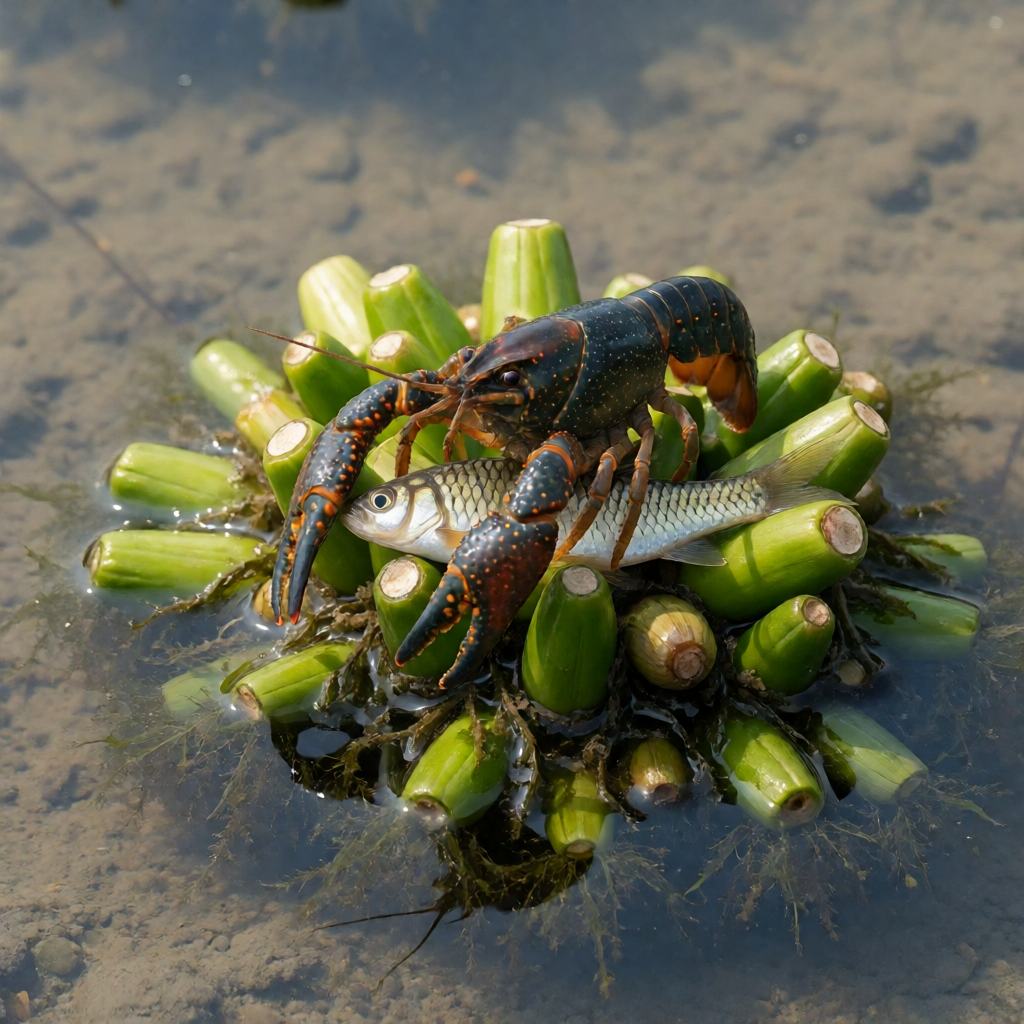
The red-crowned crane is an omnivore of the wetland and of the wet field. The greater part of the diet is made up of the animal food of the shallow water. The species takes the fish and the frogs and the tadpoles. It takes the aquatic insects and the snails and the crayfish and the crabs. It also takes a great quantity of the vegetable food. The roots and the tubers and the bulbs of the aquatic plants are all important. So are the seeds of those plants and the grain of the rice field. The balance between the animal and the vegetable food changes with the season.
It changes with the habitat and with the age of the bird as well. The bird feeds by walking slowly through the shallow water. It probes the mud and the soft soil with the long bill. The species is a deliberate and a patient feeder. It takes the prey one at a time. It works a small area very thoroughly. The bird also takes the food from the surface of the wet meadow. It takes it from the dry field and from the stubble of the harvested crop.
In the winter the birds of the continental population feed in the harvested rice paddy and in the intertidal mudflat of the coast. The species is able to exploit the grain that is left on the ground after the harvest. That ability has brought the bird into a close and a complicated contact. The contact is with the agriculture of the region. The crane is a bird of the wetland that has learned to feed in the field. The insular population of Japan has travelled much further along that road. The birds of the east of Hokkaido now take a large part of their winter food from the grain that is deliberately provided for them. The survival of the population in the hardest months of the winter depends entirely on that feeding.
A pair for life
The breeding cycle
The red-crowned crane forms its pair bond at the age of 2 or 3 years. The bond lasts for the whole of the life of the birds. The pair performs one of the most elaborate of all the displays of the birds. The 2 birds call in strict alternation and they bow and leap. They spread the wings in a dance. That dance is performed at the beginning of the nesting season. It is also performed whenever the bond needs to be reinforced. The bird is a territorial nester. The pair defends an area of the marsh of a very considerable size. The nest is a great mound of the reeds and the sedge.
The other vegetation of the marsh goes into it as well. The mound is built up in the shallow water. The platform is large and is often more than a metre across. The eggs are laid in the centre of the platform and they sit just above the level of the water. The clutch contains 2 eggs in the usual case. The eggs are laid 1 or 2 days apart. They are incubated for between 29 and 34 days. Both parents take part in the incubation. The second egg is often lost. The first chick hatches before the second.
The parents cannot attend to both the new chick and the remaining egg. They cannot give the same care to each. So the species very often raises only 1 young in the year. The chicks are covered in a pale and a reddish-brown down. They leave the nest within 1 or 2 days of the hatching. They follow the parents through the marsh and the wet field. They are able to fly at about 3 months of age. The young bird remains with the parents for the whole of its first winter and often for a much longer period. It does not breed until it is 2 or 3 years old.
Vulnerable, and split in two
Conservation
The red-crowned crane is assessed as Vulnerable on the global Red List. The assessment reflects the small and the fragmented population. It reflects the continuing loss of the wetland on which the species depends. The wild population is put at between about 3,400 and 4,600 birds by the most recent surveys. The figure is divided between 2 groups. The insular population holds about 1,800 birds. The continental population holds about 1,600 birds. The bird is therefore one of the rarer of the large cranes of the world. The species was formerly classified as Endangered.
The change of the category reflects the growth of the insular population of Japan under the winter feeding programme. It does not reflect any improvement in the condition of the continental population. The continental bird has continued to decline over the same period. So the assessment of the 2 populations as 1 species conceals 2 very different trends. The greatest cause of the decline of the continental population is the loss and the degradation of the wetland. The marsh has been drained for the agriculture and the reed bed has been cut and burned. The water of the rivers has been diverted and polluted. The development of the coast of the Yellow Sea has removed a very large part of the intertidal habitat. The species uses that habitat in the winter.
The reclamation of the tidal flat for the industry and for the port has been particularly damaging. The disturbance of the nesting site by the people and by the grazing animals is a further and a serious pressure. The eggs and the chicks are taken by the foxes and the other predators of the marsh. The collision with the power line is a recognised cause of the death of the adult birds. The species is protected by the law in all of the countries of its range. The nature reserves of the region of the Amur and of the Ussuri and of the east of Hokkaido are the centre of the international effort to save the bird. So are the reserves of the coast of the Yellow Sea. The captive population of the zoos of China and of Japan is one of the largest of any of the cranes of the world. It provides the animal for the projects of the reintroduction.
Quick hits
Five things to remember
- The red patch on the crown is a patch of bare skin and not a crest of feathers. It becomes a much deeper red when the bird is excited or alarmed.
- The 2 populations of the species live in 2 entirely different ways. The birds of Hokkaido do not migrate at all. The continental birds travel south for thousands of kilometres every autumn.
- A pair of red-crowned cranes stays together for life. The 2 members of the pair call in strict alternation. That duet is one of the most elaborate of the displays of any bird.
- The bird very often raises only 1 young in the year. The first chick usually hatches before the second. The parents cannot tend to both with the same care.
- The species is a symbol of longevity and of fidelity in China and in Japan. The crane is one of the most frequently painted of all the birds of East Asia.