 By st20113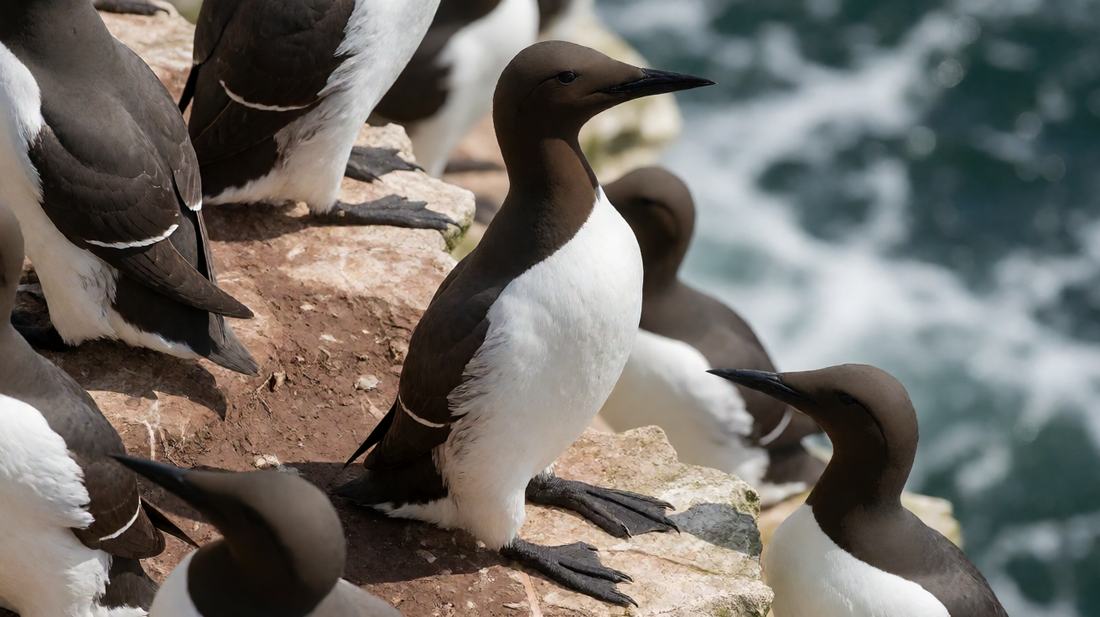
Uria aalge | Common Guillemot
Species Profile · Alcidae
Common Guillemot
A penguin-like auk of the crowded sea cliff whose single pear-shaped egg rolls in a circle instead of off the ledge — and whose chick jumps to the sea before it can fly.
IUCN: Least Concern
Range
Length
Weight
Nest
Dive
The auk of the crowded ledge
Shoulder to shoulder on the cliff
The common guillemot is a large, sturdy seabird. It belongs to the family Alcidae, the auks. It is one of the most numerous birds of the North Atlantic. Its colonies are among the densest in the world. A single cliff may hold tens of thousands of birds. Each bird stands shoulder to shoulder with its neighbours. The species spends the rest of the year at sea.
Auks are the northern answer to penguins. They fly, but they swim and dive far better. The guillemot is the largest living auk. The great auk has been extinct for over a century. Its wings are short and narrow. Its flight is fast and whirring. Its diving is among the best of any bird.
Birds have reached depths of more than one hundred metres. A dive may last more than a minute. So the guillemot is a very marine bird. It comes ashore only to breed. Then it uses the narrowest ledges of the cliff.
Family tree
Uria, the guillemots and murres
The common guillemot sits in the genus Uria. This is a small group of large auks. Its members have long, slender, pointed bills. The genus holds only 2 species. One is the common guillemot of the Atlantic. The other is the thick-billed murre of the Arctic and Pacific. The two look and behave much alike. They were once treated as one species. The thickness of the bill separates them.
So does the amount of white in the plumage. The guillemot is the close relative of the Atlantic Puffin (Fratercula arctica). That bird is much smaller and far more colourful. Its huge bill is famous. It nests in a burrow rather than on a ledge. Both live in the same colonies. The two show how varied the auks became. One long-billed bird nests in the open. One short-billed bird nests in the dark.
Linnaeus described the guillemot in 1758. Today we accept several subspecies. Atlantic and Pacific birds form two main groups. The bridled form is a colour variation. It has a white eye-ring and a thin white line. It is commoner in the north and west. Ringing shows great loyalty to a colony. A bird returns to the same ledge each year.
Upright, dark and white
How to identify one
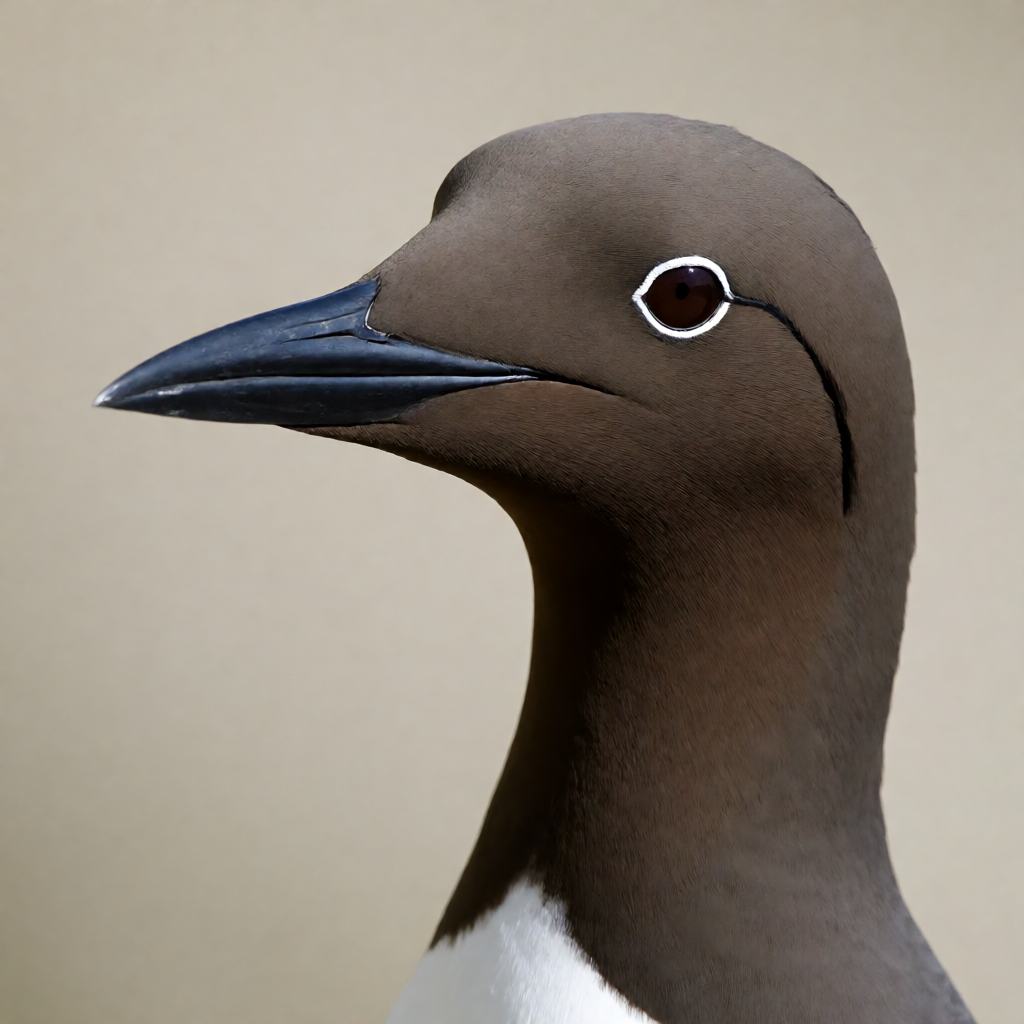
An adult guillemot is 38 to 45 centimetres long. Its wingspan is 64 to 73 centimetres. It weighs 850 to 1120 grams. It is a large, streamlined auk. Its bill is long, pointed and wholly black. On the ledge the bird stands upright. In the water it becomes a torpedo. Both sexes look alike. The head, neck, back, upper wing and tail are dark chocolate brown.
That colour is deepest in summer. It fades to grey-brown in winter. The breast and belly are clean white. The white runs up the neck in a sharp line. Winter plumage is much paler about the head and throat. So the bird looks different in the two seasons. The bridled form adds a white eye-ring. A white line runs back across the dark cheek. This form is much commoner in the north and west.
The wings are short and narrow. Flight is fast, direct and slightly whirring. The bird flies low over the water. It cannot glide or soar like a gull. It swims and dives with its wings. It uses them much as a penguin uses flippers. The feet only steer. The voice is a growl or a purr. That sound fills every crowded colony.
1
2
3
Cliff ledge and open ocean
Where it lives
The common guillemot needs a narrow ledge on vertical rock. It also needs rich, cold water within reach of the colony. So it lives on exposed rocky coasts. It also lives on the open water around them. In summer the bird ranges across the whole North Atlantic and North Pacific. It nests from Britain and northern France in the south. It reaches Iberia as well. Further north it uses Greenland, Iceland, Svalbard and arctic Canada.
It also nests on the Siberian coasts. Colonies sit on vertical, inaccessible rock. A group may hold only 20 or 30 pairs. Offshore islands free of mammals suit it too. A bird will use the narrowest ledge. It needs only bare rock above the waves. The site must be within reach of the sea. In winter the bird leaves the land completely.
It spends the whole season on the open ocean. It may move far south of the breeding range. British, Icelandic and Norwegian birds winter in the North Sea. They also use the English Channel and the Bay of Biscay. Some reach Portugal and Morocco. Pacific birds move south to Japan and California. So the bird is a creature of the sea for most of its life.
A diver of cold seas
What it eats
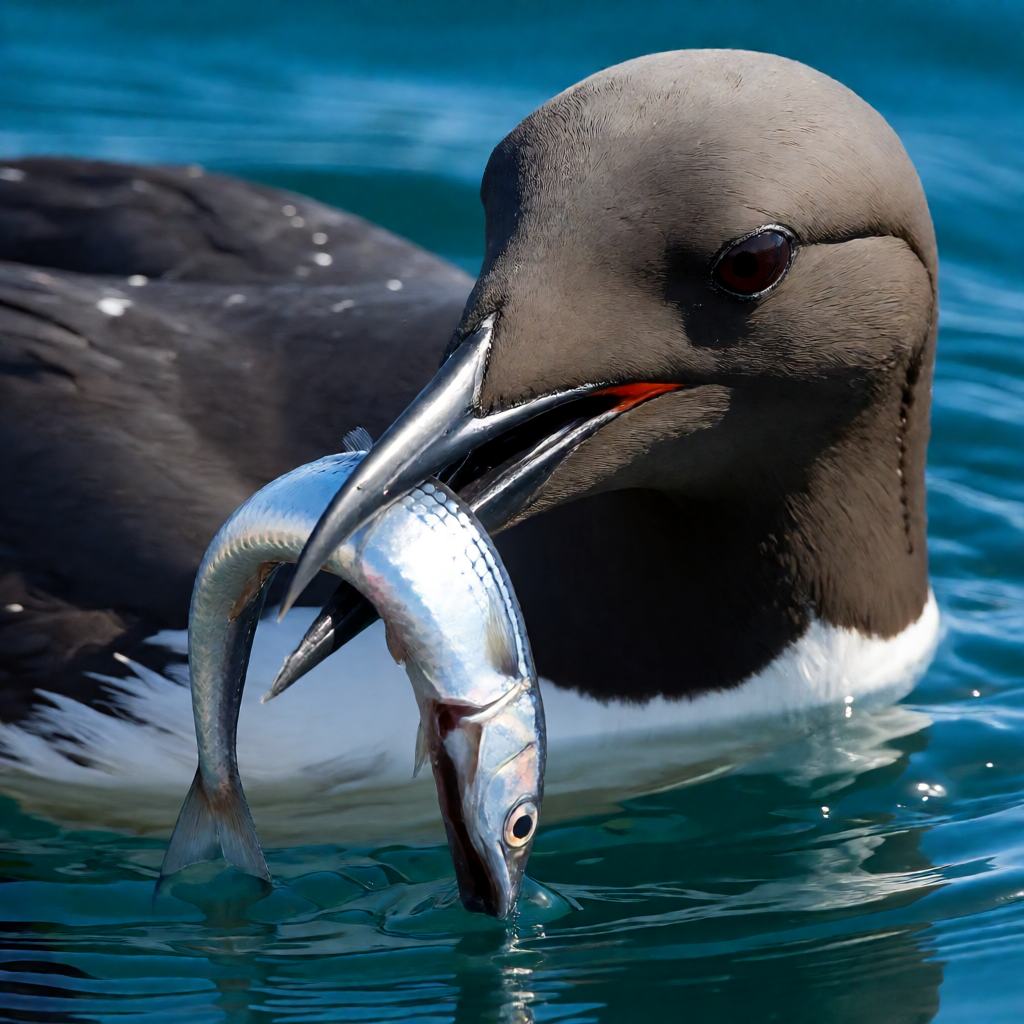
The common guillemot eats fish from the open water. Its diet is mostly small, slender fishes of the cold seas. Sandeels are the most important item. They swarm around the northern colonies in summer. Sprats and young herring matter too. So do capelin and young cod. Young gadoid fishes of several kinds add to the list. The bird takes some small squid as well.
It also eats crustaceans and bristle worms. The feeding method is the auk’s dive. The bird swims down from the surface with its wings. It then chases the fish underwater with great agility. No gull or tern can match that. Recorded dives pass one hundred metres. Birds have been taken in nets set far deeper still. A dive most usually lasts between thirty seconds and a minute.
The bird carries fish in the bill, not in a throat pouch. A single fish held crosswise is the classic image. It is the guillemot on the ledge at the height of the season. Feeding happens in daylight, mostly morning and evening. Birds fly out to the fishing grounds in long, low lines. So the species depends on abundant cold-water fish.
An egg that rolls in a circle
The breeding cycle
Common guillemots pair in the spring. The bond often lasts for many years. The birds are among the most faithful of all seabirds. They return to the same mate and the same ledge. The pair re-occupies the same metre of rock each year. The bird builds no nest at all. The single egg is laid on the bare ledge. The shape of the egg is the key adaptation. It is pyriform, or pear-shaped.
It is broad at the blunt end and pointed at the narrow one. That shape makes the egg roll in a tight circle. It turns about the narrow end instead of running straight. So it rarely falls from the narrow ledge. Both parents sit for between 28 and 34 days. The egg rests on the bare feet. It is covered by the feathered brood patch of the belly. The downy chick is fed by both parents. It stays for between 15 and 30 days.
It then weighs about a quarter of the adult. It does not fledge like an ordinary bird. It jumps from the cliff in the evening. The adult often calls from the sea below. The chick glides down and lands on the water. It then swims away with the male parent. The pair spends the winter together on the ocean. The female stays at the colony a while longer.
A bird of the sea cliffs
Conservation
The common guillemot is Least Concern on the global Red List. Its range is enormous. The world total runs to many millions of birds. Yet the species has declined sharply in the south and east of its range. British, North Sea and Baltic populations have fallen a great deal in recent decades. The bird is now red-listed in Britain. It is a species of the highest concern in the south of its range. The main cause is the change in its food supply.
The sea has warmed. Sandeels, herring and sprats have been overfished. So the birds find less food in the breeding season. Adults that cannot feed enough either fail to breed or abandon the chick. That loss of food is the single biggest threat. Other pressures add to it. Oil, chemicals and plastic pollute the sea. Gill nets and drift nets drown many birds.
Recreation, diving and climbing disturb the colonies. Climate change brings direct and indirect effects. The species is protected across its whole range. Key colonies are reserves and special protection areas. They are wardened through the season. Monitoring guillemot breeding success has become a key test. It helps measure the health of the northern seas.
Quick hits
Five things to remember
- The guillemot is the largest living auk and the nearest thing the north has to a penguin. It can fly, but it has become so suited to swimming that it uses its wings like flippers. Its feet only steer.
- The single egg is pear-shaped and lies on bare rock with no nest. The shape is one of the neatest seabird adaptations. A knocked egg turns about its narrow end and rolls in a tight circle instead of off the ledge.
- The chick leaves the ledge at about a quarter of the adult weight and cannot yet fly properly. It jumps from the cliff in the evening and glides down to the sea. It then swims away with its father.
- The bridled form has a white ring around the eye and a thin white line behind it. It is a colour variation and not a separate species. It is much commoner in the far north and west.
- The guillemot is one of the deepest diving birds. Recorded dives pass one hundred metres, and birds have been taken in nets far deeper. A typical dive lasts between thirty seconds and a minute.