 By st20113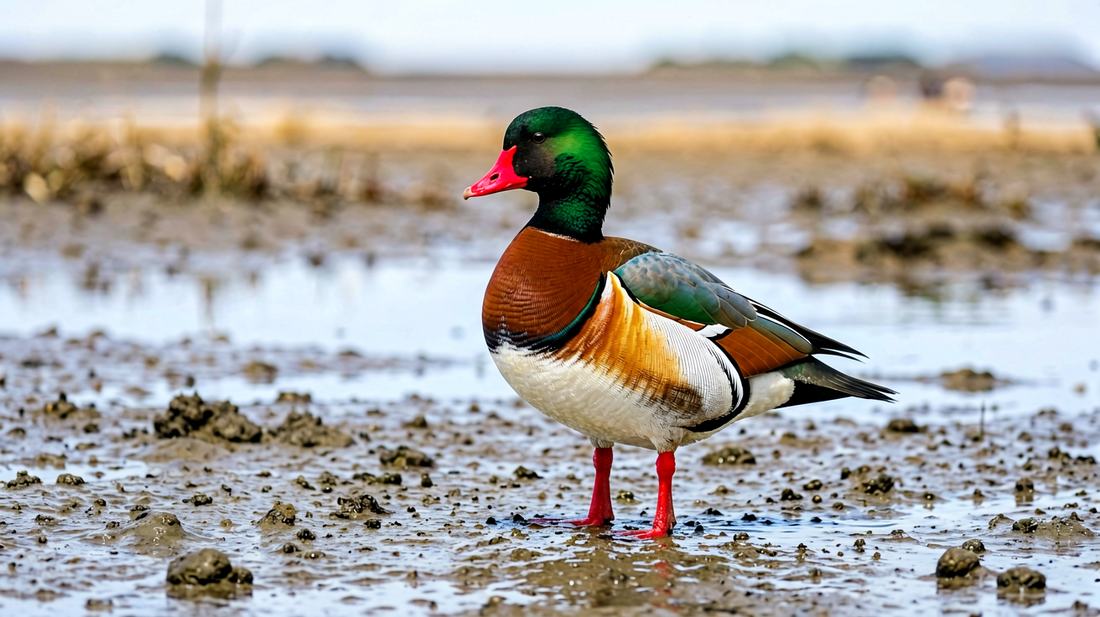
Tadorna tadorna | Common Shelduck
Species Profile · Anatidae
Common Shelduck
A big pied duck of the estuary rather than the marsh — and the one that lays its eggs in a rabbit burrow and then walks its brood back down to the shore.
IUCN: Least Concern
Range
Length
Weight
Nest
Moult flock
The duck of the estuary
A shelduck, not a dabbler
The common shelduck is a large duck. It belongs to the duck and goose family. It has bold colours. It is one of the few waterfowl of cool north-west Europe that lives on estuaries. Most waterfowl of the region live on freshwater marsh instead. The shelduck feeds by sifting the surface film of intertidal mud. It also probes the soft sediment under shallow water. It looks for small molluscs and crustaceans. These gather there in huge numbers. The bird has a deep green head and neck. Its body is white.
A broad chestnut band crosses its breast. The band continues around the front of its flanks. Its wings are black and white with a green patch. Its bill is bright red. In the breeding male the top of the bill carries a swollen red knob. No other European duck looks like it. The species nests in holes and burrows, not in marsh plants. It may travel 2 or 3 kilometres inland to lay its eggs. It uses a rabbit burrow, a badger sett or a hole in a tree. It also uses a cavity under a shed floor or a stack of hay. It then leads its brood back across open country to the shore.
The birds flock together outside the breeding season. The species has the most spectacular moulting gathering of any European waterfowl. A large part of the north-west European population assembles in late summer. The birds gather in a few favoured estuaries. They stay there flightless for 3 or 4 weeks. The shelduck is also unusual among ducks in the way it rears its young. The ducklings are combined into large nursery groups. Only a few adults attend them. A single female may be in charge of 40 or 50 ducklings, and those ducklings are not her own.
Family tree
Tadorna, the shelducks
The common shelduck sits in the genus Tadorna. This is a group of about 7 species of large, goose-like ducks. They are spread through the Palaearctic, the Ethiopian and the Australasian regions. The bird is the type species of that genus. It is also the type species of the subfamily Tadorninae. Morphologists long regarded that group as a stage between the true geese and the typical ducks. Molecular work has shown it to be a distinct lineage within the family. It is closer to the sheldgeese of the southern hemisphere. It is less close to the dabbling ducks that share its habitat. The species is monotypic.
No subspecies are recognised. Its range runs from the Atlantic coasts of western Europe eastwards. It reaches the Black Sea and the Caspian. It continues to central Asia and the borders of China. Some variation has been described within that range. It lies in the depth of the chestnut breast band. It also lies in the extent of the green on the head. That variation is clinal rather than taxonomic, and it does not warrant formal division. The link between the shelducks and the true geese still draws interest. The two groups share a number of features that are unusual in the family.
Some of their members graze. All have a loud, goose-like voice. They give their young a long period of care. They tend to moult into a duller eclipse plumage. In the shelduck these characters combine with a bill that sifts soft sediment. That bill is a compromise. The grey geese of the genus Anser have a grazing bill. The snow goose Anser caerulescens is an example. The dabbling ducks have a finer filtering apparatus. The shelduck bill sits between the two.
Pied plumage and a red bill
How to identify one
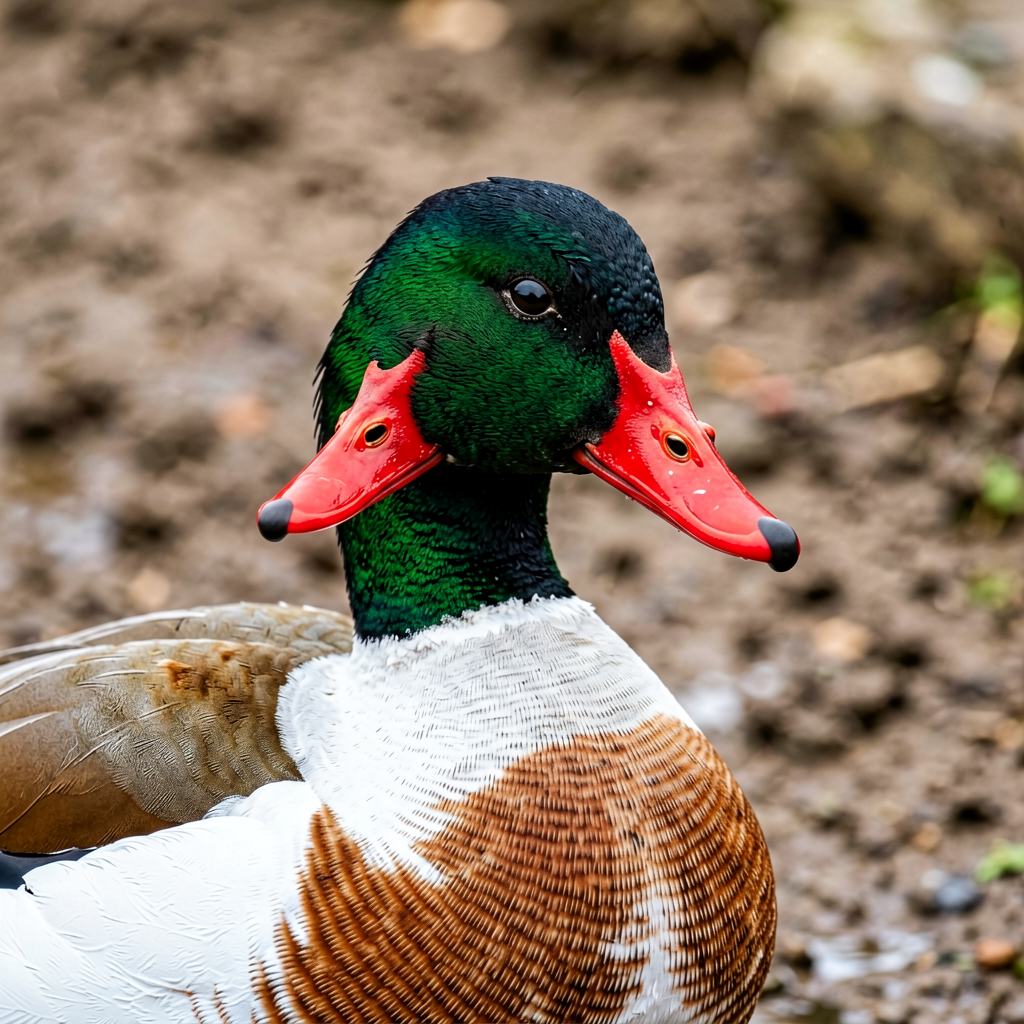
The common shelduck is a heavy-bodied bird. It has a long neck and a small head. It measures between 58 and 67 centimetres in length. Its wingspan is between 110 and 133 centimetres. Its weight runs from about 900 grams in a small female. A large male reaches 1.5 kilograms. The male is on average 10 to 15 per cent heavier than his mate. Outside the post-breeding moult he is also told by a fleshy red knob. That knob swells above the base of his bill in the breeding season. It goes down once the young have hatched. The plumage of the adult male is boldly pied. The head and upper neck are very dark green. They look almost black in poor light. The lower neck, breast and belly are white.
A broad band of rich chestnut runs across the breast. It continues around the front of the flanks. The mantle and scapulars are black with a green gloss. The wing coverts are white. The primaries and secondaries are black. The speculum is a dark iridescent green. The bill is bright red in the male. It is pinkish red in the female. The legs and webbed feet are pink. The iris is dark brown in both sexes. The female is duller than the male. Her head is paler and less glossy. Her chestnut band is often smaller and less clear. She has a whitish patch around the base of the bill and the eye.
She has no knob. The juvenile is duller again. It has a grey head and a diffuse, dirty-looking breast band. Its bill is pinkish and its legs are grey-brown. Those features make a brood easy to pick out. The young of no other European duck look quite like that. Like most of the family, the shelduck moults all its flight feathers at once. Adults of both sexes cannot fly for between 3 and 4 weeks. That happens in the second half of the summer. It is why the great moulting gatherings form. They gather in a small number of estuaries. Those estuaries offer both food and safety from land predators.
1
2
3
Mudflats, burrows and the shore
Where it lives
The common shelduck is a bird of the temperate coast. It needs 2 things. The first is shallow, sheltered water over soft sediment. That sediment must be rich in small invertebrates. The second is dry land close to that water. A hole or a burrow must be found there for the nest. Estuaries supply both. So do tidal creeks, salt marshes, muddy bays and sandy shores. The best areas lie on the North Sea and the English Channel.
The Wadden Sea runs from the Netherlands to Denmark. The coasts of the Baltic, the Black Sea, the Caspian and the Mediterranean also hold birds. So do the inland salt lakes of Anatolia, Spain, North Africa and central Asia. The species is largely sedentary in the milder parts of its range. Many British and Dutch birds stay within a few tens of kilometres of their breeding sites all year. The northern and eastern populations are more or less migratory. Birds that breed in Scandinavia, the Baltic states and Russia move south-west in autumn. They winter in the Low Countries, in Britain, in France and on the Iberian peninsula. The inland breeding populations of Turkey and central Asia are also highly mobile.
They depend on a chain of salt lakes. That chain is vulnerable to drought. It is also vulnerable to the taking of water for farms and towns. Outside the breeding season shelducks feed in flocks. They gather on the exposed mud of estuaries and on the shallowly flooded shore. In the moulting period they collect at a small number of traditional sites. That habit makes them very dependent on a few estuaries. The most important in Europe are the Severn and the Wadden Sea. The estuaries of the German Bight matter too.
Sifting the mud
What it eats
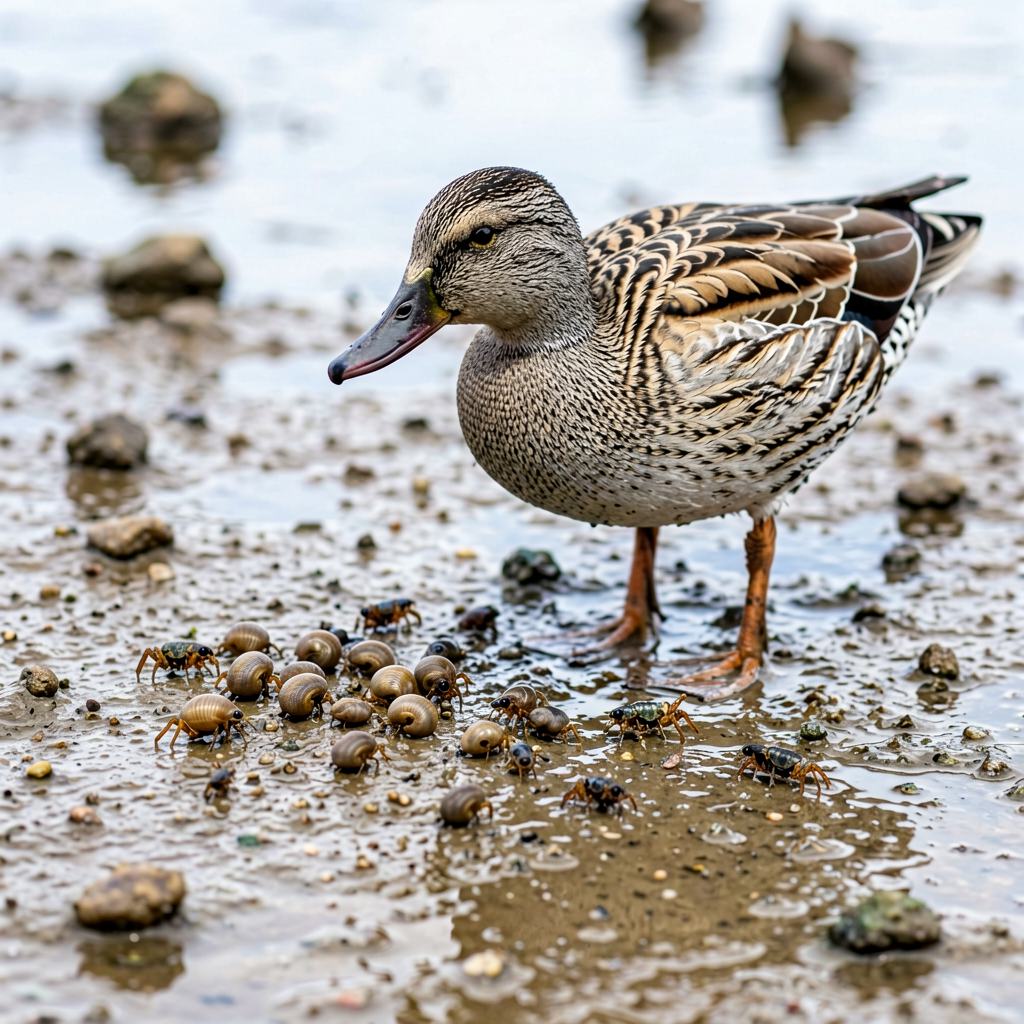
The common shelduck feeds almost entirely on small water invertebrates. On the mudflats of north-west Europe its main prey is a tiny conical mud snail, Hydrobia ulvae. Its dense populations on the surface of the sediment are cropped in huge numbers. The birds also take a small bivalve, Macoma balthica. They eat a burrowing amphipod, Corophium volutator. They take the ragworm Hediste diversicolor and various tube-dwelling polychaetes. They eat ostracods and small shrimps. They take the larvae of midges and other water insects. The most typical feeding method is a form of surface skimming.
It is often described as mowing. The bird walks forward across the wet mud. Its bill is slightly open and its neck is stretched out. It sweeps the tip of the bill from side to side. It moves through the thin film of water and sediment. It sifts out the larger particles with fine, tooth-like lamellae. It also uses the stiff papillae that line the edges of the jaws and the tongue. Where the water is deeper the bird upends or dives in the shallows. It probes the sediment with the tip of the bill.
In the brackish lagoons of the Mediterranean and central Asia the diet is topped up with brine shrimps. It is also topped up with the seeds and tubers of water plants. On the saline lakes of Anatolia the species feeds on masses of brine fly larvae. Those larvae pile up along the shore. The ducklings feed at first on small crustaceans and insect larvae. They take these from the water and from the surface of the mud. They grow fast on that diet. They reach the size of the adults in about 6 weeks.
A hole for a nest
The breeding cycle
The common shelduck is long-lived and largely monogamous. Pairs may stay together for several years. The species is unusual among ducks. The birds do not breed until they are 3 or 4 years old. That is exceptionally late. It goes with a low yearly output and a long life. Ringing has shown that individuals may live for 15 years or more. Courtship begins in the winter flocks. The male bobs his head and whistles. Both sexes pump the head and neck in a set display. Once a pair has formed it succeeds by renting a hole. It does not defend a nesting area.
Several pairs may therefore nest in the same rabbit warren or on the same building. The nest itself is a scrape in the floor of the burrow. It is lined with grass and with a thick bed of down. The female plucks that down from her own breast. The clutch holds between 8 and 12 creamy white eggs. Occasionally there are as many as 15. The female incubates them alone for between 27 and 29 days. The male stays nearby. He goes with her on the feeding trips that she makes once a day. The ducklings are precocial. They are covered in dense grey down with a dark crown and back. They leave the burrow within 24 to 48 hours of hatching.
They sometimes jump several metres to the ground. The female then leads them to water. She often walks them 2 or 3 kilometres across fields, roads and hedges. As soon as the broods reach the shore they mix with the young of other pairs. They form the large crèches that are famous among ducks. Such a group may hold 50 ducklings. In exceptional cases it holds more than 100. Only 2 or 3 adults attend it. The young fledge at between 45 and 50 days. The family groups break up in late summer. The immature birds then join the moulting and wintering flocks.
Moult flocks and their losses
Conservation
The common shelduck is listed as Least Concern on the global Red List. The world population is estimated at several hundred thousand birds. The species still shows a strange pattern of conservation need. It is abundant in total. Yet it is highly vulnerable at particular places and seasons. The north-west European population numbers between about 30,000 and 45,000 breeding pairs. It is concentrated in Britain, the Netherlands, Germany, Denmark and France. The British and Dutch birds in particular depend on a handful of estuaries for the moult. At that time the whole local population is flightless.
It is therefore very sensitive to disturbance. Shipping, aircraft, wildfowling and recreation of every kind all disturb it. A single pollution incident at such a site can affect a large share of the whole north-west European stock. A lasting rise in disturbance can do the same. The species is also exposed to the commercial harvesting of shellfish. It feeds on the same beds of cockles, mussels and Macoma that are dredged for people. The depletion of those beds has been linked to local declines. That has happened in the Wadden Sea and elsewhere. Highly pathogenic avian influenza swept through wild waterfowl in Europe in recent years.
It caused clear losses among shelducks. So much of the population gathers at so few moulting sites. That makes the species unusually open to any infectious disease. Conservation work has therefore focused on a few things. The moulting and wintering estuaries have been made protected areas. Disturbance and shellfish dredging within them are regulated. The winter counts made by teams of volunteers are monitored. Those counts provide the only long series of information that exists for the species.
Quick hits
Five things to remember
- The moulting gathering in the Severn Estuary may hold 4,000 or more flightless shelducks. That is the largest single assembly of moulting waterfowl in Britain.
- Shelducks nest in rabbit burrows, badger setts and tree holes. They also nest under the floors of sheds, and a pair may travel 3 kilometres inland to find a hole.
- Broods mix into crèches that may hold more than 100 ducklings. Only 2 or 3 adults attend such a group, and that kind of shared care is rare among ducks.
- The bill is not the grazing bill of a goose. It is not the fine comb of a dabbling duck either. It is a sifting tool, and the birds sweep it over the mud. The movement has been compared to mowing a lawn.
- Shelducks do not breed until they are 3 or 4 years old. That is one of the latest ages at first breeding of any European duck, and the birds live for 15 years or more.