 By st20113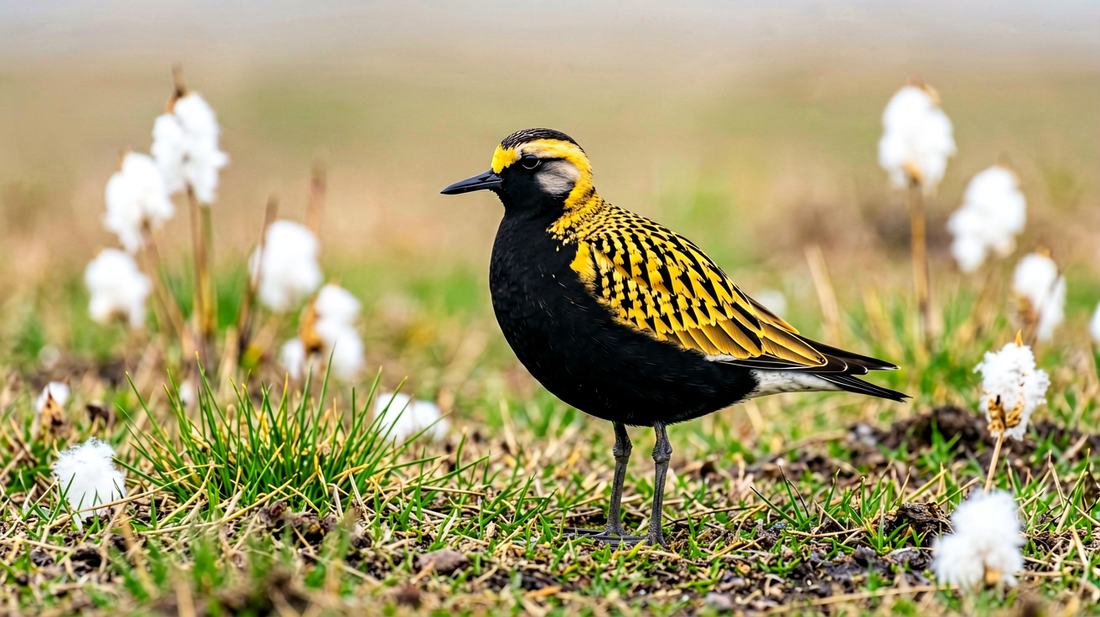
Pluvialis apricaria | Golden Plover
Species Profile · Charadriidae
Golden Plover
A moorland wader whose British birds make up the whole world population of the southern breeding group.
IUCN: Least Concern
Range
Length
Weight
Clutch
Bill
Two homes, far apart
The moorland plover
The golden plover is a medium-sized wader of the plover family. Its breeding range is unusual. It breeds in two separate zones. One is the arctic and subarctic tundra of Scandinavia and northern Russia. The other is the high moorland and mountain grassland of Britain and Ireland. This gives the British birds great value for wildlife. It is the world’s most southerly breeding group.
Hundreds of km of sea and land cut it off from the northern birds. In winter the birds come down to the lowlands. They gather on wet grassland, coastal marsh and arable stubble. Flocks may hold several thousand birds. At that season they feed on the same fields as lapwings. That is when most people see them. The breeding plumage is striking.
The whole face, throat, breast and belly are jet black. A narrow white band borders the black. It runs from the forehead down the neck and along the flank. The upperparts are black, spangled with golden spots. At a distance the bird looks scattered with sequins. In winter this is replaced by pale buff and grey. You must then go by build, bill and habits.
Family tree
Pluvialis, the rain bird
The golden plover is in the family Charadriidae, the plovers and dotterels. That family holds about 66 species worldwide. Within it the bird sits in the genus Pluvialis. This small group holds four very similar species. They take each other’s place right round the north. There is the golden plover of the Palaearctic. There is the Pacific golden plover of north-east Asia and Alaska. There is the American golden plover of northern Canada. The fourth is the grey plover, which breeds right around the Arctic.
It is the only one that winters in numbers in the south. The genus name Pluvialis is Latin for of rain. Mediaeval writers noticed these birds gathered in wet weather. The species name apricaria comes from apricus, meaning sunlit. It refers to the gleaming golden spots. So the scientific name recalls both rain and sunshine. Recent genetic work changed the family tree. The golden plover and the American golden plover are closest. The Pacific golden plover is more distant.
That turns round the old grouping based on plumage. The northern lapwing is a familiar relative in the same family. It has rounded wings and a broader bill. The golden plover is slimmer and longer-winged. The species shows only slight local variation. It is usually treated as one species. The gaps between the groups are smooth, not sharp.
Sequins on the moor
How to identify one
An adult golden plover is 26 to 29 cm long. Its wingspan is 67 to 76 cm. It weighs 140 to 220 grams. Weight changes a lot with season and condition. Birds just in from their journey are lightest. Fattening birds in midwinter are heavier. Breeding birds in spring are heaviest. The body is compact and rather pigeon-like. The head is large for the body. The neck is short and slender. The bill is short, straight, black and about 25 mm long. The legs are shorter than those of most waders.
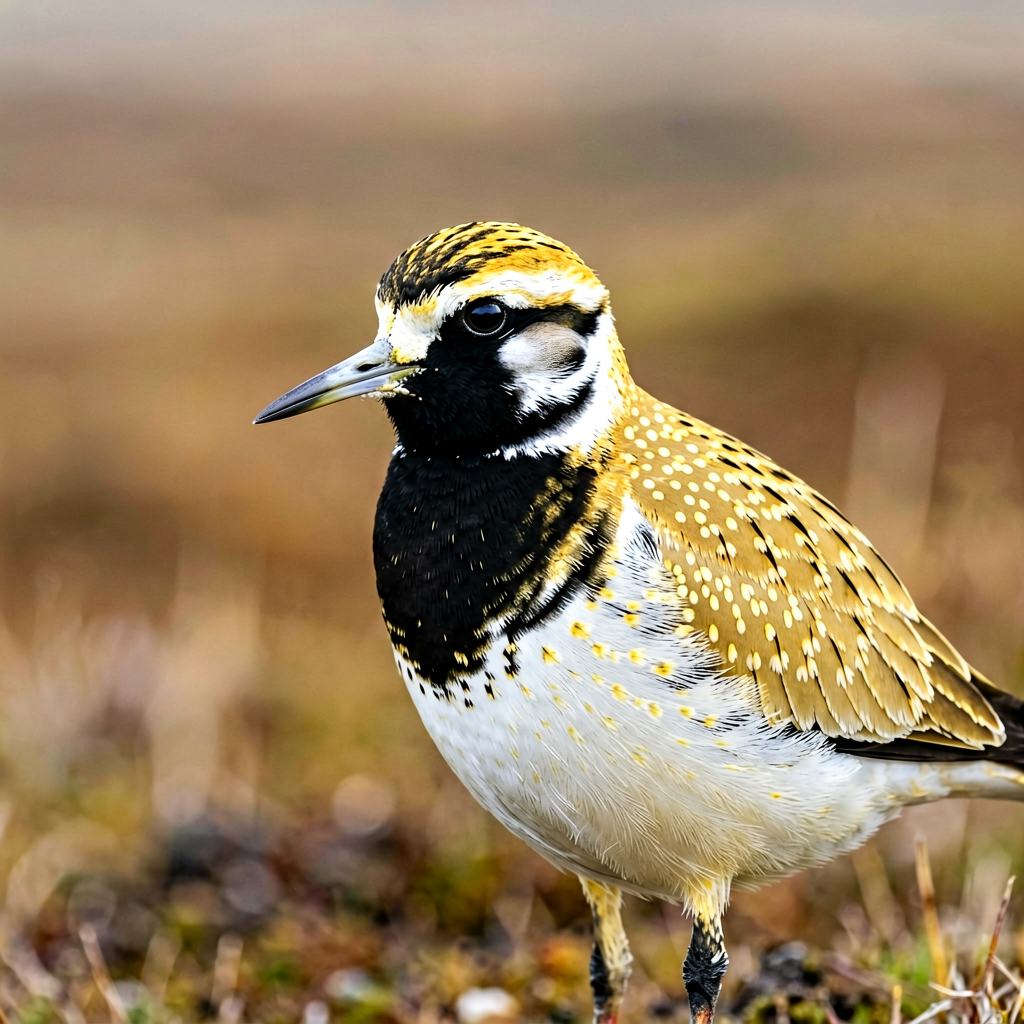
They are bare for about half their length. They are dark grey-brown to black. The breeding plumage comes from a partial moult in late winter. Males show an unbroken black face, throat and breast. Females and young birds have some white or buff mottling below. A narrow white band splits black from the upperparts. It runs from the forehead above the eye down the neck to the flanks. The upperparts are black or dark brown. Each feather of the mantle and wing coverts has a golden-yellow tip. The spots line up in rows along the feather tracts. This makes a neat, almost tiled pattern. It gives the plumage its metal sheen.
Females have smaller and less obvious spots. The wings are long, pointed and dark. The tail is short and dark with a narrow pale tip. The underwing coverts and axillaries are white. That splits it in flight from the grey plover, whose underwing is black. The winter plumage comes from a full moult. It starts on the breeding grounds in July. It finishes on the wintering grounds by about October. The bird is then pale buff and grey-buff. A paler eyebrow stripe becomes more obvious.
1
2
3
Tundra, bog and winter stubble
Where it lives
The golden plover breeds in treeless open country. It wants short, sparse plants and much bare ground. In the Arctic that means dryish tundra heath and mossy hummock tundra. It also uses fell-field in northern Scandinavia and arctic Russia. There it is often the commonest breeding wader. In Britain and Ireland it means high blanket bog and dwarf-shrub heath above about 300 metres. It also uses montane grassland of the eastern Highlands. The Pennines, the Cheviots, the Wicklow Mountains and the western Highlands all hold birds. The needs are always the same.
It wants open ground with a long view. It wants turf short enough to run over. It wants stones or hummocks for nesting and for lookouts. Its food is mainly cranefly larvae. The hatch must fall when the chicks are reared. The British breeding range has shrunk a lot. It is now confined to the higher and more remote uplands. Several things caused this. Grazing and drainage lower down cut the mix of turf.
Large areas of moorland were planted with conifers in the twentieth century. Foxes and carrion crows have grown in numbers. The climate has warmed as well. That moves the insect hatch ahead of the chicks’ hatching. In winter the bird uses damp grassland and coastal grazing marsh. It also uses flooded pasture, cereal stubbles and ploughed land. It prefers fields that are grazed short. Short fields give the clearest view of soil prey.
Craneflies on the clock
What it eats
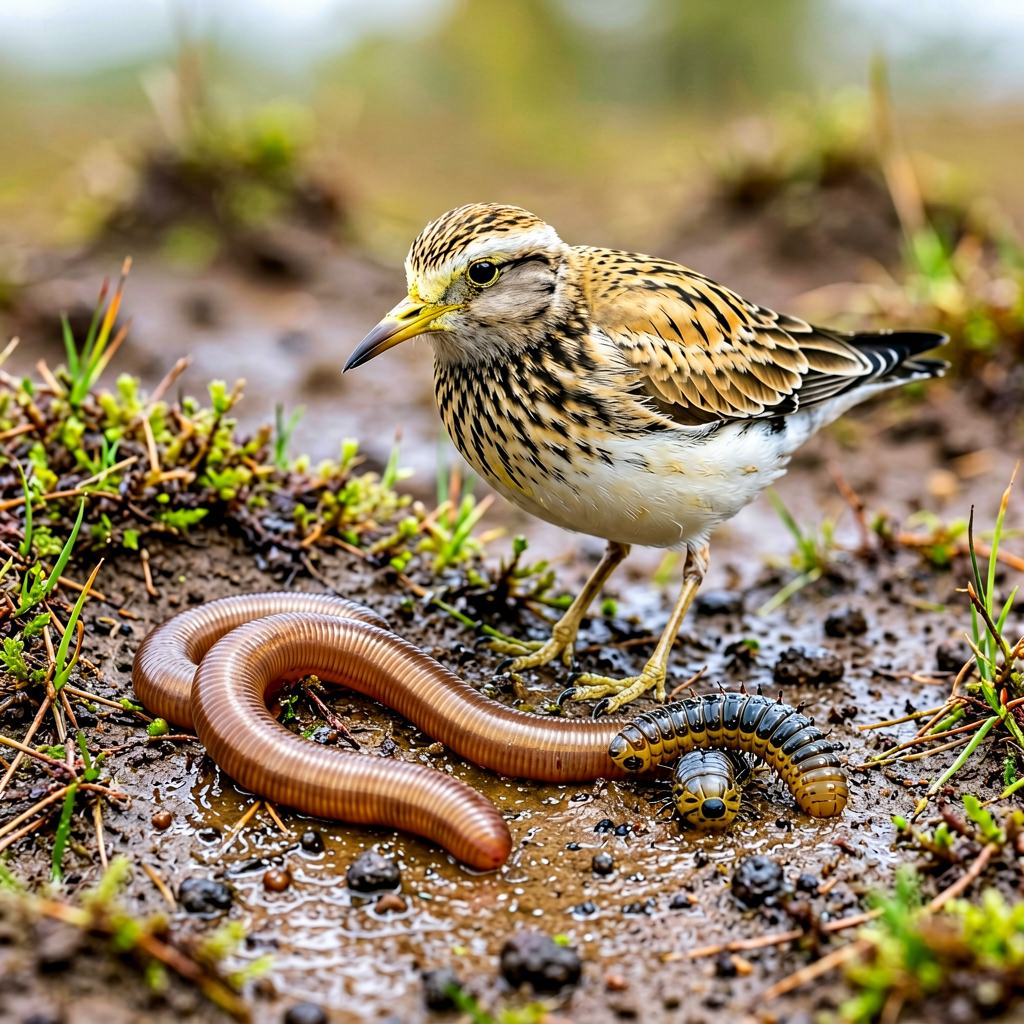
The golden plover eats mainly insects in the breeding season. In winter it eats insects, worms and some plant food. On the Arctic tundra it lives largely on the larvae and adults of true flies. Craneflies and smaller tipulids are the most important. Their larvae live in the surface layers of the soil. It also takes beetles, sawfly larvae and moth caterpillars. It eats spiders as well. The timing of the insect hatch drives its breeding success. That timing turns on soil heat and on the melting of snow. In Britain the diet is similar.
Tipulid larvae and beetles dominate. Sawfly larvae, ants, spiders and snail shells are taken in smaller numbers. Chicks are fed on tiny bugs for their first few days. The parents pick these from the plants. The chicks lean less on their parents as they grow. In winter the birds feed on damp swards and stubbles. Their food then has earthworms, tipulid larvae, beetles and leatherjackets. They also take soil insects and spiders. In some areas and months they eat a lot of plant matter. Grass seeds, cereal grains and the leaves of winter crops all feature.
On the moors they take crowberry and bilberry berries. The birds feed by sight, not by touch. That sets them apart from the probing godwits and curlews. A plover runs forward in short bursts. It pauses with its head up and its eye fixed on a spot. Then it stoops quickly to snatch the prey. Hundreds of birds repeat this across a field at once. The flock looks constantly busy, yet no bird seems to hurry.
Four eggs in the open
The breeding cycle
Golden plovers return to the breeding grounds in March and April. Males arrive about a week before females. Pairs form on the breeding grounds or in the wintering areas. The male has a striking display flight. He rises on slow, deep, flapping wings, like a giant butterfly. He whistles a soft three-note call. That call is one of the sounds of the high moor in spring. The patch held is small, usually less than 5 hectares. Males defend it against other males. They use the flight display and ground poses. They also chase rivals off. The female picks the nest site.
It is usually a shallow scrape in the turf. It often sits on a slight hummock or ridge. A stone or a grass tuft usually hides the sitting bird from above. The clutch normally holds 4 pear-shaped eggs. They are laid at intervals of about two days. The eggs are pale yellow-buff with bold black blotches. This gives very good cover on the moor. Both parents sit on the eggs. The female takes the larger share by day. The male takes over at night. Sitting lasts 28 to 31 days. The chicks can run at once.
They leave the scrape within a day or two of hatching. Both parents lead them to damper ground with better food. They fledge at about 25 to 30 days. Only one brood is raised each season. Lost clutches are often replaced. The clutch laid second is usually smaller. In the far north there may be no re-lay at all. First-year birds probably do not breed. Birds are probably two or three years old at first breeding. Adults live a long time. Ringing has found birds more than 12 years old.
The southern group is British
A shrinking range
The golden plover is Least Concern worldwide. That reflects very large numbers overall. It is put at several hundred thousand pairs. The arctic breeding range is vast. European and national reviews are less cheerful. The species is listed as needing action in several countries. Britain is one of them. The loss of breeding range there is well recorded.
British breeding numbers are put at 40,000 to 50,000 pairs. They make up the whole world stock of the southern breeding group. Numbers have fallen greatly. The bird has retreated from the lower, drier edges of its old range. The pattern suggests pressure from two sides. At lower levels, farm improvement of poor upland has cut habitat quality. At higher levels, the best high ground is being lost to erosion and to conifer planting. Warming also brings the soil bugs the chicks need out too early.
Several measures would help. Grazing must be run to keep a mix of short and taller plants. Tree planting must be kept off the higher, wetter parts of the plateaux. Foxes and crows that take eggs and chicks can be controlled where there is good cause. On the wintering grounds, damp grassland and stubble must be kept. Wet pastures are being drained. Winter stubbles are being lost to autumn sowing. Visits to coastal marshes disturb the largest gatherings of birds.
Quick hits
Five things to remember
- The scientific name is a small contradiction: Pluvialis means of rain, from the old belief that these birds gathered before wet weather, while apricaria comes from apricus, meaning sunlit, after the gleaming gold spots of the breeding bird.
- The golden plover’s migration across Europe was worked out in the 1940s and 1950s by fitting the birds with tiny numbered nose rings, a study that became a classic of bird migration research.
- In winter plumage the bird is so much duller that many people who see flocks on farmland assume they are small, short-billed lapwings.
- The four eggs are marked with black scrolls and blotches in a pattern peculiar to each egg, and a sitting bird is very hard to see even from a few metres away.
- Britain holds the entire world population of the southern breeding group, which nests on high moors while the rest of the species breeds on Arctic tundra hundreds of km further north.