 By st20113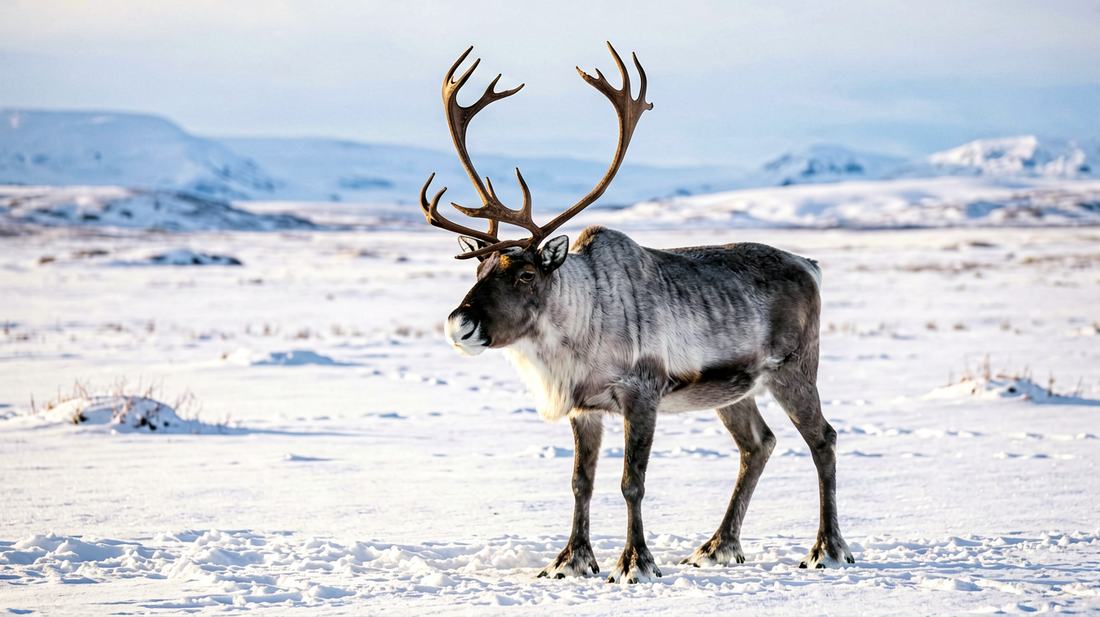
Rangifer tarandus | Reindeer
Species Profile · Cervidae
Reindeer
The only deer in which both sexes grow antlers, and the most travelled land mammal on Earth, walking thousands of kilometres between forest and tundra.
IUCN: Least Concern
Range
Shoulder
Antlers
Migration
Winter food
The deer of the far north
The reindeer
The reindeer is called the caribou in North America. It is the only deer where both the male and the female grow antlers. It is the most migratory land mammal on Earth. Some herds travel thousands of km each year. They move between winter forest and summer tundra. Reindeer live in the cold north of Europe, Asia and North America.
Their range runs from the Arctic coast to the boreal forest. They eat lichens, mosses and shrubs. Most big plant-eaters cannot digest these. Their coat has hollow hairs that trap air. This keeps them warm far below freezing. Their broad hooves spread their weight on snow and soft ground.
Their nose warms the cold air before it reaches the lungs. People in northern Europe and Siberia have herded reindeer for thousands of years. Reindeer are still central to the Sámi and other Arctic peoples. Wild herds are in trouble in parts of their range. Woodland caribou have dropped sharply in number.
Family tree
The only member of its genus
The reindeer is in the order Artiodactyla. It belongs to the family Cervidae and the genus Rangifer. It is the only living member of that genus. This means it has no close relatives among the deer. A better-known relative is the Red Deer. The red deer is a larger forest and moorland deer of temperate Europe. Only its males grow antlers.
It eats mainly grasses and leaves, not lichen. The two show how different deer can be. The red deer grazes in warm months in rich habitats. The reindeer is built for cold. It lives where the growing season lasts only a few weeks. Several subspecies are known. They include the Eurasian tundra reindeer and the Finnish forest reindeer.
The Svalbard reindeer is the smallest and the most settled. The Arctic caribou of North America and Greenland is another. Scientists disagree on how many subspecies exist. Herds mix where they meet. Body size also shifts slowly with latitude. Carl Linnaeus named the species in 1758. The name tarandus may come from an old word for an animal with branching horns.
Antlers, hooves and hollow hair
Built for the cold
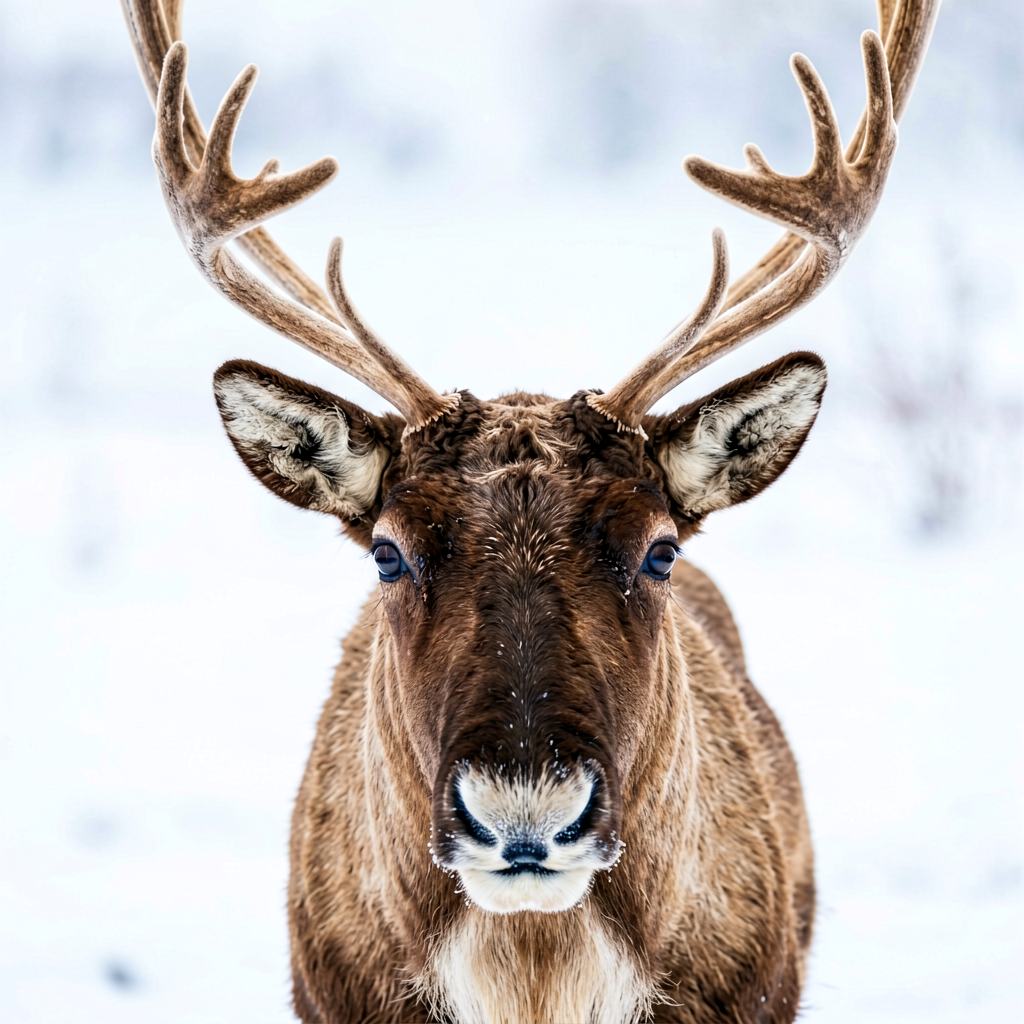
An adult reindeer stands 80 to 150 cm at the shoulder. It weighs 60 to 300 kg. Males are much bigger than females. Northern herds are smaller than southern ones. The coat is thick and made of hollow hairs. These hairs hold air and give great warmth. Coat colour ranges from dark brown to pale grey. Some herds are almost white. The muzzle is covered in hair. The small nostrils have folded skin inside.
This warms the air before it reaches the lungs. The hooves are large, round and splayed. They change with the seasons. In summer the soft ground makes them hard and grippy. In winter they grow broad and cupped like snowshoes. They also help the animal dig through snow to lichen. Both sexes grow antlers. This is unique among deer. The antlers are bone. They drop and regrow each year.
Males use them to fight in the rut. They shed them in December. Females keep theirs all winter to guard feeding spots. They shed in spring. The eyes shift colour with the season. They are golden in summer and deep blue in winter. This may sharpen sight in the dim polar light. The animal then finds pale lichen under snow. Reindeer can run at up to 80 km/h. They are also strong swimmers.
1
2
3
Tundra, taiga and mountain
Where herds roam
Reindeer and caribou live across northern Europe, Asia and North America. Their range runs from the Arctic tundra and islands south through the taiga. It reaches mountain chains like the Norwegian fjell and the Rockies. They favour open, cold ground. This includes tundra, heath, lichen woodland and peatland. They also use the edge of the boreal forest. They need a large area with forest or thick shrubs. This gives shelter in winter and a place to calve.
In most of their range they migrate between summer and winter grounds. Some Arctic herds travel huge distances. Trips of more than 3,000 km a year have been recorded. They cope well with deep snow. They fail when rain falls on snow and freezes to ice. Then they cannot dig to their food. Svalbard reindeer break this rule. They stay in one small area all year.
They eat what they find on the tundra. Reindeer were taken to places outside their range. These include parts of Alaska and the subantarctic island of South Georgia. The South Georgia herd was later removed to save native plants. Lost habitat is a major threat. Roads, mines, pipelines and dams cut their migration routes. The animals are easily disturbed while calving.
What it eats
A winter diet of lichen
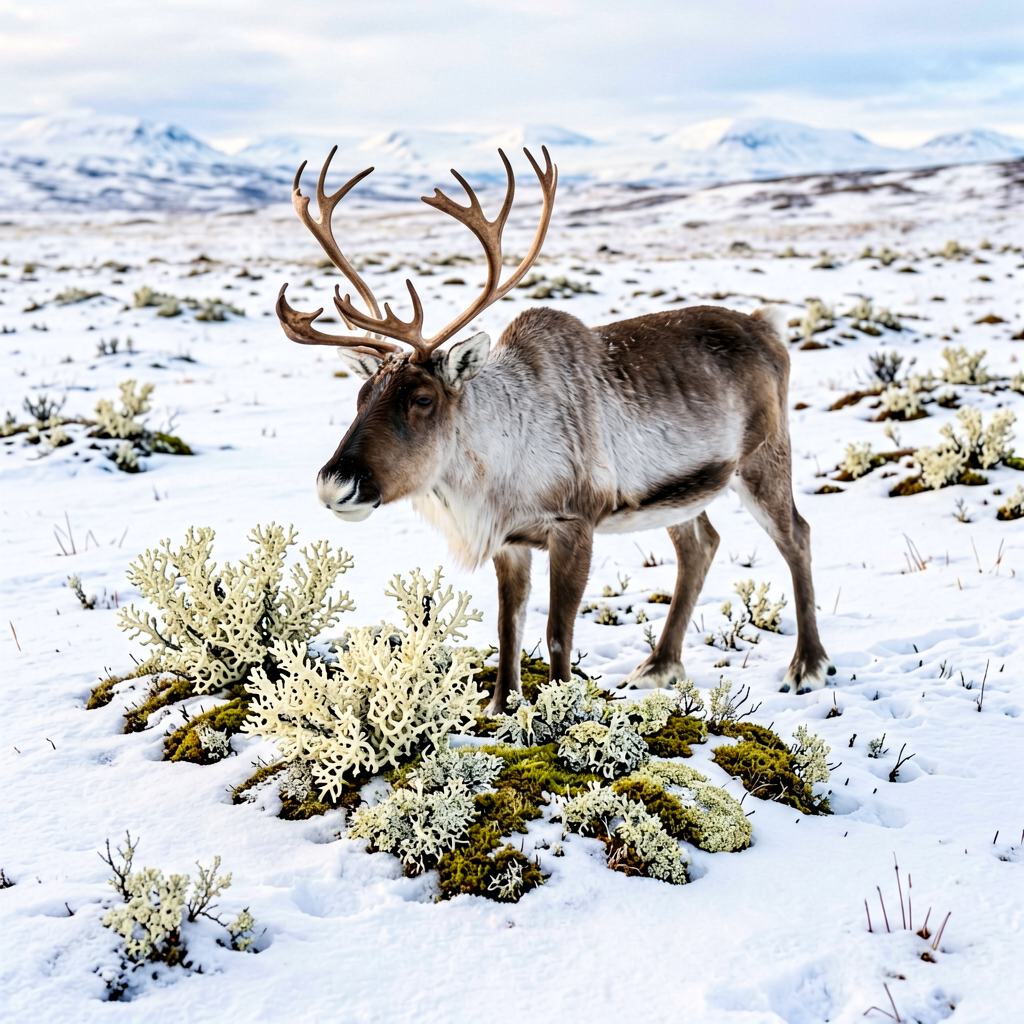
Reindeer eat mainly lichen. This odd diet lets them survive winter where other big plant-eaters would starve. In winter they live on lichens. The pale, branching reindeer lichen is the key kind. They also eat mosses, sedges and the twigs of dwarf shrubs. In summer they switch to richer food. They eat grass, sedges, herbs, willow and birch leaves, and mushrooms. These give the protein and minerals for antler growth, milk and fat.
Reindeer chew cud and have a four-part stomach. Tiny microbes in the gut break down tough lichen. Other mammals cannot use it. They feed in groups. They paw craters through the snow to reach plants below. In winter one animal may spend its whole day digging and eating. Lichens grow very slowly. They need years or decades to recover from heavy grazing.
That is why herds roam such wide areas. Overgrazing one spot does real harm. Wolves and brown bears kill adults. Golden eagles, lynx and wolverines take calves. Mosquitoes and warble flies plague them in summer. The insects drive them onto windy ridges and snow patches.
Calves on the summer tundra
Mating and migration
Reindeer mate in autumn. The rut runs from late September to October. Males fight for control of female groups. They gather harems of five to twenty females. They defend them with long shoving matches. After mating the cow carries the calf about seven and a half months. Calves are born in May and June. This times the birth to fresh plant growth.
One calf is normal. Twins are rare. A newborn weighs 4 to 6 kg. It can stand within an hour. It can run within a day. This matters where wolves are never far. Calves start on solid food at a few weeks. They are weaned by autumn.
They stay with their mothers through the first winter. Females first calve at two or three years. They breed every year after that. A wild female may live twelve years or more. Only about half the calves survive their first year. Herd size rises and falls with the winter and the food.
A warming Arctic
Northern herds in retreat
The reindeer is not at risk worldwide. As a whole the species is Least Concern. This hides sharp local losses. Canada’s woodland caribou are in rapid retreat. Some groups are down to a few hundred animals. The Finnish forest reindeer and some Arctic island herds are also at risk. The main pressures are industry in the north.
Logging and roads break the old forests the caribou need. Mining and oil drilling are growing. Snowmobiles and traffic cause distress. In the Norwegian mountains, cabins and ski areas have cut off migration routes. Climate change is a rising threat. Warmer winters bring more rain on snow that locks the ground in ice. The treeline is creeping north into the lichen tundra.
Herders manage semi-wild herds. They kill predators and move animals between summer and winter pastures. Overgrazing is a known problem in some districts. Conservation protects old forest. It also guards migration routes. Large calm calving grounds are set aside.
Quick hits
Five things to remember
- The reindeer is the only deer species in which both males and females grow antlers.
- Its winter food is mostly lichen, which its gut microbes can digest and most other large mammals cannot.
- Some Arctic herds travel more than 3,000 kilometres a year, the longest migration of any land mammal.
- A reindeer’s eyes change from golden in summer to deep blue in winter to improve vision in polar twilight.
- Its hollow coat hairs trap air so effectively that the animal can rest comfortably in temperatures well below minus thirty degrees Celsius.