 By st20113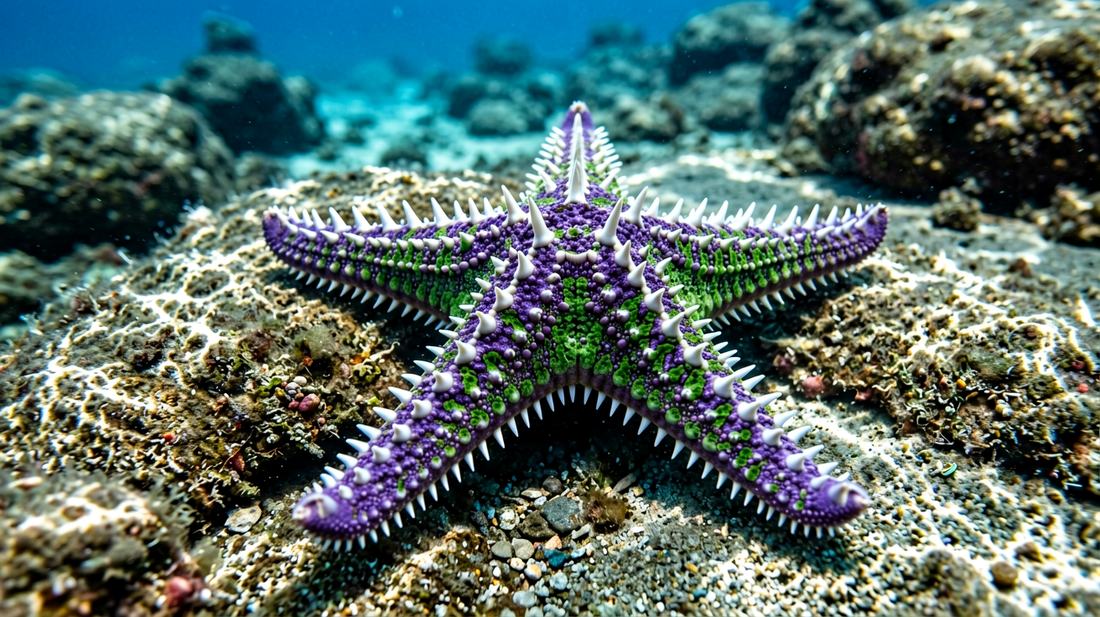
Marthasterias glacialis | Spiny Starfish
Species Profile · Asteriidae
Spiny Starfish
One of the largest starfish in European seas, a five-armed predator up to seventy centimetres across that is a routine throw-away of scallop dredging.
Not assessed by IUCN
Range
Spread
Arms
Depth
Spawning
A giant among starfish
The spiny starfish
The spiny starfish is the biggest starfish in British and Irish waters. It is a soft hunter that grows as wide as a dinner plate. Three rows of sharp white-tipped spines run down each arm. Its colours range from pale grey and yellow to deep purple and green. The upper side often shows a paler, mottled pattern. Arm tips are often dark or blue. The common starfish pries open mussels.
The spiny starfish is a general hunter. It eats barnacles, sea urchins, other starfish and dead animals. It has been seen attacking scallops on fishing grounds. To eat prey bigger than its mouth, it pushes its stomach out through its mouth. It digests the food outside its body. The species lives on rock and gravel beds. It lives from the low shore to about 200 metres.
It ranges along the north-east Atlantic. Its range runs from Iceland and Norway to West Africa. It is also found across the Mediterranean. It is not fished. It is caught and thrown away in bottom trawls and dredges. Its numbers matter because it is a main hunter of shellfish beds.
Family tree
A northern relative of the common starfish
The spiny starfish is in the phylum Echinodermata. It is in the class Asteroidea and the family Asteriidae. It is the only species in the genus Marthasterias. Its nearest kin is the Common Starfish. That starfish is in the same family. It has the same five-armed shape. It can push its stomach out of its body too.
The common starfish is smaller, smoother and far pickier about food. The common starfish eats only bivalves. It grows to about twenty centimetres. The spiny starfish is a larger, freer hunter. It reaches three times that size. The class Asteroidea has about 1,500 living species. The family Asteriidae holds many of the best-known sea stars of the north-east Atlantic.
These include the sunstars and the blood star. Marthasterias is a small genus. Its sorting is hard because animals from different depths look different. A near kin in the southern hemisphere is seen by some as a separate species. The species was first named in 1767.
Spines, arms and pincers
How to identify one
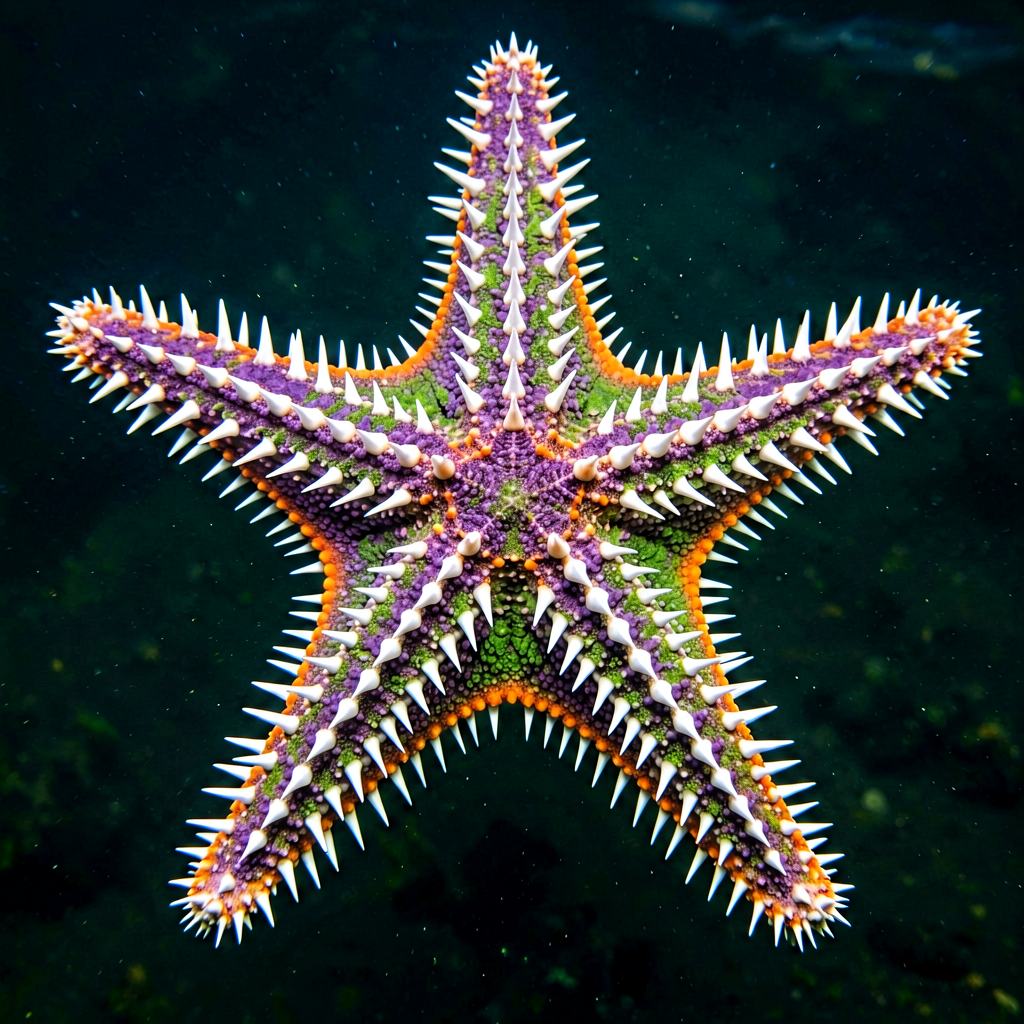
An adult spiny starfish is usually 40 to 60 centimetres across. Big ones reach about 70 centimetres. This makes it much bigger than the common starfish. It almost always has five arms. Six-armed ones turn up now and then. The arms are long, tapering and lined with bold spines. These spines sit in three clear rows along each arm.
A row of big, sharp, white or pale-tipped spines runs down the middle. Smaller spines lie on each side. Tiny pincer-like parts called pedicellariae keep the animal clean of young larvae and small pests. Tiny finger-like parts called papulae take in oxygen from the water. Colour ranges from pale grey, yellow or orange to deep purple and green. They have a paler centre and darker arm tips. Some show a blue or violet tint.
Tube feet in rows under the body grip the ground. They also hold prey while it feeds. The mouth sits in the centre of the underside and is big and soft, so the starfish can push its stomach out and take fairly big bites. Growth is slow. Big animals are likely at least ten years old. Lost arms grow back over months.
1
2
3
Rock, gravel and kelp
Where it lives
The spiny starfish lives on both sides of the north-east Atlantic. Its range runs from Iceland, Norway and the British Isles south to Morocco and the Canary Islands. It is found across the Mediterranean. It lives on rock, stone and gravel beds. It is also found on coarse sand and shell gravel. It needs something firm to grip. It lives just below the low tide mark to about 200 metres.
It is most common in shallower water above fifty metres. It likes open coasts with clean, oxygen-rich water. It avoids mud and brackish estuaries. Around Britain and Ireland it lives all round the coast. It is often found among kelp roots, in rock gullies and under boulders. It is a common catch in scallop dredges and beam trawls. Young ones live in the shallows and among seaweed.
Adults move into deeper water. They are most often seen on the scallop grounds of the Irish Sea and the Channel. The species is a big, slow hunter whose young spread little. Local groups can be cut by repeated dredging. The animals are often hurt by fishing gear. Single animals can live for years in one small spot. They return to favourite feeding sites.
What it eats
A predator of shellfish
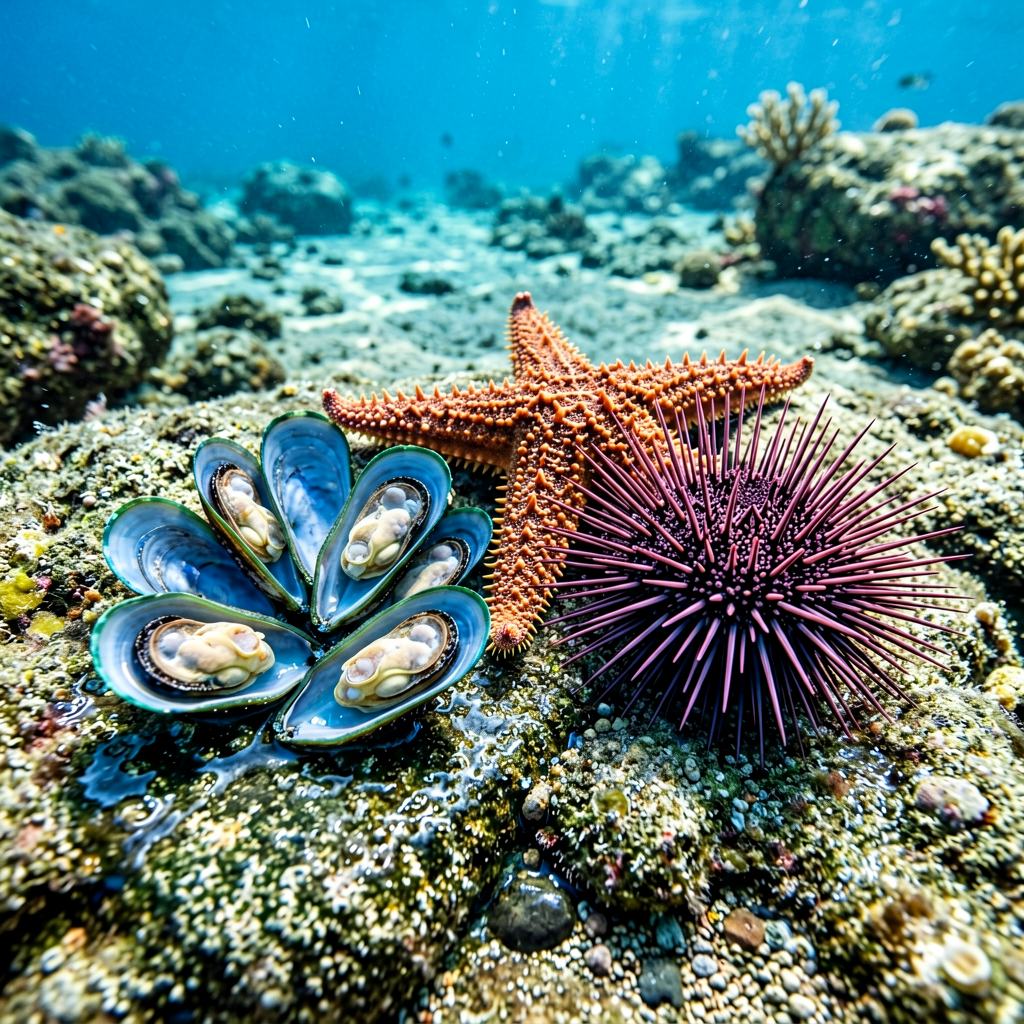
The spiny starfish is a hunter and a scavenger. It eats many kinds of prey. Its food includes mussels, scallops, oysters, barnacles, sea urchins, brittlestars, other starfish and dead animals. It attacks shellfish by gripping the shell with its tube feet. It pulls until the animal inside tires. Then it pushes its stomach out through its mouth. It digests the prey in its own shell.
Small sea urchins are swallowed whole. The starfish digests them inside its body. Big urchins are attacked from above. They are eaten through the gap between the spines. The species is a key hunter of scallops and oysters on farms. Studies of scallop beds found it a main cause of young shellfish death. It also scavenges.
It gathers on dead fish and crabs like the common starfish. Feeding is slow. One big meal may take many hours to digest. Adult spiny starfish have few foes. Young ones are eaten by crabs, big fish, gulls and other starfish. Eggs and larvae are eaten by plankton feeders. Arms lost to foes or harm grow back over months.
Millions of eggs
Spawning in spring
Spiny starfish have separate males and females. They do not seem to change sex. The species breeds once a year. Spawning happens in spring. Around the British Isles it is usually March to May. This is when the water warms and plankton grows. Males and females release eggs and sperm into the sea. They often do it at the same time to a chemical signal. One big female may shed several million eggs in a season.
The egg becomes a free-swimming larva. It is called a bipinnaria. It drifts in the plankton for weeks. It eats tiny algae. Then it passes a second stage called a brachiolaria. It settles on the seabed and becomes a small starfish. The larval stage lasts weeks. It can drift tens of kilometres on currents. This lets the species reach new ground.
It also links separate groups. Young grow slowly. A starfish may take years to reach full size. It likely matures at three or four years. The species can regrow lost arms. Animals that lose an arm fleeing a foe usually live. But regrowth costs energy and slows growth.
Dredged from the seabed
The cost of bottom fishing
The spiny starfish has no formal status. It has no plan to manage it. It is not eaten or gathered in large numbers. Its main threat is bottom fishing. Scallop dredges and beam trawls break the animals. They pull them to the surface. It is a common throw-away in those fisheries.
Repeated dredging over one spot removes the big hunters. It changes the whole seabed life. The starfish matures slowly. It breeds only once a year. Groups recover slowly from such loss. Dredged scallop beds show big animals grow scarce. Extra nutrients and pollution hurt the species in indirect ways.
They change the seabed and its food supply. The starfish builds up toxins in its body. This makes it useful for pollution tests. Climate shift is moving many north-east Atlantic sea stars. The south edge of its range may shrink as the water warms. As a key hunter of scallops and oysters, it draws the interest of fish scientists. Some plans would protect seabed spots from dredging.
Quick hits
Five things to remember
- It is the biggest starfish in British and Irish waters, reaching about 70 centimetres across.
- Each arm carries three rows of sharp, white-tipped spines, which give the species its name.
- It can push its stomach out of its mouth to digest prey outside its own body.
- It is one of the main hunters of scallops on fishing grounds.
- Big animals are likely at least ten years old, and they can regrow an arm lost to a foe.