 By st20113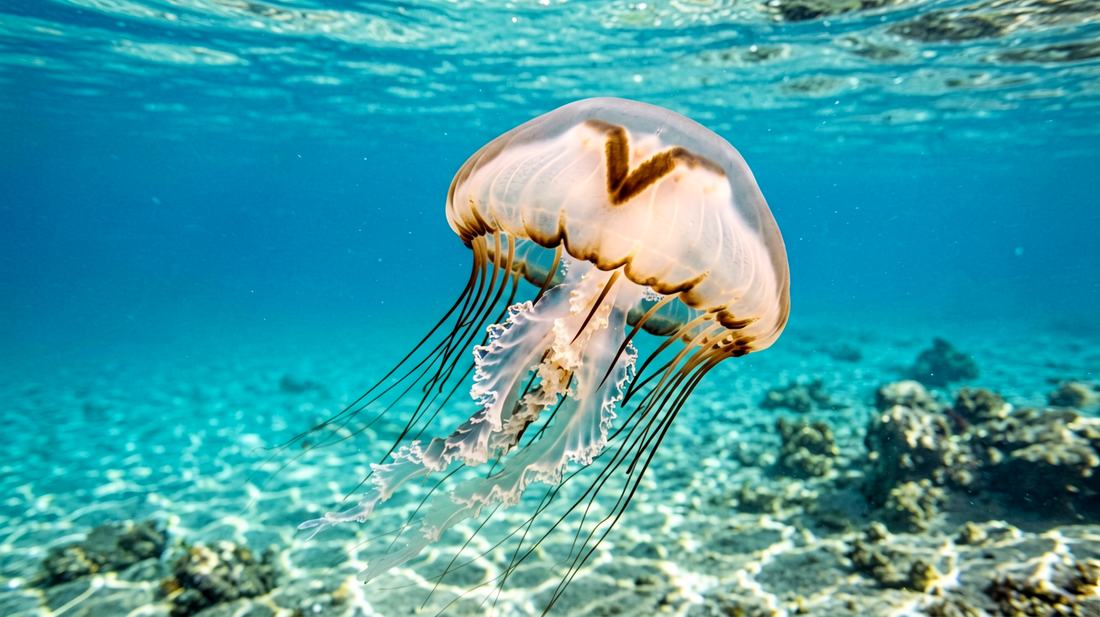
Chrysaora hysoscella | Compass Jellyfish
Species Profile · Pelagiidae
Compass Jellyfish
A coastal drifter with compass-point bands on its bell and twenty-four stinging tentacles that make swimmers keep their distance.
Not assessed by IUCN
Range
Bell
Tentacles
Adult life
Assessed
A drifter that stings
The compass jellyfish
The compass jellyfish is a clear sea creature. Its pale bell carries brown V-shaped bands. These bands spread from the centre like compass points. That marking gives the animal its name. It drifts in the cool coastal waters of the north-east Atlantic. It lives in the Irish Sea, the North Sea and the western Mediterranean.
Swimmers often meet it in late summer. Around its bell hang twenty-four long tentacles. Four ruffled arms trail behind it. It pulses slowly through the water. The sting is painful. It leaves a red, itching welt that can last for days.
It is not dangerous to a healthy adult. Like all jellyfish, it is not a single animal. It is a colony of tissues working as one body. It spends its life held in the water column. It eats small creatures that drift into its tentacles.
Family tree
Kin of the moon jellyfish
The compass jellyfish belongs to the phylum Cnidaria. It is in the class Scyphozoa. Its order is Semaeostomeae. Its family is Pelagiidae. Its closest well-known kin in European waters is the Moon Jellyfish. The moon jellyfish is a far gentler kind. It has a flatter, almost clear bell. Its short fringe tentacles rarely sting a swimmer.
Both animals share the same basic cnidarian plan. A bell contracts to drive the body forward. Sting cells called nematocysts pack the tentacles. A simple nerve net replaces a brain. The genus Chrysaora holds roughly a dozen known species. Among them are the Atlantic sea nettle and the Pacific sea nettle. The group is still being revised. Jellyfish preserve badly.
Museum specimens lose the colour patterns that split the species. The compass jellyfish was first described by Carl Linnaeus. He was a Swedish naturalist. He did so in 1767. Its scientific name comes from Greek myth. Chrysaor was a giant. His name meant he who has a golden sword. This refers to the golden-brown bell and the weapons in its tentacles.
Bell, bands and tentacles
How it is built
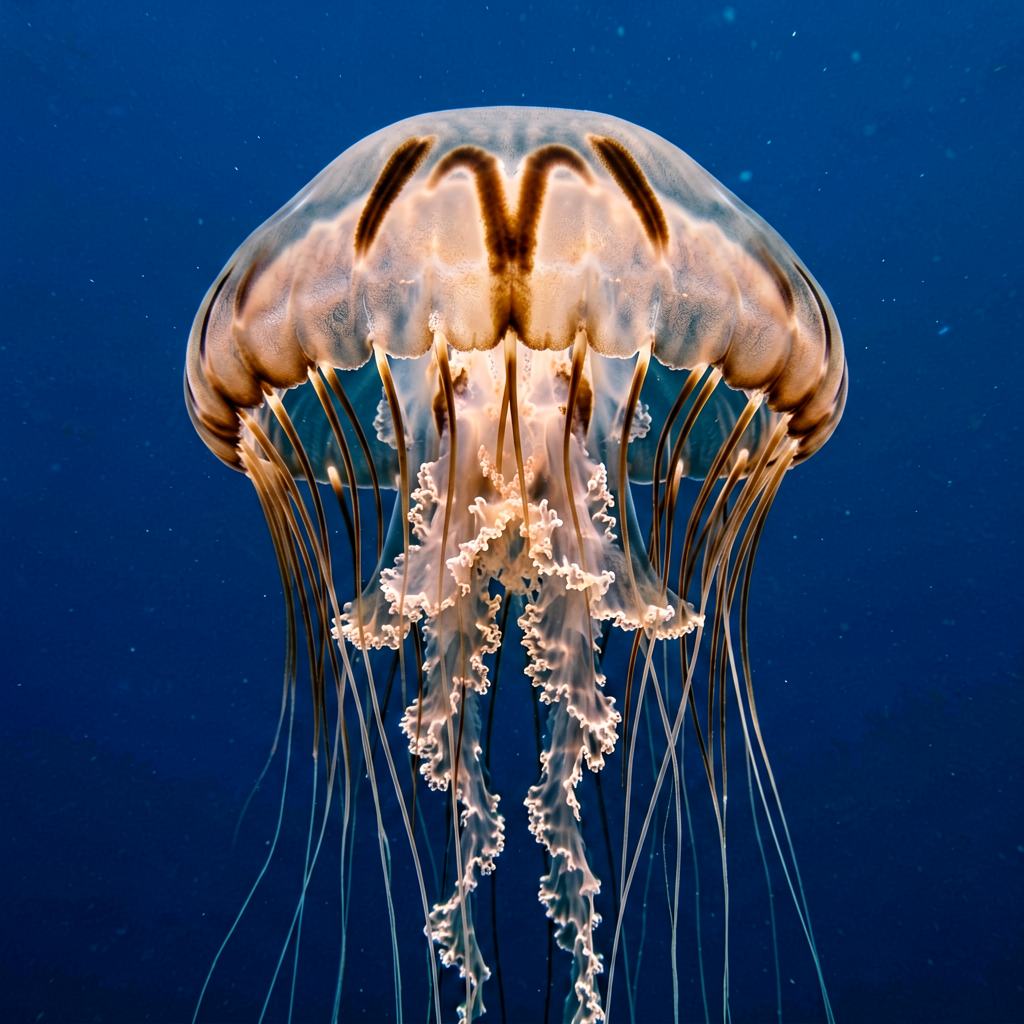
The bell of an adult measures 15 to 25 cm across. The largest reach about 30 cm. The bell is shaped like a shallow saucer. It is thin at the rim and thicker at the top. It is almost clear except for the brown marks. Between sixteen and twenty-four tentacles hang from the margin. Each can stretch far longer than the bell itself. Four long, frilly oral arms trail from the centre of the underside. The brown V-shaped stripes run from the centre to the edge. Between them lie pale, clear panels.
Small sense organs called rhopalia sit around the rim. Each holds a tiny balance stone. Each also has light-sensitive cells. These tell the animal which way is up. The whole body is about 95 per cent water. That is why a stranded jellyfish melts into a smear of jelly within hours. Nematocysts are the sting cells. They are packed on the tentacles. They also occur on the oral arms. Each fires a tiny harpoon when touched.
The animal swims by rhythmic pulls of the bell. It is a weak swimmer. It travels only a few hundred m a day under its own power. Currents do most of the work. Compass jellyfish are pale yellow-brown when young. They become more patterned with age. The sex can be told by hand. The organs seen through the bell are pink in males. They are darker brown in females.
1
2
3
Swarms in summer
Where it drifts
The compass jellyfish is found from southern Norway south to Morocco. It ranges along the Atlantic coast of Europe. It is also found throughout the Mediterranean Sea. It is a coastal kind. It is commonest in shallow water over the shelf. That shelf lies within about 30 km of the shore. It has been recorded as deep as 200 m.
Around Britain and Ireland it peaks from June to September. Warm water and plenty of plankton let numbers grow fast. It is often washed into bays, harbours and estuaries on summer tides. In winter the adults die off. The species survives as small polyps. They cling to rocks, shells and other hard surfaces. Water heat strongly shapes its range.
In the past three decades it has become a regular summer guest in parts of the North Sea. There it was once rare. Swarms can hold thousands of animals. They are driven by wind and current, not by gathering. The species tolerates salt levels below full seawater. It can survive for a time in estuaries. It does not breed there.
What it eats
Fishing without chasing
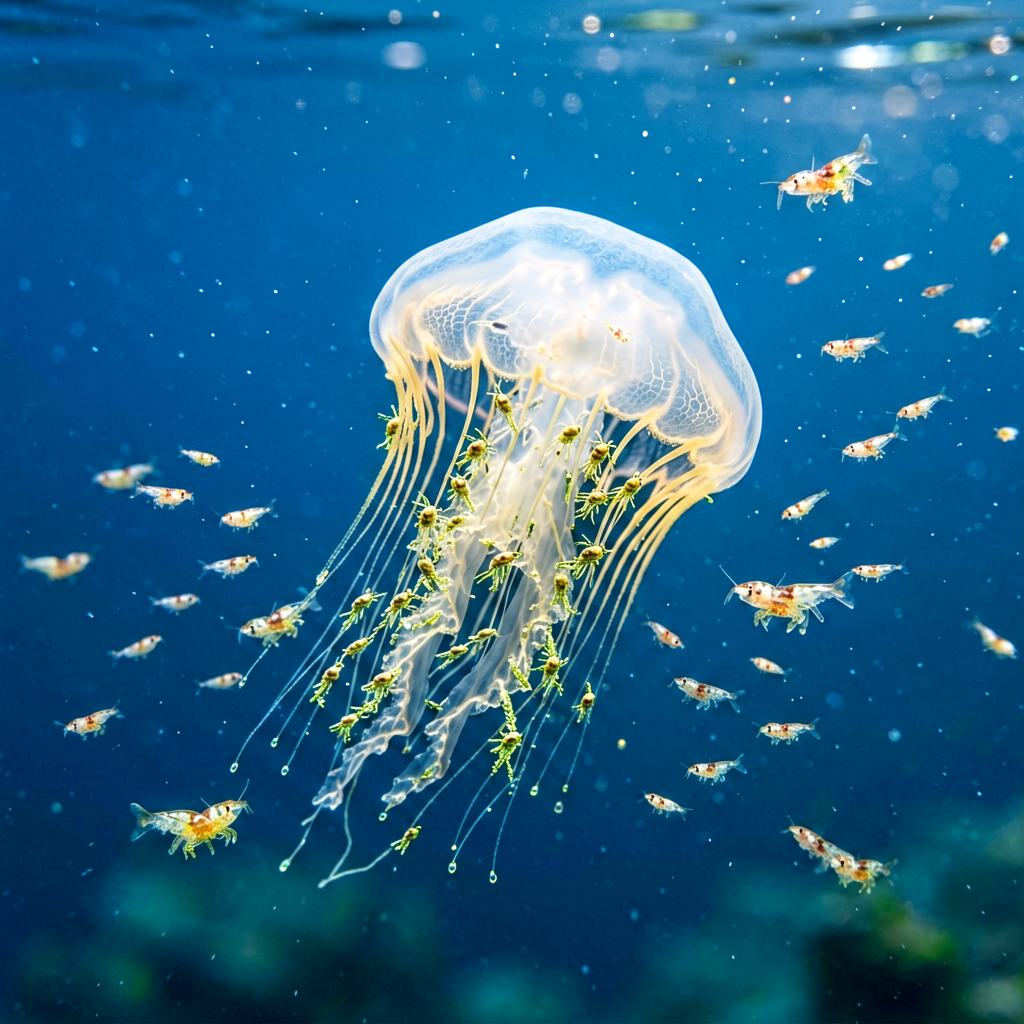
Compass jellyfish are drifting hunters. They catch whatever plankton touches their tentacles. Small crustaceans make up much of the diet. These include copepods, amphipods and shrimp larvae. They also eat fish eggs and fish larvae. Tiny molluscs and young of other jellyfish are taken too. The tentacles are loaded with nematocysts.
These fire on contact. They inject a toxin that stuns prey within seconds. The oral arms then carry the food to the mouth. The mouth sits in the centre of the underside. The animal cannot chase its food. It depends on water motion to bring a meal. A jellyfish in a strong current eats far more than one in still water.
Jellyfish take prey too small for most fish. They feed in plankton-rich water that bigger animals ignore. In turn they are eaten by leatherback turtles. Ocean sunfish and some large fish eat them too. Small parasitic crustaceans ride on the bell. In warm years with plenty of plankton, one animal can grow from a few mm to full size in weeks.
Polyp and jellyfish
A life in two parts
The compass jellyfish has a life cycle of two other bodies. Adult males release sperm into the water. Females take the sperm into their bodies. Fertilised eggs become tiny swimming larvae called planulae. Each planula settles on the seabed. It grows into a polyp. A polyp is a small, stalked animal with tentacles. It looks nothing like a jellyfish. It can live for months or years.
When the state is right, the polyp divides sideways. It forms a stack of discs. These peel off one by one as tiny jellyfish. They are called ephyrae. Each is only a few mm wide. This process is called strobilation. It can release dozens of young from one polyp. It usually happens in spring. Then the water warms and food becomes plenty.
The ephyrae grow fast through summer. They become mature adults within a few months. Adults usually live less than a year. They die in autumn or winter after they spawn. The species depends on the polyp stage to survive cold months. This switch is one of the oldest breeding plans. It has let jellyfish persist for more than 500 million years.
Following the sea
A species nobody manages
The compass jellyfish is not listed as threatened. It is common throughout its range. It carries no formal status. There is no fishery for the species. No targeted rules exist. It is caught and thrown away in some trawl and gillnet fisheries. Its main pressures are indirect. Warmer seas appear to favour jellyfish.
Higher water heat speeds up strobilation. Overfishing removes fish that eat jellyfish and their plankton food. Nutrient runoff from farms can trigger plankton blooms. These feed large jellyfish swarms. Such swarms clog fishing nets. They also clog cooling-water intakes at power stations. A sting hurts but is rarely serious. Most experts advise rinsing with seawater.
They say to remove tentacle bits. They warn against fresh water. Fresh water can trigger more sting cells to fire. Jellyfish numbers rise and fall with ocean state. The species is a useful sign of change in coastal seas. Long-term checks around the British Isles record its summer swarms each year.
Quick hits
Five things to remember
- The brown V-shaped bands on its bell look like compass points. That gives the species its common name.
- Up to twenty-four sting tentacles trail behind the bell. Each one is longer than the body is wide.
- The adult dies within a year. Its seabed polyp stage can survive several seasons and release dozens of young at once.
- A compass jellyfish is about 95 per cent water. It melts into a smear of jelly within hours of being stranded.
- Small crabs and fish young sometimes ride on its bell. They use the sting tentacles as moving shelter.