 By st20113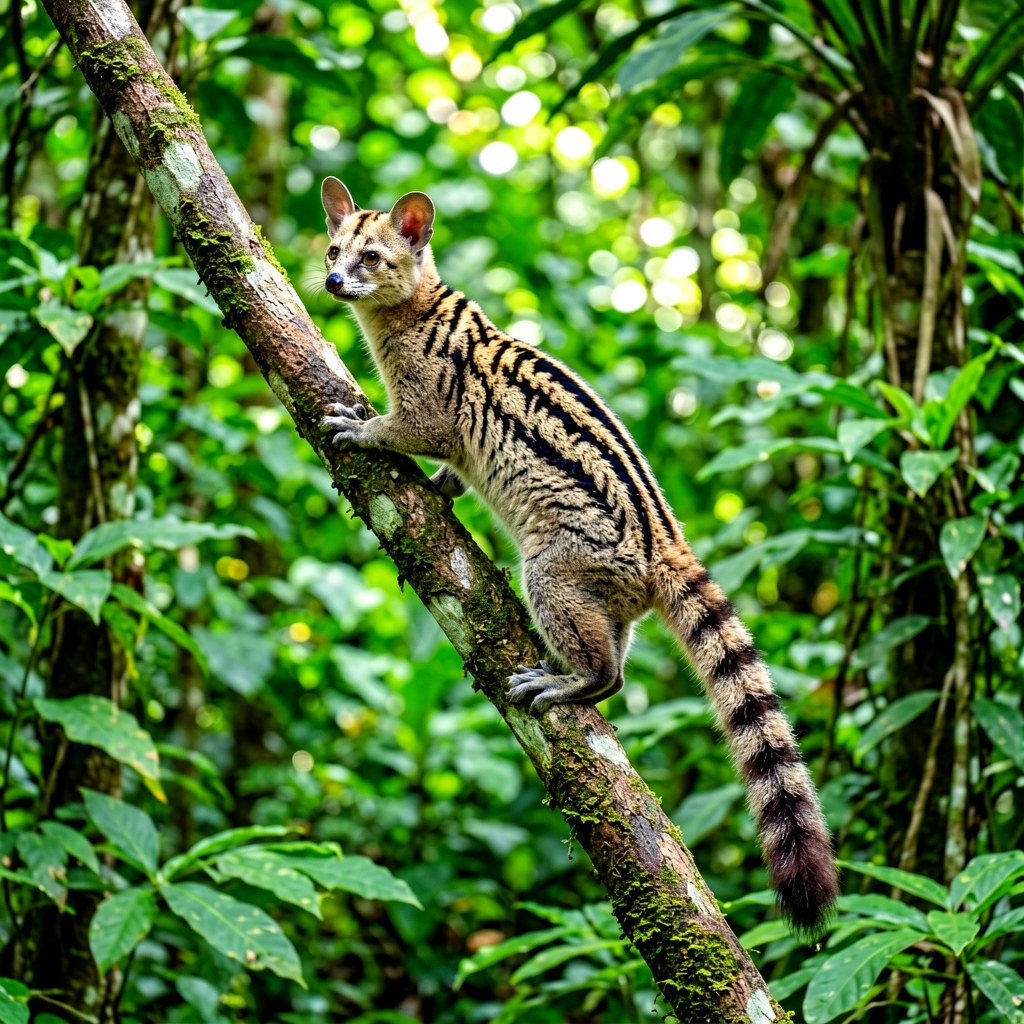
Arctogalidia trivirgata | Banded Palm Civet
Introduction
The banded palm civet, also known as the three-striped palm civet, is a small, slender viverrid of the humid forests of Southeast Asia. Its name refers to the three dark longitudinal stripes that run along the length of its back, a pattern that helps break up its outline among the dappled light of the canopy. Adults measure 43 to 71 centimeters from head to body with a tail almost as long again, and they weigh between 2 and 5 kilograms, making the species one of the more delicately built members of the civet family. Strictly arboreal and largely nocturnal, the banded palm civet spends most of its life in trees, where it forages for fruit, small vertebrates, and insects. Although seldom seen by people because of its shy, retiring habits, it is an important component of tropical forest ecosystems as both a frugivore and a predator.
Taxonomy
The banded palm civet is placed in the genus Arctogalidia within the family Viverridae and the order Carnivora, where it sits among the small-bodied, tree-dwelling civets of Asia. Its scientific name, Arctogalidia trivirgata, refers directly to the three stripes, with “tri” meaning three and “virgata” meaning striped, a useful key to identifying the species in the field. Within the viverrid radiation it is most closely related to the palm civets of the genus Paradoxurus, though it is more gracile and more thoroughly arboreal than its cousins. As a carnivoran it shares a distant ancestry with musteloid forest predators such as the [Fisher](https://www.gloencyc.com/fisher-pekania-pennanti/), another agile, climbing hunter that pursues prey through trees in boreal forests. Unlike the fisher, the banded palm civet has a longer, more prehensile tail and a diet dominated by fruit rather than mammals. Several subspecies have been described across its wide Southeast Asian range, though their validity is still debated by taxonomists using genetic data.
Physical Characteristics
The banded palm civet has a lithe, elongated body supported by short, slender legs, well suited to a life spent clambering through branches. The coat is short and soft, ranging from grey-brown to rich reddish brown on the upper parts and fading to a paler, creamy buff on the underparts and limbs. The defining feature is a set of three dark stripes running from the shoulders to the base of the tail, flanked by two additional, fainter lines along the sides in some individuals. The head is narrow with a pointed muzzle, large dark eyes adapted to nocturnal vision, and small rounded ears, while a pale stripe often runs along the top of the snout. The tail is long, bushy at the base, and only partly prehensile, serving as a balancing organ rather than a true grasping appendage. Males are slightly larger than females and possess a stronger scent gland, which the species uses to mark territory. The claws are sharp and semi-retractile, aiding both climbing and the capture of small prey.
Habitat
The banded palm civet is a creature of primary and secondary tropical forest, ranging from lowland evergreen rainforest to hill forest up to about 1,500 meters in elevation across Southeast Asia, including parts of India, Bangladesh, Myanmar, Thailand, Malaysia, Indonesia, and the Philippines. It is strongly associated with intact canopy and with the fruiting trees that provide both food and travel routes, and it avoids open grassland and heavily degraded land. During the day it rests in tree hollows, dense epiphytic clumps, or tangles of vine, emerging after dusk to move along branches and lianas in search of food. The species is generally solitary, with each animal maintaining a home range that overlaps loosely with those of neighbors but is defended through scent marking. Fragmentation of forest forces individuals into smaller, isolated patches where fruit is seasonal and competition with other civets and primates intensifies. Because it depends on continuous tree cover, the banded palm civet is among the first carnivores to disappear when forest is converted to plantation or cleared for agriculture.
Diet
The banded palm civet is primarily frugivorous, and figs make up a major part of its annual intake wherever they are available, with the animal switching to other ripening fruits as the seasons change. Alongside fruit it takes a variety of animal prey, including insects, small birds and their eggs, lizards, frogs, and the occasional small rodent, which it stalks and seizes among the branches. Nectar and flower parts are eaten at certain times of year, and the species may incidentally pollinate the plants it visits. Foraging is almost entirely arboreal, with the civet gleaning fruit directly from twigs and probing crevices for invertebrate prey using its slender muzzle. Because it consumes whole fruit and later defecates the seeds, often far from the parent tree, the species is an effective seed disperser for many canopy species. Stomach content and scat studies show that the proportion of fruit rises during mast-fruiting events, when the forest produces a superabundance of figs and other crops that draws civets into concentrated feeding areas.
Reproduction
Reproduction in the banded palm civet is poorly documented in the wild, but captive and field observations indicate a short gestation of roughly 45 days followed by the birth of a small litter, usually one to three young. The cubs are born blind and helpless in a tree hollow or other concealed nest, and they are cared for by the solitary mother until they are old enough to climb and forage independently. Weaning occurs after several weeks, and the young disperse to establish their own overlapping home ranges once they reach independence. Sexual maturity is reached within the first year or two of life, allowing the species to reproduce quickly when conditions are favorable. There is no lasting pair bond, and males do not participate in parental care. Because so little is known about wild breeding, estimates of litter size and seasonality vary across the species’ range, and researchers suspect that births may be timed to coincide with peaks in fruit abundance to support nursing females.
Conservation
The banded palm civet is currently assessed by the IUCN as Least Concern, but this status masks a steady, range-wide decline linked to the loss and fragmentation of Southeast Asian rainforest. The species is sensitive to habitat disturbance and is rarely found outside fairly intact forest, so the conversion of lowland forest to oil palm, rubber, and pulpwood plantations poses the principal long-term threat. It is also taken in snare lines and traps set for bushmeat and is sometimes sold in local wildlife markets, though it is not a major trade species. Because it is small, cryptic, and nocturnal, population trends are hard to monitor, and the true extent of decline may be underestimated. Conservation measures emphasize the protection of connected forest tracts, the retention of fruiting trees within managed landscapes, and stricter enforcement against snaring in protected areas. Continued research on its ecology is needed to design corridors that allow movement between isolated forest patches.
Fun Facts
- The species gets its name from the three dark stripes running lengthwise down its back, a feature unique among palm civets.
- It is an excellent climber that rarely descends to the ground, spending almost its entire life in the forest canopy.
- Figs can make up the bulk of its diet during certain seasons, earning it a key role as a forest seed disperser.
- Unlike many civets, it has a long tail that acts as a balancing pole rather than a grasping limb.
- The banded palm civet is so secretive that it was long known to science mainly from museum skins before field cameras revealed its habits.