 By st20113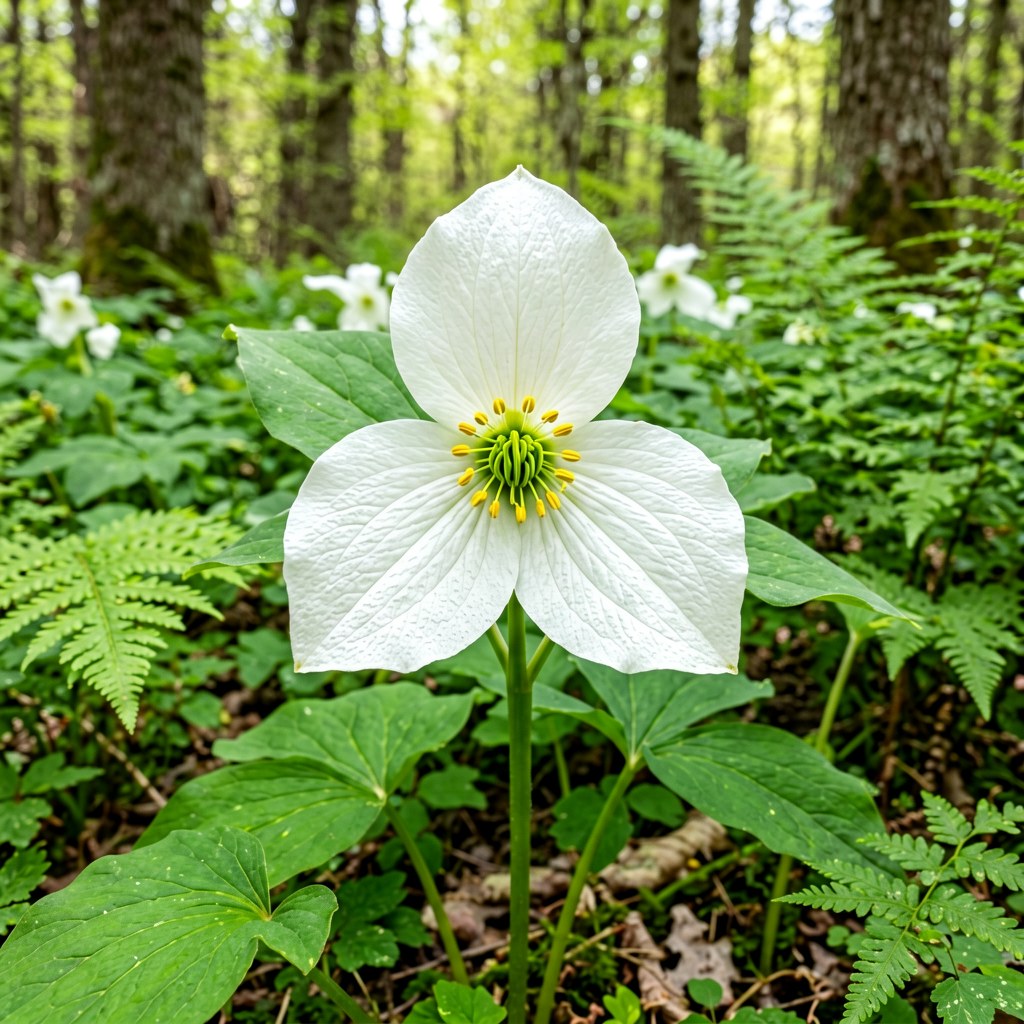
Trillium grandiflorum | Large-flowered Trillium
Introduction
The large-flowered trillium (Trillium grandiflorum) is a beloved wildflower of the deciduous forests of eastern North America, celebrated for its showy white blossoms that open in spring and gradually blush pink with age. Often called the white wake-robin or simply trillium, it is the official provincial flower of Ontario and a cherished signal of the woodland spring. The plant is a slow-growing perennial that spends most of the year as a single underground rhizome, sending up one iconic three-parted shoot when the canopy leafs out. Because each flower rises on a stem bearing a whorl of three leaves, three petals, and three sepals, the number three defines the entire architecture of the species. Trilliums are protected by law in many states and provinces because their populations are easily damaged by careless collecting and habitat loss. Its fleeting flowers and dependence on intact forest make it a flagship for deciduous woodland conservation.
Taxonomy
Trillium grandiflorum was described by Andre Michaux in 1803 and is placed in the family Melanthiaceae, within the order Liliales, according to the APG IV classification, though it was long assigned to a separate family Trilliaceae. The genus Trillium contains roughly fifty species of rhizomatous perennials confined to temperate North America and eastern Asia, all united by the trimerous, three-parted organization of their shoots. The large-flowered trillium is part of a North American clade that includes the red Trillium erectum and the painted Trillium undulatum, from which it is separated by petal color, posture, and habitat. For readers comparing monocot relatives, the better-known [Orchid](https://www.gloencyc.com/orchid-orchidaceae/) shares the broad monocot lineage and also produces intricate flowers with three sepals and three petals, though orchids belong to a different order and are usually tropical epiphytes. Molecular data relocated the genus to Melanthiaceae alongside false hellebores, away from its former place among the lilies. The species name grandiflorum, meaning large-flowered, refers to its comparatively ample blossoms.
Physical Characteristics
A mature large-flowered trillium rises 20 to 45 centimeters from a knobby underground rhizome, producing a single unbranched stem crowned by a whorl of three broadly ovate leaves 8 to 15 centimeters long, each leaf veined and sessile or nearly so. From the center of this whorl rises one erect flower on a short pedicel, bearing three green sepals, three white petals 3 to 6 centimeters long, and a central whorl of six stamens surrounding a three-lobed ovary. The petals open pure white and, over the course of several days, oxidize and age to soft pink or rose, a change that helps track pollinator visitation. A form with fully double flowers, Trillium grandiflorum f. plenum, is prized in cultivation. The fruit is a fleshy, ridged berry, greenish to reddish, that ripens by midsummer. The rhizome is slow to enlarge and may persist for decades, producing one flowering shoot per year once maturity is reached. Foliage dies back completely after the brief spring growing season.
Habitat
Trillium grandiflorum occupies rich, mesic deciduous forests across eastern North America, from southern Ontario and Quebec through the Great Lakes states and Appalachian highlands to parts of the southeastern United States. It favors well-drained, humus-rich loams on slopes and ravine bottoms where sugar maple, beech, basswood, and tulip poplar form a closed canopy. The critical ecological cue is the spring light gap: the plant must leaf out, photosynthesize, and flower in the few weeks before the canopy closes and shade deepens. It thrives in the cool, moist air of north-facing woods and along stream terraces, where leaf litter and mycorrhizal fungi support its nutrient uptake. The species is absent from wet bottomlands, dry ridgetops, and conifer stands, reflecting its narrow tolerance for soil moisture and light. Throughout its range it is increasingly confined to protected woodlands, old cemeteries, and nature preserves as agriculture and development fragment its habitat.
Diet
As a photosynthesizing autotroph, the large-flowered trillium manufactures its food in the broad leaves of its spring shoot using the C3 pathway of oxygenic photosynthesis. Because the canopy above closes within weeks, the plant must compress most of its annual carbon gain into the bright early-spring window, fixing carbon dioxide into sugars that are promptly shuttled below ground to enlarge the perennial rhizome. This stored carbohydrate bankrolls the following year’s single leaf and flower, making the rhizome the plant’s essential energy reserve. Mineral nutrition is drawn from the forest floor through fine roots associated with mycorrhizal fungi, which help extract phosphorus and nitrogen from the leafy humus; in return the plant supplies the fungi with photosynthetic carbon. The trillium requires no feeding by animals, but it is partly dependent on ants, which carry its seeds and inadvertently enrich the seed’s surroundings.
Reproduction
The large-flowered trillium reproduces sexually by seed and vegetatively by the gradual elongation and branching of its rhizome, though cloning is slow and a colony may represent decades of growth. Flowers open in April or May and are pollinated chiefly by early-season beetles, flies, and bees that visit the nectarless but pollen-rich blossoms; the strong central ovary develops into a fleshy berry if pollination succeeds. Each berry holds several large seeds bearing a fleshy oil-rich appendage called an elaiosome, which is avidly collected by ants that carry the seeds to their nests, consume the elaiosome, and leave the seed to germinate, a dispersal strategy known as myrmecochory. Seedlings are extremely slow, often requiring seven to ten years of rhizome growth before producing a first flower, and many never reach maturity. Because the plant invests so heavily in a single annual shoot, a flower picked or a leaf removed can cost the rhizome a year of stored energy. This combination of slow growth and ant-dependent dispersal explains why many jurisdictions protect the species.
Conservation
The large-flowered trillium is not globally endangered and remains locally abundant in intact forest, but it is listed as a species of special concern or protected in numerous states and provinces because of poaching, deer browsing, and woodland fragmentation. In many areas it is illegal to pick the flowers or dig the rhizomes, and enforcement at popular wildflower sites helps limit damage. The most serious threats are the loss of mature deciduous forest to development and the explosion of white-tailed deer populations, whose heavy browsing removes the leaves and starves the rhizomes of the carbon they need to persist. Climate-driven shifts in spring timing can also desynchronize flowering from pollinator and ant activity. Conservation strategies emphasize protecting large, continuous forest blocks, fencing or managing deer where feasible, and educating the public that a picked trillium often dies. Botanical gardens and native plant societies propagate trillium from seed and redistribute nursery-grown stock for shade gardens.
Fun Facts
- The flower starts pure white and turns pink as it ages, so a patch of trilliums shows a gradient of color through the blooming season.
- Each plant is built on the number three: three leaves, three petals, three sepals, and a three-chambered ovary.
- Ants disperse the seeds by carrying off the oily elaiosome, effectively planting the next generation in their own nests.
- It can take seven to ten years from seed to first flower, which is why transplanted wild trilliums rarely survive moving.
- The large-flowered trillium is the official provincial flower of Ontario, Canada, where it is a springtime symbol of the woods.