 By Iris
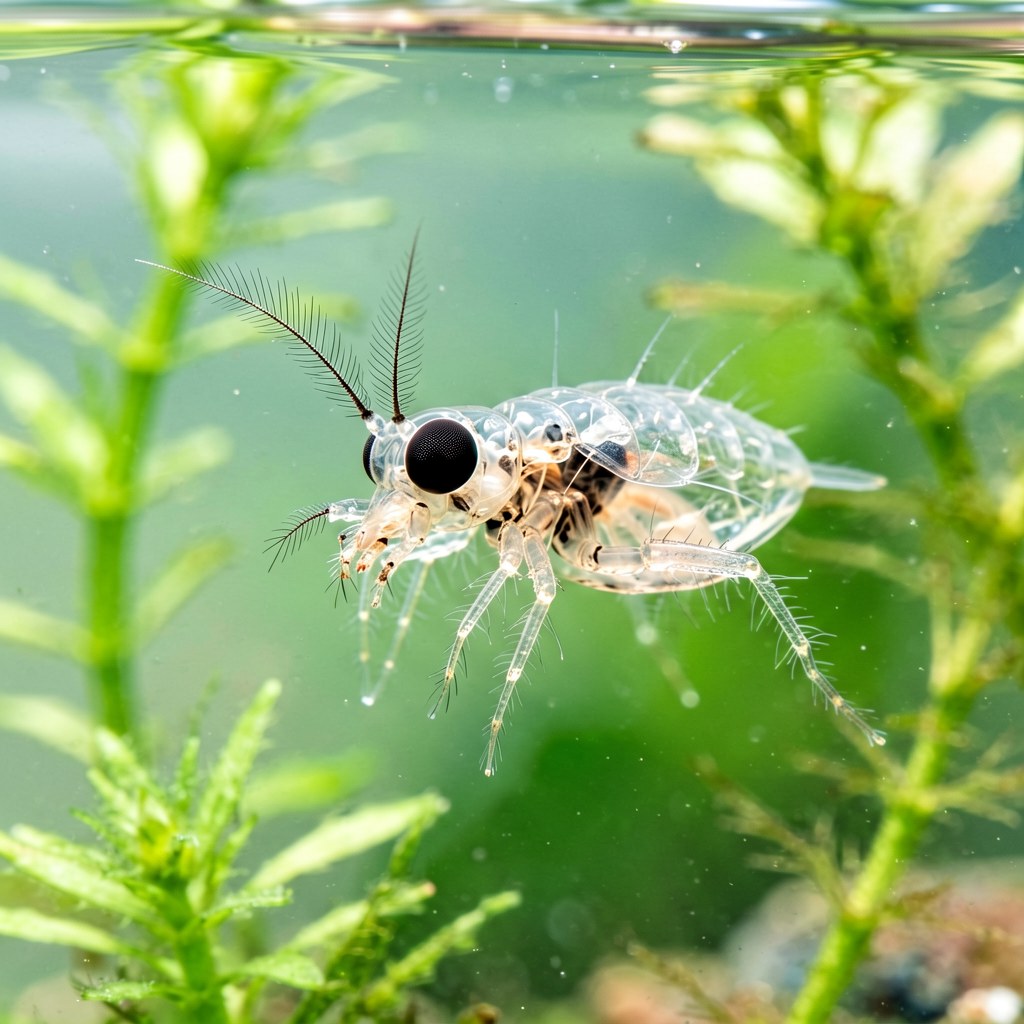
Daphnia pulex | Water Flea
Introduction
The water flea Daphnia pulex is a tiny crustacean no longer than a few millimetres, yet it is one of the most studied animals in biology and ecology. Found in ponds, lakes, and slow-moving streams across the Northern Hemisphere, it drifts through the water column in immense numbers, filtering microscopic algae and bacteria from every litre it passes through. Its transparent body makes it almost invisible against the water, but under a microscope it reveals a striking anatomy: a large, black compound eye, a pair of branched antennae used for jumping, and a beating heart visible through the carapace. Though it looks delicate, the water flea has survived unchanged for millions of years, outliving entire lineages of fish and amphibians. It is a keystone of freshwater ecosystems, a mirror of environmental health, and a living laboratory for questions about reproduction, evolution, and toxicity.
Taxonomy
Daphnia pulex belongs to the class Branchiopoda, a diverse and ancient group of crustaceans that also includes fairy shrimp and clam shrimp. It is closely related to [Photosynthesis | Plant Energy Process](https://www.gloencyc.com/photosynthesis-plant-energy-process/), which shares many ecological traits. Within Branchiopoda it is placed in the order Anomura and the family Daphniidae, the true water fleas, named for the rapid, hopping swimming motion that resembles a flea’s jump. The genus Daphnia contains more than a hundred species, many of them nearly indistinguishable morphologically, and D. pulex is one of the best known because of its widespread distribution and its use in laboratory research. As a crustacean it is a distant relative of lobsters and crabs, sharing the same basic body plan of a segmented exoskeleton, jointed limbs, and compound eyes, but it has lost many of the hard parts that characterise its larger relatives. Its closest living cousin is probably Daphnia longispina, with which it forms a species complex that is still being resolved by genetic analysis. Understanding its place among the branchiopods links it to ancient fossil lineages that reached back hundreds of millions of years, long before insects colonised land.
Physical Characteristics
The body of Daphnia pulex is enclosed in a bivalve carapace that folds over the sides like a hinged shell, leaving the abdomen and appendages exposed beneath. The head bears a large compound eye that dominates the dorsal surface, and a smaller simple eye, or naupliar eye, located near the front. Two pairs of antenna project forward; the first pair is small and sensory, while the second pair is large and branched, acting as the primary swimming organs. Behind the head, five pairs of thoracic limbs fold beneath the body and beat in a coordinated rhythm to create a water current that brings food particles to the mouth and also provides propulsion. The abdomen is short and ending in a claw-like furca used for steering and for the characteristic jump when the animal contracts its body muscles. The exoskeleton is thin and largely transparent, allowing internal organs to be seen, including the beating heart, the digestive tract, and, in females, developing eggs. Males are smaller, with more elaborate first antennae used to grasp females during mating.
Habitat
Daphnia pulex inhabits freshwater bodies ranging from temporary rain pools and ditches to large lakes and reservoirs. It prefers still or slow-moving water rich in dissolved oxygen and suspended organic particles. The animal is most abundant in the upper layers of the water column during the day, where sunlight supports the growth of the phytoplankton it feeds on, but it performs diel vertical migration, descending to deeper, darker water at night to avoid visual predators such as fish. In winter, when ice covers the surface and light is scarce, populations decline but persist as eggs deposited in the sediment, called resting eggs or epipyelia, which can remain viable for decades. The species tolerates a broad range of temperatures, from near-freezing to about twenty-five degrees Celsius, and can survive modest fluctuations in pH and salinity. Its distribution is limited mainly by the presence of fish, which prey heavily on adult daphnids, and by the availability of suitable algal food.
Diet
The water flea is a suspension feeder, filtering microalgae, bacteria, and detritus from the water column. Each thoracic limb is armed with fine setae that form a net through which water is pumped by the beating of the limbs. Particles larger than about five micrometres are trapped and swept toward the mouth, where they are passed into the digestive tract. The preferred diet consists of green algae such as Chlorella and Scenedesmus, but the animal will consume almost any suitable particle, including flagellates, diatoms, and even small bacteria. In laboratory conditions, D. pulex can survive on a diet of a single algal species, though growth and reproduction are best on mixed diets. The rate of water filtration can exceed the animal’s own body volume many times over in a single minute, making it an extremely efficient processor of plankton. Because it consumes so much algae, the water flea plays a crucial role in controlling algal blooms and maintaining water clarity in lakes and ponds.
Reproduction
Daphnia pulex reproduces primarily by cyclic parthenogenesis, alternating between asexual and sexual reproduction depending on environmental conditions. In spring and summer, when food is abundant and conditions are favourable, females produce clones of themselves by parthenogenesis; each egg develops without fertilisation and grows into a genetically identical female. This allows populations to increase explosively, sometimes reaching thousands per litre of water. As conditions deteriorate—due to crowding, declining food, or changing temperature—females begin to produce males and haploid eggs that require fertilisation. Mating males grasp females with their modified first antennae, and the fertilised eggs develop into resting eggs encased in a protective shell called an ephippium. These ephippia are dropped to the bottom and can remain dormant in the sediment for years, hatching only when conditions improve. This dual reproductive strategy allows the species to exploit favourable periods rapidly while surviving harsh conditions through durable resting eggs.
Conservation
The water flea is one of the most widespread and abundant freshwater animals in the world and is not considered threatened anywhere in its range. Its ecological importance is immense: it forms a critical link between primary producers and higher trophic levels, serving as the principal food source for juvenile fish, amphibians, and many invertebrate predators. Despite its abundance, D. pulex is highly sensitive to pollution, making it a standard organism in ecotoxicology tests to assess the safety of chemicals, pesticides, and industrial effluents. Because of this, conservation of the species is essentially conservation of clean freshwater habitats. Threats include agricultural runoff containing fertilisers and pesticides, industrial discharge, habitat destruction through drainage and damming, and climate change, which can alter the timing of seasonal blooms and disrupt the delicate balance between daphnid populations and their predators. Monitoring D. pulex populations therefore provides early warning of ecological degradation in freshwater ecosystems.
Fun Facts
- A single water flea can filter its own body volume in water every minute, removing huge quantities of algae and bacteria.
- It has one of the fastest heart rates of any animal relative to its size, beating up to one thousand times per minute in warm water.
- The resting eggs can remain viable in lake sediment for decades, sometimes hatching after being undisturbed for over a century.
- It is nearly transparent, so you can watch its heart beat and its gut process food in real time through a microscope.
- In laboratory studies, water fleas have been used to detect the effects of pollutants in water for more than a hundred years.