 By st20113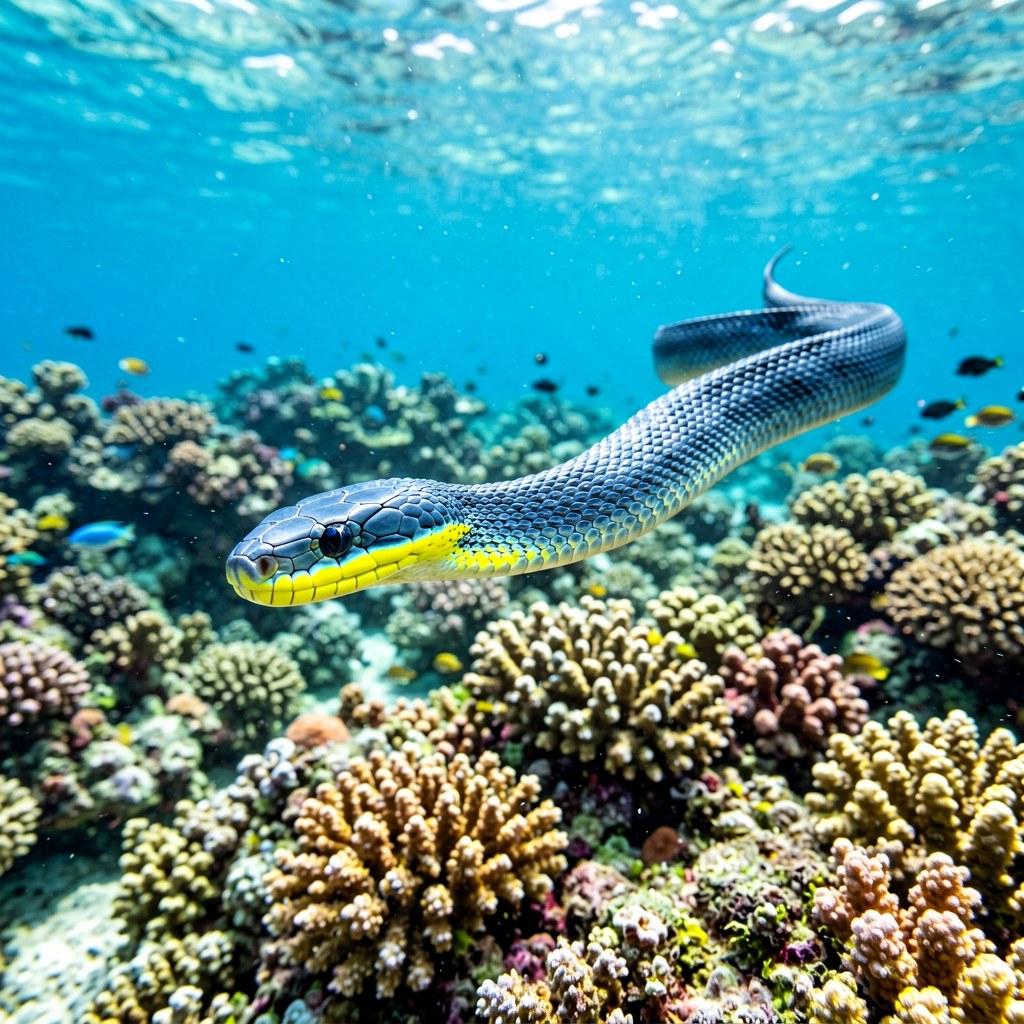
Laticauda laticaudata | Yellow-lipped Sea Krait
Introduction
The yellow-lipped sea krait, Laticauda laticaudata, is one of the most distinctive sea snakes of the Indo-Pacific, instantly recognised by the bright yellow band that runs along its snout and lips. A venomous elapid that spends its life shuttling between coral reefs and the rocky shores where it rests and breeds, it is a creature of two worlds: a superb swimmer in the ocean, yet dependent on land for digestion, shedding, and laying eggs. Ranging from the eastern Indian Ocean across the Pacific to islands such as those of Japan and Australia, it is a familiar sight to divers and fishers alike. Despite its potent venom, the yellow-lipped sea krait is remarkably placid and rarely bites unless severely provoked, and it plays a valuable role as a predator of reef eels and small fish. Its unusual life cycle makes it a favourite example of how fully marine animals can retain crucial ties to the land.
Taxonomy
Laticauda laticaudata belongs to the family Elapidae, the front-fanged venomous snakes that also include cobras, mambas, and most other sea snakes, within the genus Laticauda, the sea kraits. As a snake it is a member of the order Squamata and the suborder Serpentes, the same great lineage that contains the familiar [Grass Snake](https://www.gloencyc.com/grass-snake-natrix-natrix/) and every other snake on Earth, all sharing the elongated, limbless body plan and the specialised jaw that allows swallowing large prey. Within Elapidae the sea kraits are unusual in being only semiaquatic, retaining the more terrestrial habits lost by fully pelagic sea snakes. The genus name Laticauda means “broad tail,” a reference to the flattened, oar-like tail used in swimming, and laticaudata repeats the theme. The yellow-lipped sea krait sits among several related kraits that share the reef-edge, amphibious lifestyle across the tropical Pacific.
Physical Characteristics
The yellow-lipped sea krait is a slender, moderately sized snake, typically sixty to a hundred centimetres long, with a body that is bluish-grey to dark steel above and pale below, crossed by broad black bands that may merge in older animals. The namesake feature is unmistakable: a clean yellow stripe runs along the upper lip and sometimes over the snout, setting it apart from its relatives. Its tail is laterally flattened into a paddle, and its nostrils are set high and equipped with valves that close underwater, allowing it to hold its breath for extended dives. The body is cylindrical but the tail clearly compressed for propulsion. Like all elapids, it possesses short, fixed fangs at the front of the mouth and a venom that is primarily neurotoxic. The eyes are small and the head barely distinct from the neck, an adaptation that suits a life spent probing into reef crevices after hidden prey rather than chasing it in the open.
Habitat
This sea krait is intimately associated with coral reefs, rocky shores, mangroves, and sheltered bays throughout the tropical Indo-Pacific. During the day it often hunts among the reef, slipping into cracks and holes in search of eels, but it regularly returns to land, hauling out onto beaches, rocks, and boat ramps to rest, digest, slough its skin, and breed. It shows strong site fidelity, sometimes using the same resting spots for years, and it tolerates a broad range of salinities, occasionally entering estuaries and even freshwater-influenced coasts. The species prefers shallow, clear water where reefs are well developed, and it is most active around dawn and dusk. Its dependence on both reef and shore makes it sensitive to coastal degradation: where mangroves are cleared or reefs are damaged, the krait’s two essential habitats are simultaneously eroded.
Diet
The yellow-lipped sea krait is a specialist predator of eels and other slender, reef-dwelling prey. Using its forked tongue and chemical senses, it probes into crevices and burrows where moray and conger eels hide, seizing them with a quick strike and subduing them with venom before swallowing them whole. Small fish and crustaceans are taken occasionally, but eels form the core of the diet, and the snake’s slender form and tolerance of tight spaces are perfect for this hunt. Its venom acts quickly on small prey, and the snake is patient, often wedging itself into a crevice and waiting. Because it feeds almost entirely underwater but digests on land, the rhythm of its life is a continuous commute between hunting grounds and shore. By controlling eel numbers, it helps maintain the balance of the reef communities it inhabits.
Reproduction
Unlike the fully marine sea snakes that give birth to live young at sea, the yellow-lipped sea krait is oviparous: it must come ashore to lay eggs. Females seek out sheltered, humid crevices in rocks, soil, or vegetation just above the high-tide line, where they deposit a small clutch of elongated eggs that develop through the warm, moist incubation period. The reliance on land for reproduction is the species’ clearest terrestrial tie and the reason it cannot be described as wholly marine. Mating occurs in the water or on land during the warmer part of the year, and the young hatch as miniature, fully independent snakes that soon take to the reef. This amphibious reproductive strategy makes the krait vulnerable at the nesting stage to disturbance and predation, but also allows populations to persist along coastlines where suitable nest sites are available close to productive reefs.
Conservation
The yellow-lipped sea krait is currently assessed as Least Concern, and it remains widespread and locally common across its extensive Indo-Pacific range. Its habit of resting on shores and around human activity means it is frequently encountered, and accidental capture in fishing gear—particularly gillnets—is the main source of mortality where fisheries are intense. Habitat degradation, especially the loss of healthy reefs and of vegetated shorelines used for nesting, poses the greatest long-term risk, as does pollution of coastal waters. The species is protected under various national regulations in parts of its range, and it benefits broadly from the establishment of marine protected areas that safeguard reef ecosystems. Because it is placid and of little threat to people, coexistence is straightforward: leaving resting kraits undisturbed and reducing bycatch are the most effective conservation measures.
Locally, sea kraits have long featured in the folklore and traditional medicine of coastal communities, and in some regions they are caught for their skin or meat, though such harvest is minor compared with accidental fisheries bycatch. Their calm temperament has also made them a subject of interest for divers and underwater photographers, who value close encounters with the animals as they forage along reefs. Practical conservation therefore centres on bycatch reduction, modifying nets and encouraging the careful release of captured kraits, and on preserving the intact reefs and vegetated shores the species needs at different stages of its life. Given its broad range and placid nature, the outlook for the yellow-lipped sea krait remains comparatively favourable among sea snakes.
Fun Facts
- It is among the few sea snakes that must return to land to lay eggs, bridging a fully marine hunting life with a terrestrial nursery.
- The yellow lip-stripe that gives it its name is one of the most reliable field marks in the entire sea snake group.
- Its tail is flattened into a paddle and its nostrils close underwater, allowing long, comfortable dives on the reef.
- Although its venom is potent, the snake is exceptionally calm and almost never bites unless grabbed or trapped.
- Leatherback turtles and large fishes sometimes prey on it, making the krait both predator and prey in the reef food web.