 By Iris
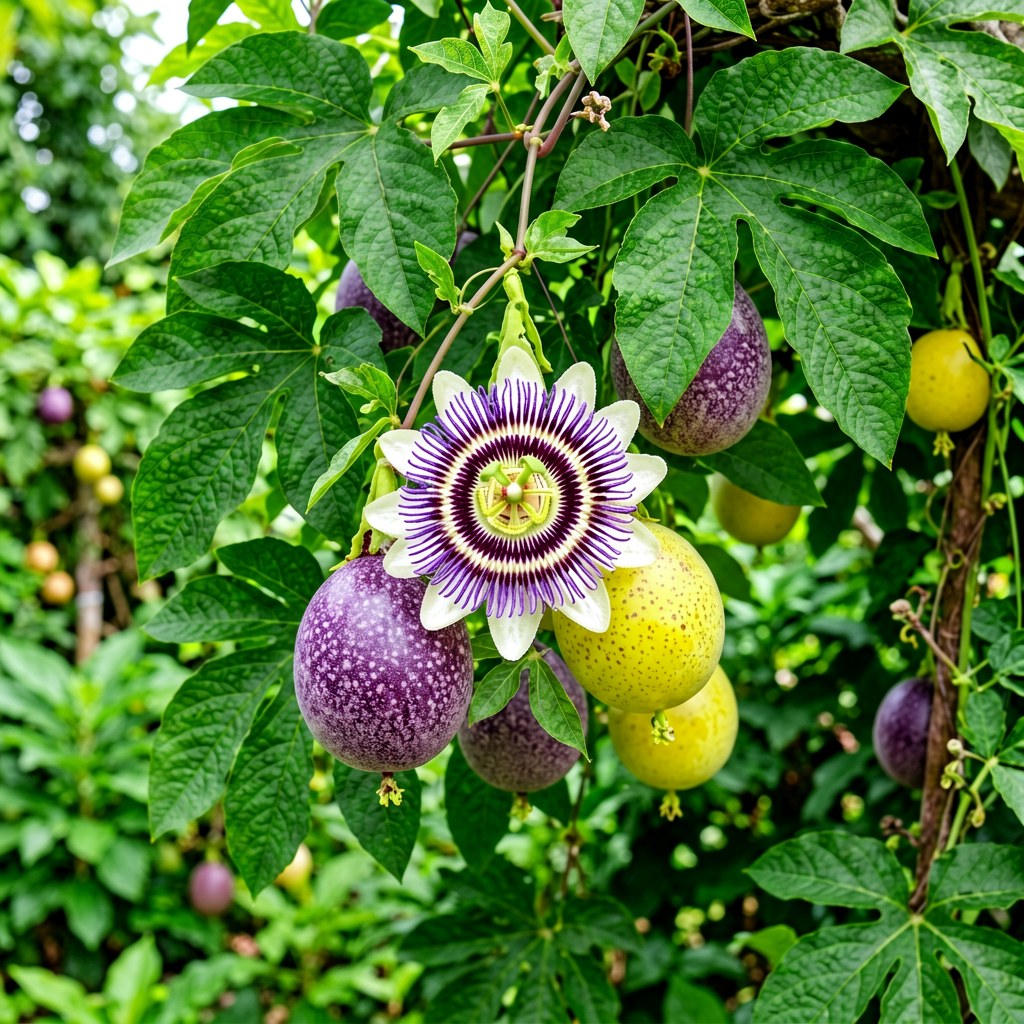
Passiflora edulis | Passion Fruit
Introduction
The passion fruit, Passiflora edulis, is a vigorous tropical vine cultivated across the warm regions of the world for its aromatic, tangy fruit, which is eaten fresh, pressed into juice, and used to flavour everything from desserts to cocktails. Climbing by tendrils and smothered in glossy leaves and extraordinary flowers, it is as ornamental as it is useful. Two main forms are grown commercially: the purple passion fruit, with a wrinkled deep-purple rind, and the yellow form, generally larger and more tart. Native to the tropical Americas, the plant was carried by explorers and traders to Africa, Asia, Australia, and the Pacific, where it now flourishes in home gardens and plantations alike. Beyond its culinary fame, P. edulis belongs to one of the largest and most botanically fascinating plant genera on Earth, and its intricate bloom has intrigued naturalists and artists for centuries.
Taxonomy
Passiflora edulis is a member of the family Passifloraceae, within the genus Passiflora, which contains more than five hundred species of mostly climbing plants. Like every green plant it depends fundamentally on [Photosynthesis](https://www.gloencyc.com/photosynthesis-plant-energy-process/) to convert sunlight into the sugars that fuel its growth and fruit production, drawing the necessary carbon dioxide from the air and water from the soil. The genus name Passiflora means “passion flower,” bestowed by early European missionaries in the Americas who saw symbolic meaning in the flower’s parts. P. edulis was scientifically described in the eighteenth century, and within the genus it sits among the fleshy-fruited passionflowers prized for both flavour and hardiness. Its close relatives include ornamental passionflowers and the closely related giant granadilla, and the whole genus is noted for the elaborate structure of its flowers, which in this species are followed by the familiar fruit.
Physical Characteristics
The passion fruit is a perennial, woody-stemmed vine that can climb or sprawl across several metres of support when given warmth and space. Its leaves are deeply three-lobed, alternately arranged, and rich green, with toothed margins and a slightly leathery texture. Climbing is achieved by coiled tendrils that emerge opposite the leaves and twist around any available support. The flowers are among the most complex in the plant world: a ring of white or lavender petals surrounds a fringe of fine, coloured filaments called the corona, above a central column bearing the reproductive organs. The fruit is a round or ovoid berry, two to eight centimetres across, with a smooth to wrinkled rind that turns deep purple or golden yellow at ripeness and encloses a cavity filled with juicy, seed-laden pulp. Each fruit may hold dozens of small, edible seeds suspended in the aromatic jelly.
Habitat
In its native range the passion fruit grows in the warm, humid lowlands and foothills of tropical South America, where it scrambles over trees and fences in forest edges and clearings. Cultivated forms need frost-free conditions, full sun to light shade, and well-drained soil rich in organic matter; they flourish between roughly sea level and mid elevations in the tropics and subtropics. The vine is sensitive to prolonged cold and to waterlogging, but it is otherwise unfussy and quickly becomes established wherever the climate suits. Around the world it is grown both in smallholder gardens and on commercial trellises, and it has naturalised in places such as Hawaii, Queensland, and parts of Africa, sometimes spreading beyond cultivation in disturbed ground. Its success outside its homeland reflects both its vigour and the universal appeal of its fruit.
Diet
As a plant, the passion fruit is an autotroph that manufactures its own food, but it is also intimately linked to animals through pollination and seed dispersal. The showy flowers produce nectar that attracts a variety of pollinators, including bees, carpenter bees, and in some regions hummingbirds and bats, and successful fruit set usually requires the transfer of pollen between flowers. The ripe fruit is eaten by birds, mammals, and people, all of whom disperse the seeds in their droppings; this mutualism has helped the species spread far beyond its origin. In agriculture the vine draws nutrients from the soil and benefits from pollinators provided by surrounding flowering plants, and a single healthy plant can yield hundreds of fruits across a season. The relationship between flower, pollinator, and frugivore is so tight that poor pollinator visitation is a common limiting factor in commercial production.
Reproduction
Passion fruit flowers are typically self-incompatible, meaning a given plant cannot fertilise itself and requires pollen from a genetically distinct individual to set fruit. Bees and other visitors carry pollen between plants, and growers sometimes plant multiple vines or manage pollinator access to ensure good crops. After fertilisation the flower withers and the ovary swells into the developing berry over several weeks to months, depending on temperature. Ripe fruits fall or are harvested and the seeds inside germinate readily in warm, moist soil. The vine itself is also easily propagated from cuttings, a method preferred by growers because it preserves desirable fruit traits and reaches fruiting faster than seedlings. Under good conditions a planting can remain productive for several years before vigour declines and the plot is renewed.
Conservation
The cultivated passion fruit is not threatened; it is one of the most widely grown fruit crops of the tropics and is secure in cultivation everywhere it is wanted. In its native South America the wild populations remain part of intact and modified landscapes, though, as with many useful plants, the genetic diversity of wild relatives is worth safeguarding. Some wild Passiflora species are indeed threatened by habitat loss, and the genus as a whole benefits from the protection of native forest margins where pollinators and natural enemies keep the plants healthy. For the backyard grower, the main conservation-relevant action is simply to avoid aggressive chemical use that would harm the bees and other insects the vine depends upon, allowing the plant’s natural reproductive cycle to proceed.
Economically, passion fruit is a valuable tropical export crop, with major production in Brazil, Colombia, Ecuador, Kenya, and India supplying both fresh fruit and the concentrated juice that flavours yoghurts, soft drinks, and confectionery worldwide. Breeding programmes continue to improve disease resistance and yield, particularly against the fusarium wilt and viruses that can ravage plantations, while researchers study the fruit’s rich load of antioxidants and vitamin C for potential health benefits. In a few regions outside its native range the vine has shown weedy tendencies, spreading along roadsides and disturbed ground, a reminder that even useful crops warrant watchful management; for most growers, however, its high value and relatively easy cultivation make it a mainstay of smallholder and commercial orchards alike.
Fun Facts
- The flower’s intricate parts inspired its name: early missionaries interpreted the corona filaments and other structures as symbols of the Christian Passion, hence “passion flower.”
- A single fruit can contain more than a day’s recommended intake of vitamin C, along with vitamin A and dietary fibre.
- The vine can grow several metres in a single season and will cover a fence or trellis with astonishing speed in the tropics.
- Both the pulp and the crunchy seeds are edible, and the seeds contribute much of the fruit’s characteristic texture.
- The yellow and purple forms differ not only in colour but in flavour, with the purple generally regarded as the more aromatic for fresh eating.