 By st20113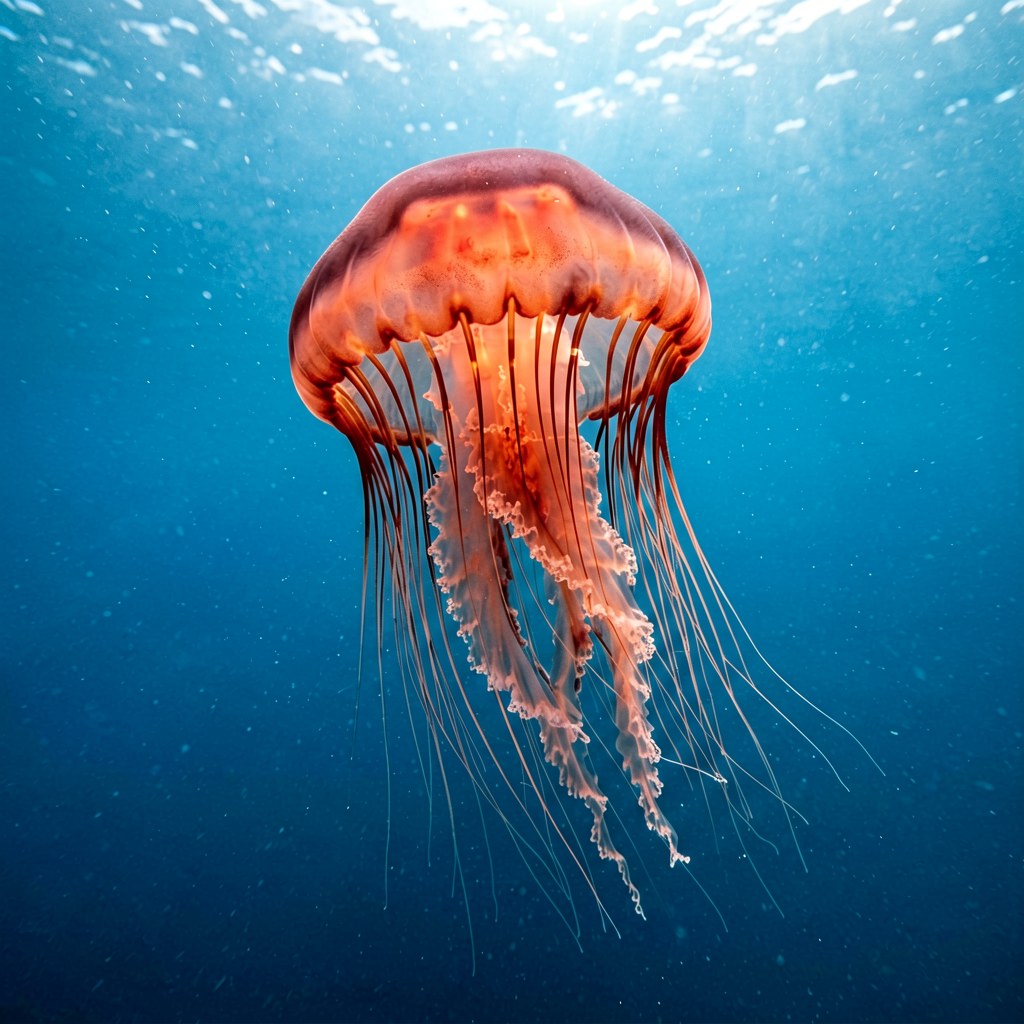
Cyanea capillata | Lion’s Mane Jellyfish
Introduction
The lion’s mane jellyfish, Cyanea capillata, is the largest jellyfish in the world and one of the most spectacular inhabitants of cold northern seas. In favourable conditions its bell can exceed two metres across and its trailing tentacles may stretch more than thirty metres—longer than a blue whale—creating a drifting curtain of stinging threads beneath the ice-blue dome. Found in the North Atlantic, North Pacific, and Arctic Oceans, it is a creature of cool, productive waters, pulsing slowly through the upper layers of the sea and harvesting the small animals that blunder into its tentacles. Though its sting is only moderately dangerous to people, the sight of a full-grown lion’s mane is unforgettable, and it plays an outsized role in northern marine food webs, both as predator and as prey for leatherback turtles and large fishes. It has also entered popular culture as the giant jellyfish of cold-water legends.
Taxonomy
Cyanea capillata is a member of the phylum Cnidaria, the same radical group that includes [Staghorn Coral](https://www.gloencyc.com/coral-acropora-millepora/), sea anemones, and the small green hydra, all united by their stinging cells called nematocysts. Within Cnidaria it belongs to the class Scyphozoa, the true jellyfish, and the genus Cyanea, which contains the large, fleshy “hair jellies.” The species name capillata means “hairy,” a reference to the dense mass of fine tentacles that hang from the bell margin like a lion’s mane. As a scyphozoan it passes through the same two-stage life cycle shared by most jellyfish: a bottom-dwelling polyp that buds off free-swimming medusae. Its relationship to reef-building corals is ancient and structural—both deploy batteries of cnidocytes to capture prey—even though one builds reefs and the other drifts as a soft, pulsating bell through cold open water.
Physical Characteristics
The defining feature of the lion’s mane jellyfish is its size and its curtain of tentacles. The bell is a soft, hemispherical dome that ranges in colour from deep red and orange in large individuals to yellow and pale blue in smaller ones, often with a frilled or lobed margin. From that margin hang eight clusters of fine, thread-like tentacles, each cluster containing hundreds of individual strands, so that a single animal may trail thousands of stinging threads. Four frilly mouth-arms extend from the centre beneath the bell and shuttle captured food to the mouth. The animal has no brain, heart, or bones; a simple nerve ring coordinates its pulsing, and most bodily functions rely on diffusion. The bell propels it by rhythmic contraction, expelling water to glide forward, while the tentacles drift behind, passively entangling prey. Large individuals can weigh more than the bell of a small car when fully hydrated.
Habitat
Lion’s mane jellyfish favour the cool, temperate, and subarctic waters of the Northern Hemisphere, including the North Atlantic, the northern North Pacific, and Arctic coastal seas. They are typically found in the upper water column, from the surface down to a few hundred metres, and they are often carried by currents into bays, fjords, and shallow coastal waters where their prey concentrates. As a cold-water species, they are most abundant in spring and summer, and their populations bloom when plankton is plentiful. They are not strong swimmers and largely go where the sea takes them, though they can adjust buoyancy and pulse to stay within productive layers. In some regions dense swarms appear seasonally, sometimes washing large numbers onto beaches after storms, where the tentacles can still sting even when the animal is out of the water.
Diet
The lion’s mane is a passive but effective predator and filter-feeder. Its vast tentacle array captures zooplankton, small fishes, copepods, and other jellyfish, which are paralysed by nematocysts and then moved by the mouth-arms to the central mouth. Because the tentacles form such an enormous three-dimensional net, the jellyfish can sweep a huge volume of water as it drifts, making it surprisingly efficient despite its slow pace. It also consumes considerable quantities of smaller medusae, placing it in competition with, and as a predator of, other jellyfishes. Like corals, it benefits from the dense plankton blooms of cold northern seas, and its abundance rises and falls with the productivity of the water column. In turn, it is an important food source for leatherback turtles, sunfish, and certain large fishes that have evolved resistance or tolerance to its stings.
Reproduction
Reproduction follows the classic scyphozoan alternation of generations. A mature medusa releases eggs and sperm into the water, and fertilised eggs develop into tiny larvae that settle onto the seabed and metamorphose into polyps. These polyps can survive for extended periods, budding asexually to produce clones and, when conditions are right, pinching off young medusae that grow rapidly into the familiar bell-shaped adults. This two-stage cycle lets the species persist through unfavourable seasons as hardy polyps and then explode in number when warmth and food return. A single polyp colony can produce many medusae, and because the medusa stage is short-lived, the population is effectively replenished each favourable season. The strategy makes lion’s mane numbers highly variable from year to year, tracking the shifting conditions of northern seas.
Conservation
The lion’s mane jellyfish is not considered threatened; it is naturally abundant across a vast northern range and is highly resilient thanks to its variable life cycle. In some areas, indeed, its blooms are becoming more frequent or intense, a pattern some scientists link to warming seas, overfishing of its competitors, and coastal eutrophication that fuels plankton growth. Because it is both predator and prey in a changing ocean, shifts in its abundance can ripple through food webs, affecting everything from small fish to the turtles that eat it. There is no conservation programme aimed at the species, nor any need for one, but monitoring its populations provides a useful window into the health and changing productivity of cold-water ecosystems. The principal human concern is the occasional sting to swimmers and the clogging of fishing gear by large blooms rather than any threat to the jellyfish itself.
Humans have found a few uses for the lion’s mane despite its sting: in parts of Asia the bell is harvested for food, and a small gelatin and collagen industry processes jellyfish for culinary and cosmetic purposes, though the lion’s mane is less prized than some tropical species. More widely, its booming populations are read by scientists as a possible signal of marine change, since jellyfish often thrive where fish have been overharvested and where warmer, nutrient-altered waters favour their planktonic young. Understanding these cycles is increasingly important as coastal economies grapple with jellyfish clogging intakes at power and desalination plants. The species needs no protection, but its fortunes are tightly woven into the broader story of how northern seas are being reshaped by human pressure.
Fun Facts
- The lion’s mane is the largest jellyfish known, with tentacles recorded at lengths exceeding thirty metres—longer than a blue whale.
- Its bell colour shifts with size, from pale blue in the young to deep red and orange in the largest adults.
- A single animal can trail thousands of individual stinging threads from its eight tentacle clusters.
- It is a favourite food of the leatherback turtle, which seems unfazed by stings that deter most predators.
- Although it looks fearsome, its sting is generally mild to humans, causing only temporary discomfort except in sensitive individuals.