 By st20113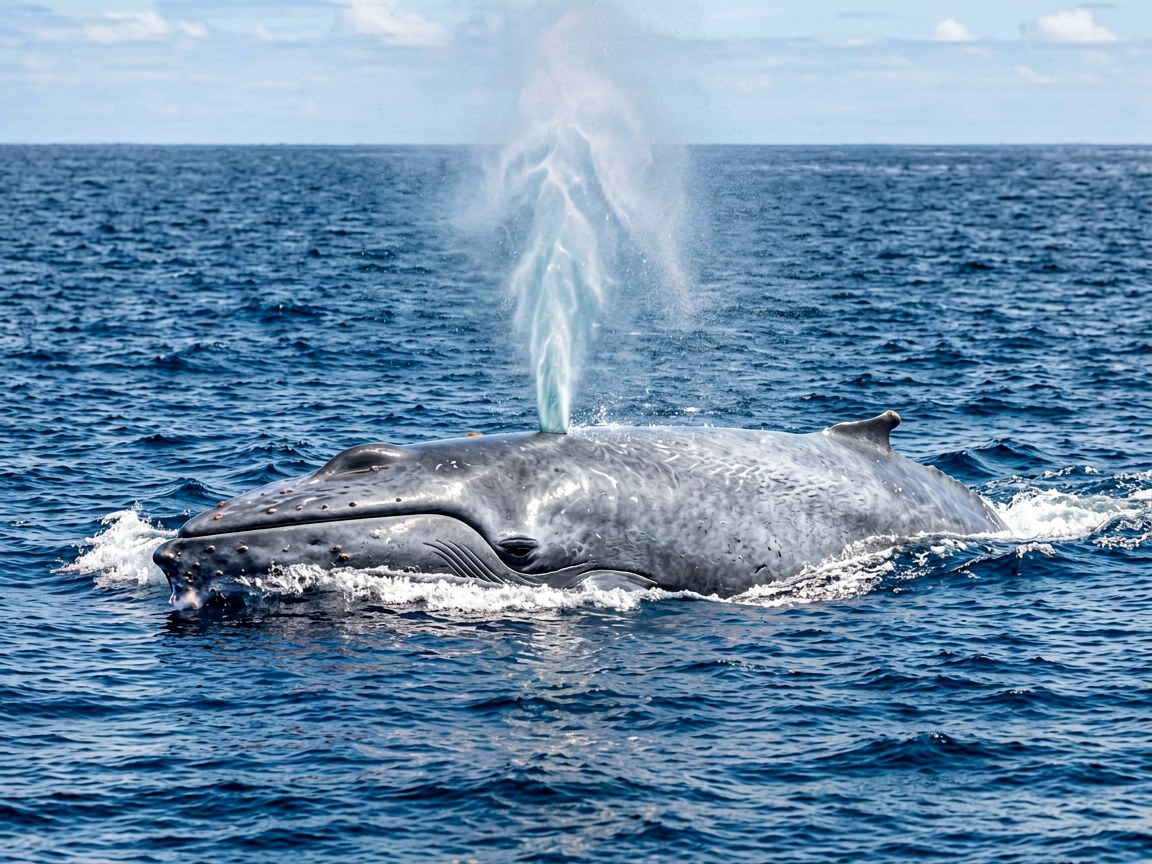
Balaenoptera physalus | Fin Whale
Introduction
Balaenoptera physalus, the fin whale, is the second-largest animal on Earth after the blue whale, reaching lengths of up to 27 metres and weights near 80 tonnes. Sometimes called the “greyhound of the sea” for its slender, fast-swimming build, it roams all the world’s oceans from polar edges to warm tropics. Despite its enormity, it feeds on some of the smallest prey in the sea—dense swarms of krill and small schooling fish—by gulping vast mouthfuls of water and straining it through brush-like plates. Hunted to a fraction of its numbers in the industrial whaling era, the fin whale has slowly recovered under international protection, though it remains Endangered and faces new threats from ship strikes, entanglement, and ocean noise. Its low, distant blow and sickle-shaped dorsal fin make it a prized sight for whale-watchers.
Taxonomy
Balaenoptera physalus is a member of the genus Balaenoptera, the rorquals, in the family Balaenopteridae, the grooved whales. It is a close relative of the Delphinapterus leucas (Beluga Whale) and other cetaceans within the order Artiodactyla’s whale branch, sharing the baleen-feeding heritage of the great whales. The genus name combines Greek words for “wing” and “whale,” referring to the long flippers, while “physalus” derives from a word for “blowhole” or “spout.” Rorquals are united by their expandable throat pleats and baleen plates, and the fin whale is the largest of them after the blue whale, to which it is closely related and with which it can hybridise.
Physical Characteristics
The fin whale is built like a streamlined torpedo: a long, narrow body with a conspicuously asymmetrical head—the right lower jaw and lip are bright white while the left are dark, a pattern unique among whales. Its throat bears 50 to 100 pleats that expand like an accordion during feeding. The dorsal fin is small and set far back, and the tail flukes are broad and powerful. True to its rorqual identity, it has no teeth but rows of keratinous baleen plates hanging from the upper jaw to filter food. The body is sleek blue-grey above and white below, and adults can sprint at over 30 km/h, faster than almost any whale of comparable size. Its blow is tall and slender, reaching several metres, and its lower jaw’s white patch flashes as it surfaces.
Internally the fin whale is built for efficiency at scale: a streamlined body, a large heart that can weigh hundreds of kilograms, and a thick layer of blubber that insulates against cold polar feeding waters. Its baleen plates number around 260 on each side and are finely fringed to trap the smallest prey, while the pleated throat can expand to several times the resting girth during a lunge. The asymmetrical head colour extends to the baleen, which is pale on the right and dark on the left, though the function of this striking asymmetry remains unclear. Like other rorquals it has a folded, accordion-like tongue that helps push water out during feeding. The animal’s hearing is tuned to low-frequency sounds, letting it communicate and navigate across ocean basins where high notes are quickly absorbed.
Habitat
Fin whales are oceanic wanderers found in every ocean basin, from ice-edge waters of the Arctic and Antarctic to equatorial seas, though they avoid the heaviest pack ice. They prefer productive continental shelves, upwelling zones, and convergences where plankton and fish concentrate, often undertaking long seasonal migrations between feeding grounds in cold waters and calving areas in warmer latitudes. They are typically seen alone or in small, loose groups rather than tight pods, and they range from near shore to the deep pelagic. Different populations show distinct movement patterns; some North Atlantic animals, for example, feed off northern Europe in summer and shift south in winter. Their need for dense prey means they track ocean productivity, making them sensitive to shifts in sea temperature and currents.
Feeding aggregations form where oceanography concentrates prey: at the edges of ice shelves, along shelf breaks, and at the meeting of warm and cold currents such as the subarctic frontal zones of the North Pacific and North Atlantic. In these rich areas hundreds of fin whales may gather to exploit seasonal krill blooms or forage fish spawning runs. During winter many populations move toward lower latitudes to calve in warmer, less productive waters where predators are fewer, then return poleward to feed. Satellite tracking shows some individuals travelling thousands of kilometres between seasons, crossing entire ocean basins. Because their prey is itself sensitive to temperature and current shifts, fin whales are considered sentinels of ocean health; a poor feeding season is often the first sign of broader ecosystem change that later affects fisheries and seabirds.
Diet
The fin whale is a filter feeder that consumes tonnes of small prey each day. Its staple is krill and other euphausiids in polar and upwelling waters, supplemented by schooling fish such as herring, capelin, sardines, and anchovies depending on region. It feeds by lunge-feeding: accelerating toward a swarm, engulfing a volume of water that can exceed its own body weight, and then squeezing the water out through the baleen while the prey are trapped and swallowed. The expandable throat pleats are essential to this technique. Because each mouthful holds enormous numbers of tiny animals, the whale meets its energy needs without chasing large prey. This dependence on dense, patchy swarms makes fin whales vulnerable when fish stocks collapse or krill are displaced by warming seas.
Reproduction
Fin whales reach sexual maturity in roughly six to eight years and breed on a cycle of two to three years. After a gestation of about eleven months, a single calf—already some 6 metres long—is born tail-first in warm winter waters and nursed on rich milk that lets it gain kilograms per hour. The calf stays with the mother for about six to eight months, learning migration and feeding grounds before weaning. Males compete for females during the breeding season, though the social behaviour is far less cohesive than in toothed whales. Because calves are few and growth is slow, fin whale populations rebuild gradually; the long interval between births means recovery from past overhunting takes many decades even under full protection.
Conservation
The fin whale is classified as Endangered by the IUCN. Centuries of commercial whaling, especially the mid-20th-century factory-ship era, killed hundreds of thousands and cut populations by more than half worldwide; some regions lost over 90 percent. A 1986 moratorium by the International Whaling Commission halted most hunting, allowing partial recovery, though a few nations continue limited takes. Today the chief threats are vessel strikes in busy shipping lanes, entanglement in fishing gear, ocean noise that disrupts communication, and climate-driven shifts in prey. Protective measures include maritime speed limits in key areas, bycatch reduction, and continued trade bans. The fin whale’s vast range makes coordinated international management essential to its future.
Fun Facts
- The fin whale is the second-largest animal ever, behind only the blue whale.
- Its head is asymmetrically coloured: the right jaw is white, the left is dark.
- It can swim faster than 30 km/h despite weighing as much as a Blue Whale.
- It feeds by gulping huge mouthfuls of water and straining krill through baleen.
- Industrial whaling cut its numbers by more than half before a 1986 ban.